By now, every one in our region knows that Memphis is losing population.
Memphis is hemorrhaging people and according to the Tennessee Data Center at University of Tennessee-Knoxville’s dismal forecasts, there is no end in sight for decades.
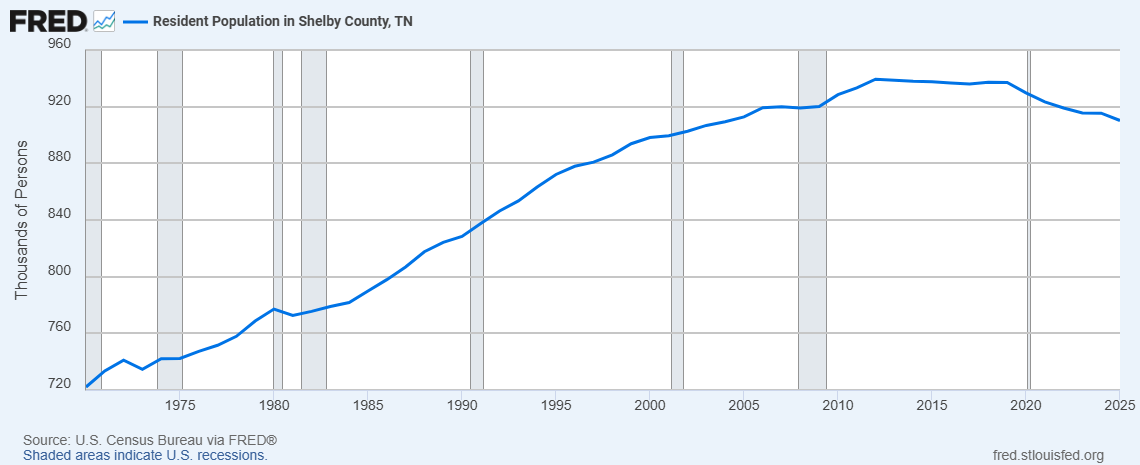
Less known is that Shelby County is losing population as well, which comes from Memphis’s decline. Shelby County’s population peaked in 2012 at 939,421; today, it is 910,226. The Tennessee Data Center says Shelby County’s population decline will continue until 2070.
In the face of the city’s tide of out-migration, it is telling that the MSA’s population is relatively steady and projected to grow slightly. Its population peaked in 2018 at 1,343,892, and last year, it was 1,341,412. Yearly projections for regional growth are modest – at 0.6% to 0.8% – but at least it’s in the positive.
Clearly, Memphis and Shelby County area are navigating a significant demographic shift.
The Region Matters
The fact that the MSA population remains about the same year to year is evidence of a singular fact: Large numbers of former Memphians aren’t leaving the region entirely, but rather moving just across county or state lines. Suburban areas like DeSoto County, Mississippi (Southaven and Olive Branch in particular) and Fayette County and outer edges of Shelby County attract families seeking different school districts, lower property taxes (although not a lower tax burden), or perceived safety.
In-migration comes from the draw of logistics and health care jobs – specialized professionals, researchers, and supply chain workers. The city has benefitted from international newcomers who have traditionally helped offset domestic losses by providing essential labor for construction and hospitality although these numbers have taken a sharp decline due to the unwelcome mat laid out by ICE and the Safe Memphis Task Force (Brookings Institution recently calculated that the influx of ICE and other federal agencies have resulted in the loss of 4,522 jobs in Memphis so far).
As for Memphis, the numbers tell the story: It lost 13,785 people between 2010-2020. The trend worsened in 2020-2024 with the loss of an additional 22,185, creating total population loss of 35,970 for 2010-2024.
So, where did these Memphians go?
What’s the Data Show?
Based on Census, IRS migration data, and long-term migration patterns, the net winners from Memphis’s out-migration are Tennessee, North Mississippi, Texas, and an assortment of destinations.
Nashville MSA is a magnet for people moving out of Shelby County, but the ring counties like Rutherford, Wilson, and Williamson, which have a cumulative population of 725,354, are attracting more former Shelby Countians than Davidson County itself. The Nashville region has consistently been the largest attractor of former Memphians for more than a decade.
DeSoto County, specifically Southaven, Olive Branch, Hernando, and Horn Lake, remains the single largest destination for people leaving Shelby County, although the flow has moderated compared to earlier decades.
Texas has become major destinations for college-educated Memphians and young professionals – Dallas and its environs, Fort Worth, McKinney, and Frisco – as well as Austin and Houston.
Using multiple years of IRS and Census migration patterns, a reasonable estimate of the 50 favorite destination cities/metros for Memphis out-migration would be:
- Nashville
- Southaven
- Austin
- Dallas
- Murfreesboro
- Atlanta
- Olive Branch
- Houston
- Franklin
- Fort Worth
- Chattanooga
- Knoxville
- Hernando
- Charlotte
- Chicago
- Phoenix
- Denver
- Orlando
- Raleigh
- Tampa
- Jacksonville
- Little Rock
- St. Louis
- New Orleans
- Plano
- Frisco
- McKinney
- Alpharetta
- Marietta
- Roswell
- Clarksville
- Brentwood
- Germantown (MS)
- Horn Lake
- Madison (TN)
- Round Rock
- Richardson
- Arlington (TX)
- Cary
- Durham
- Nashville suburbs collectively
- San Diego
- Los Angeles
- Washington
- Indianapolis
- Birmingham
- Louisville
- Huntsville
- Lexington
- Columbia (TN)
The takeaway is that Memphis is not primarily losing people to coastal superstar cities. It is losing them to its suburbs, the Nashville region, Texas metros, Atlanta, and a handful of fast-growing Sun Belt markets.
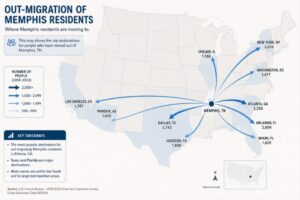
The following map shows the out-migration of Memphians within 300 miles from 2018-2023:
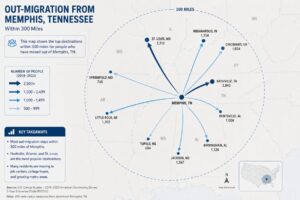
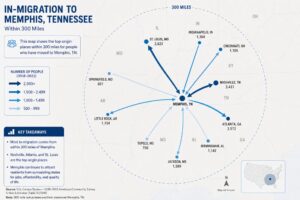
While the Nashville region is a destination for Memphians on the move, the city of Nashville is also a source of new Memphians. Between 2018-2023, contrary to conventional wisdom, the net movement between city of Memphis and city of Nashville was to Memphis’s benefit. During that time, Memphis had +580 net migration from Nashville.
During those years, the net migration from Memphis to large destinations were Miami +795; Los Angeles +869; Chicago +358; Washington +509; New York City +431.