
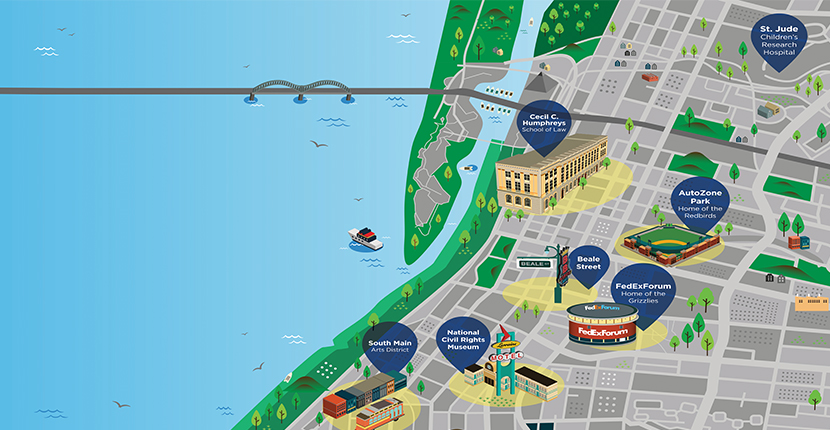
Map: Just a hint of downtown attractions/assets/islands.
**
Toby Sells, Memphis Flyer reporter, emerging media entrepreneur, and creator and host of State and Beale, last week wrote his final Flyer article for his four-part series, The Downtown Project. As part of his research, he asked for my opinion on downtown connectivity and he used it as a sidebar to his article.
The conversation grew out of my Memphis magazine City Journal column about Beale Street that contained this paragraph:
“For decades, downtown has been disconnected islands of assets: Beale Street, the National Civil Rights Museum and South Main, The Edge District and Sun Studio, Tom Lee Park and the riverfront, and the convention center. If the money from state government could improve pedestrian movement and greater integration between the assets, the return on investment would be much more than a few blocks of nightlife.”
Here’s what I submitted about connectivity to Mr. Sells:
CONNECTING ISLANDS DOWNTOWN
Downtown has an embarrassment of riches. Let’s connect them.
By Tom Jones, editor of Smart City Memphis
Memphis has an enviable mix of Downtown assets. The challenge doesn’t seem to be building them. Memphis does that. The problem is how little these assets connect to each other.
It seems that when Memphis builds a major new asset, its focus is on the project and its footprint. What’s often missing is at the same time considering how that project seamlessly fits into the fabric of Downtown.
This is one of Downtown’s greatest strategic challenges. It’s also one of its greatest opportunities.
Consider what already exists. The riverfront stretches for five miles, anchored by nationally important Tom Lee Park. Nearby are Beale Street, FedExForum, AutoZone Park, the South Main Arts District, historic Cotton Row, Court Square, the Pinch District, St. Jude Children’s Research Hospital, Bass Pro Shops at the Pyramid, the Renasant Convention Center, the National Civil Rights Museum, Memphis Rock ‘n’ Soul Museum, Orpheum Theatre, Blues Hall of Fame, The Peabody, Baron von Opperbean and the River of Time, and more.
It’s an embarrassment of riches. Each has its own identity, patrons, and purpose. Each sits on its own island. If connected, they would collectively make Memphis one of the South’s great downtown experiences. And that does not happen.
Economists have observed that the value of a place increases as its connections increase. The challenge is making sure these assets reinforce each other. It’s making 2+2 equal more than 4. Today, 2+2 often equals less than 4.
Think of Downtown as a network. Consider each asset a node. Every connection between nodes should create opportunities for restaurants, retail, housing, public art, entertainment, and spontaneous surprises. The equation is simple: The more connected the network becomes, the stronger every individual destination becomes. That’s the multiplier effect that makes great downtowns work.
Successful cities focus on making streets themselves destinations. Wide sidewalks, shade trees, and attractive landscaping, outdoor dining, public art, frequent events, comfortable lighting, protected bike facilities, inviting storefronts, places to sit and watch the world go by, street musicians, and things that make people slow down so they spend more time downtown. Most of all, it’s about a downtown built for walking.
Downtown does not need more islands. When people experience Downtown as one connected place instead of a collection of separate destinations, every investment works harder, every business benefits more, and finally, the whole becomes greater than the sum of its outstanding parts.
It can be said that Downtown Memphis has recognizable districts. Each developed independently over time. The next chapter of Downtown’s evolution should focus less on strengthening individual districts and more on stitching them together.
At a time when talent, tourism, conventions, and investment increasingly flow to cities offering rich urban experiences, connectivity becomes an economic development strategy rather than just an urban design principle.
***
Join us at the Smart City Memphis Facebook page and on Instagram where these blog posts are published along with occasional articles, reports, and commentaries that are relevant to Memphis.


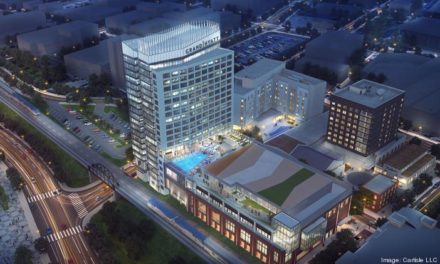


A working Trolley system is the answer….
The problem is that you can walk to your destination faster than the trolley can take you. That’s good news. Walkability is the key factor in determining a city’s success.
This conversation is so overdue. I hope it can force serious consideration of where the pivot points are for downtown and where we invest to build on strength. For too long, we’ve developed on the edges of downtown while ignoring the core where tourists, sports and entertainment destinations and office workers are clustered, along with many residents in multiple high rise and mid-rise buildings. Now is the time to focus on the connective tissue. We need to pay special attention to making the walk desirable. There are too many gaps in the current fabric, and many of the fixes are relatively cheap and quick.
St. Jude is an island, internally oriented, and has turned its back on the city. The campus expansion into the Pinch should not permit this condition to continue. It must connect to the Convention Center, Bass Pro, Mud Island, and Uptown.
The St. Jude Campus is an island, internally oriented, and turned its back on the city. Campus expansion into the Pinch must not allow this to continue, it should connect seamlessly with the Convention Center, Uptown, Mud Island, and Bass Pro using proven urban design principles.