
A walker killed in Whitehaven Friday afternoon after being struck by a vehicle suggests Memphis will once again be the deadliest city in the U.S. for pedestrians.
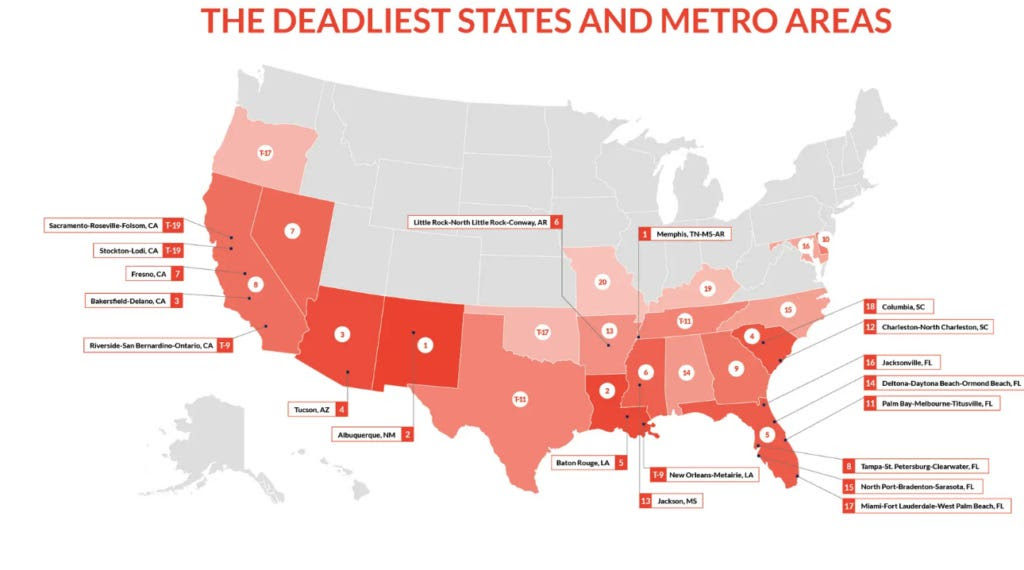
Memphis has been ranked as the most dangerous large U.S. city for pedestrians for 10 years, with the most recent data showing it at the top of the recently released Smart Growth America’s Dangerous by Design rankings.
“Between 2015 and 2019, Memphis averaged 44 pedestrian fatalities per year,” the report said. “From 2020 to 2024, that number surged to 74 annually, rising by an astonishing rate of 2.2 deaths per 100k people to reach 5.5 total in this report. Despite years of warnings and national attention, Memphis streets continue to become more deadly for people walking.”
Nearly 27% of all traffic fatalities in Memphis involve pedestrians, compared to a national average of 16%, according to the National Highway Traffic Safety Administration (NHTSA).
SGA’s report ranks Memphis, Tennessee; Albuquerque, New Mexico; Bakersfield, California; Tucson, Arizona; and Baton Rouge, Louisiana, as the most dangerous cities for pedestrians.
Speed Kills
It raises the question: what ever happened to the Memphis Safety Action Plan? Its focus appeared to be more about reducing fatalities from car crashes than reducing pedestrian deaths. Its dashboard of key measurements hasn’t been updated beyond 2023.
The Dangerous by Design report said: “For a sobering look at how the rankings compare overall, note that the first time we ranked metro areas in the 2009 version of Dangerous by Design, no metro area had a pedestrian fatality rate higher than 3.52. This year’s top 14 most dangerous metro areas have a higher rate than that and the top fatality rate of 5.5 in Memphis, TN is far more deadly than that now.”
The title of the report says it all. Pedestrians are being killed because the design of roads places them at risk.
“Since the 1950s, the primary goal for transportation has been to move vehicles quickly in nearly all contexts, and 70 years of street design reflects those choices. When roads are wide and straight, lanes are wide and plentiful, and intersections are infrequent or non-signalized, people feel comfortable driving faster—even when the speed limit is low.”
#1 for The Wrong Reasons
The recent report by Smart Growth America, which began tracking pedestrian fatality rates in major metro areas in 2009, found that Memphis’ pedestrian fatality rate of 69.5 deaths per 100,000 residents from 2015–2024 was the highest in the nation.
Other cities’ rankings are Nashville #37, Chattanooga #49, Knoxville #62, New Orleans #9, Louisville #29, Atlanta #32, Birmingham #45, Richmond #51, Detroit #54, New York #76, and Cincinnati #83.
The data shows a long-term upward trend in pedestrian fatalities in Memphis since 2009, with Memphis surpassing other high-risk areas.
When Memphis was ranked as the city with a crime rate that made it the most dangerous U.S. city, Memphians demanded action. Elected officials called for plans, there was impatience with the status quo, and while we are still struggling to find the solutions to get off the top of that list, there has been unprecedented progress.
The crisis of people dying on city streets gets a headline on the nightly news and then everyone goes about their business. It’s a rare occasion to hear an elected official in Memphis even mention the need to address pedestrian deaths.
Now What?
When the Memphis Safety Action Plan was issued, it contained valuable data about pedestrian deaths, tracking and mapping locations from 2019 to 2023. Unfortunately, the information has not been maintained and the latest year for data is three years old.
In that same year, city government launched a “Getting There Together” program. Faced with rising fatalities and injuries among pedestrians, the city of Memphis announced that it was launching a 12-month campaign aimed at educating drivers about safety on the road.
The program was heavy on public relations with posters and tagline but in the end, it did nothing to reduce the number of pedestrian deaths in Memphis. And, as is often the case, the news media did not check back after the 12 months to see what results were recorded.
***
Join us at the Smart City Memphis Facebook page and on Instagram for daily articles, reports, and commentaries that are relevant to Memphis.




Great article. I certainly would love to see a journalist followup on the “Getting There Together” program!