
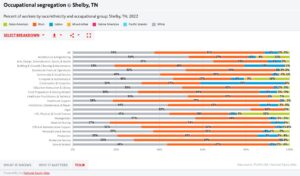
Current-day patterns of occupational segregation in Memphis and the United States are rooted in inequitable hiring practices. The long-term employment of workers of color and immigrant workers in low-wage, low-quality jobs — factory work, mining, farming, domestic labor, and custodial and food services — is central to American labor history, as the social and political vulnerability of these workers made them easier to exploit. The concentration of people of color (particularly Black and Latino workers) in more precarious industries is a practice that has persisted, even as the US economic base has shifted from agricultural to industrial to postindustrial over the past two centuries. Enduring patterns in educational inequity, along with exclusionary hiring and retention practices in some high-wage workplaces, continue to wall out many workers of color from lucrative sectors whose workforces have historically been predominantly white. A more equitable economy would have workforces in the best-compensated occupations reflect the broader population as a whole, as well as close the gaps in wages and amenities between the highest- and lowest-paying jobs. — National Equity Atlas


Strategies to grow an equitable economy: policies to reach full employment for all —
-
Invest in robust, disaggregated data collection and reporting systems and utilize granular insights on differential outcomes to drive systems change.
-
Grow new good jobs by making smart investments in infrastructure projects, supporting economic development strategies to grow high-opportunity industries, and helping entrepreneurs of color start and scale up their businesses.
-
Reduce employment barriers for people with records by “banning the box” — eliminating questions about conviction history on job applications (for private as well as public employers).
-
Connect unemployed and underemployed workers to the jobs created by new development through targeted local hiring, community workforce agreements, and community benefits agreements.
-
Protect the right of workers to organize labor unions.
-
Promote the development of worker-owned cooperatives.
-
Invest a portion of infrastructure investments in job training.
-
Implement sector-focused workforce training and placement programs that create pathways to good jobs for workers with barriers to employment.
-
Invest in innovative training and credentialing models that democratize the economic benefits of a bachelor’s degree to a wider swath of the workforce, such as paid-on-the-job training and portable, stackable credentials and micro credentials to facilitate upward career transitions.
-
Enact strong language access policies requiring interpretation and translation services for English-language learners and facilitate naturalization among green card holders.
-
At the federal level, institute a federal jobs guarantee, dedicate 1 percent of infrastructure investments to a fund for inclusive job and contracting supports, set aside a share of public contracts for businesses owned by people of color to mirror area demographics, and ensure that recently incarcerated people receive essential identification documents to support job attainment.
**Join me on Facebook, Instagram, and Linkedin where these blog posts are published along with occasional articles, reports, and commentaries that are relevant to Memphis.