
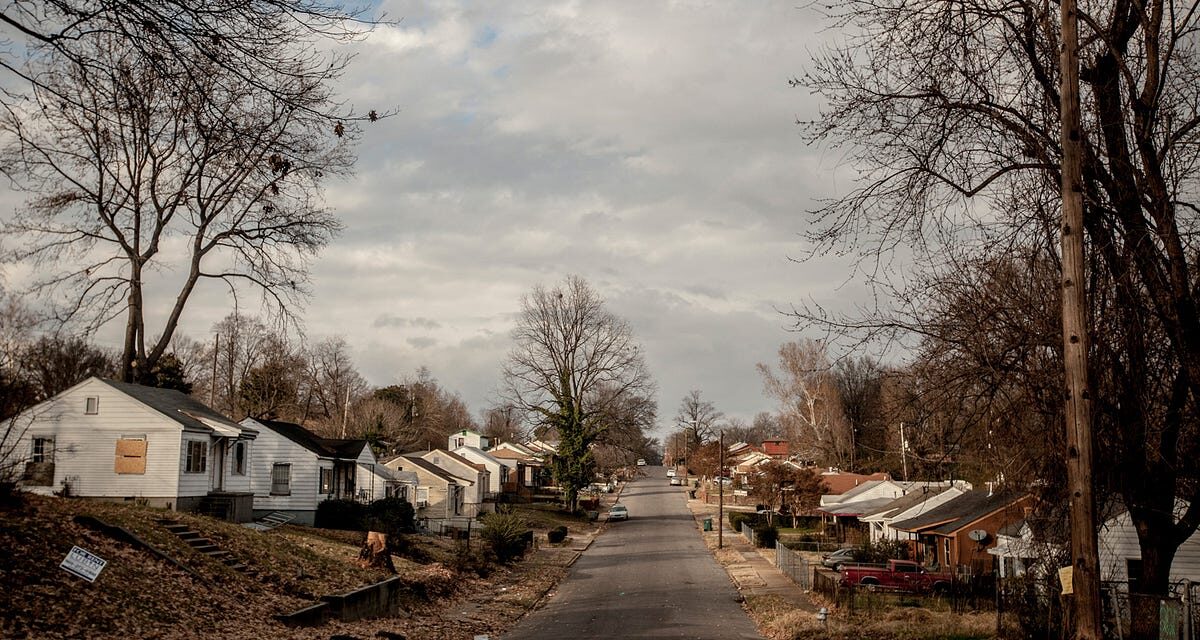
Despite every effort to combat poverty, Memphis remains one of this country’s most economically segregated cities.
Roughly two billion dollars a year is spent to reduce poverty in Memphis with no discernible sign of progress. It’s why economic segregation, which makes poverty a birthright for so many generations of Memphians, is a core issue calling for more attention and action.
Here’s the context: The latest edition of the 2025 Memphis Poverty Fact Sheet reports that the poverty rate in 2024 was 24 percent, compared to 22.6 percent just a year earlier. There’s been a 10 percent increase since 2019. For cities with more than 500,000 people, Memphis has the second highest overall poverty rate and the same ranking for child poverty.
The lack of progress exists despite almost 60 percent of all Memphis nonprofit organizations focused on poverty or the problems that flow from it, investing tens of millions of dollars from donors. There’s also federal transfer payments which direct an estimated $1.9 billion to deal with poverty in Shelby County.
Federal support comes in the form of food stamps, low-income assistance, and temporary assistance for needy families, amounting to 19 percent of the total per capita federal transfer payments to Shelby County. Social Security, Medicare, and Medicaid make up the other 81 percent.
“An interesting aspect of Memphis poverty is that it does not appear to be in sync with the rest of the nation,” wrote Dr. Elena Delavega, University of Memphis School of Social Work, and Dr. Gregory Blumenthal of GMBS Consulting in their 2025 Poverty Fact Sheet. “In 2024, poverty declined in the United States but it increased in Memphis. It is clear from the data that poverty in Memphis is structural and that economic development is lagging in this community.”
All of us celebrate what is right about Memphis and hold up exciting projects as proof of the progress that’s being made. But beneath the slogans and ribbon cuttings lies a hard truth: Memphis remains one of the most economically segregated cities in America — and in many ways, that segregation is deepening.
Economic segregation isn’t just about intractable poverty existing alongside wealth. It is about how deliberately those two realities are separated in space, opportunity, and political power. While Memphis has never been shy about talking honestly about race, poverty, and power, the force shaping daily life hides in plain sight: economic segregation.
It is not a mere accident of geography. It is the cumulative result of decades of policy decisions — redlining, highway construction, annexation, suburban flight, uneven public investment, and development incentives that reward well-to-do areas while asking poorer neighborhoods to wait their turn.
Economic development must shift from a focus on deals to a focus on outcomes. For decades, incentives have been used to attract investment without sufficient attention to guide where that investment lands — or who benefits.
As a result, ZIP codes matter here in ways that feel almost medieval. Neighborhood boundaries function like invisible walls. Where someone lives largely determines the quality of their schools, the safety of their streets, their access to grocery stores, the ability to find living wage jobs, the quality of their healthcare, and even their life expectancy. It shapes who gets opportunity — and who is told, implicitly and repeatedly, to make do with less.
The impact on children may be the most devastating consequence of economic segregation. Research consistently shows that growing up in high-poverty neighborhoods reduces educational attainment, lifetime earnings, and upward mobility. In Memphis, where many children grow up surrounded almost exclusively by poverty, the odds are stacked early and steeply against them. Schools bear the burden of unmet social needs, and while teachers often work miracles, miracles cannot substitute for structural change.
Mandy Spears of the Sycamore Institute found that “a child who grew up in a low-income home in Midtown had about a 16 percent chance of becoming a high-income adult. One mile away in North Memphis, a low-income child had less than a 1 percent chance of moving from the bottom 25 percent in household income to the top 20 percent.” Several years ago, The New York Times concluded that poor children in Memphis had the worst odds of any place in the continental United States of moving from low to high-income — only 3 percent.
Economic segregation also weakens the city as a whole because it increases the cost of delivering public services while shrinking the tax base needed to pay for them. Breaking this pattern will require more than mixed-use developments and hopeful language. It will require intentional policy choices that redistribute opportunity, not just investment.
That means prioritizing affordable housing and aligning economic development incentives with clear equity goals and measurable outcomes. It means treating access to quality schools, transit, and basic services as non-negotiable civic infrastructure, not perks tied to property values.
So what can be done?
First, Memphis must stop treating economic segregation as an immutable fact of life and call it out as a central policy challenge. That means measuring it, tracking it, and evaluating public decisions — on housing, transportation, incentives, and schools — through the lens of whether they reduce or reinforce separation by income.
Second, economic development must shift from a focus on deals to a focus on outcomes. For decades, incentives have been used to attract investment without sufficient attention to guide where that investment lands — or who benefits. If public dollars are involved, developments should contribute to economic desegregation, not deepen it. That means giving priority to projects that create quality jobs accessible to low-income residents and locating them in ways that connect people to opportunity.
Memphis has taken steps in the right direction. The City of Memphis will take 25 percent of the new property taxes created by xAI to invest in Boxtown and southwest Memphis. In the Klondike neighborhood, the $81 million Northside Square developed by The Works CDC in partnership with ComCap Partners will provide 42 affordable apartments and lease space to tenants like CodeCrew.
Economic segregation does not have to be Memphis’ destiny. It is the product of choices — and different choices can produce a different city.
**
This blog post was previously published as my City Journal column in Memphis magazine. Support local journalism by subscribing to Memphis magazine here.




Your last sentence is the most important part of your article – “economic segregation … is a product of choices”. All the public and social programs in the world will not make a difference until a majority of people in our city make better personal choices. It starts with not having children without a father present or a sufficient means of support for them. We have way too many single mothers in this city who are struggling to balance family with economic sufficiency. As a result, we have 3 generations of children who grew up with largely absentee parents and we are paying the price for it. Until we find a way to make sure these kids are cared for and nourished economically, emotionally and intellectually at home, we will never find a way to solve our root poverty problem here in Memphis. The schools and nonprofits can only do so much – the solution to our problems needs to begin in individual homes.
As always, a good article. I am not altogether certain how we get out of the hole that we dug ourselves into decades ago. A key to remember is that difference between being poor and being working/middle class is only one thing: money. And a regular supply of it. People will quickly change behaviors and outcomes when a regular flow of income passes through the household. Memphians are a generous sort of people, but few of the programs say, “here, take this $2,000 month and do as you like.” Instead, many of the antipoverty programs (public and private) are goods/services oriented. Of course, the leads back to the old Memphis economy problem: Memphis has a lot of jobs, not so many that you would really want. We are known as a low-wage city — certainly true in the past, probably true today. Finally, it is hard to solve a problem like endemic poverty when the State spends most of it time punishing the City, and the Federal apparatus has no interest at all in the problem.