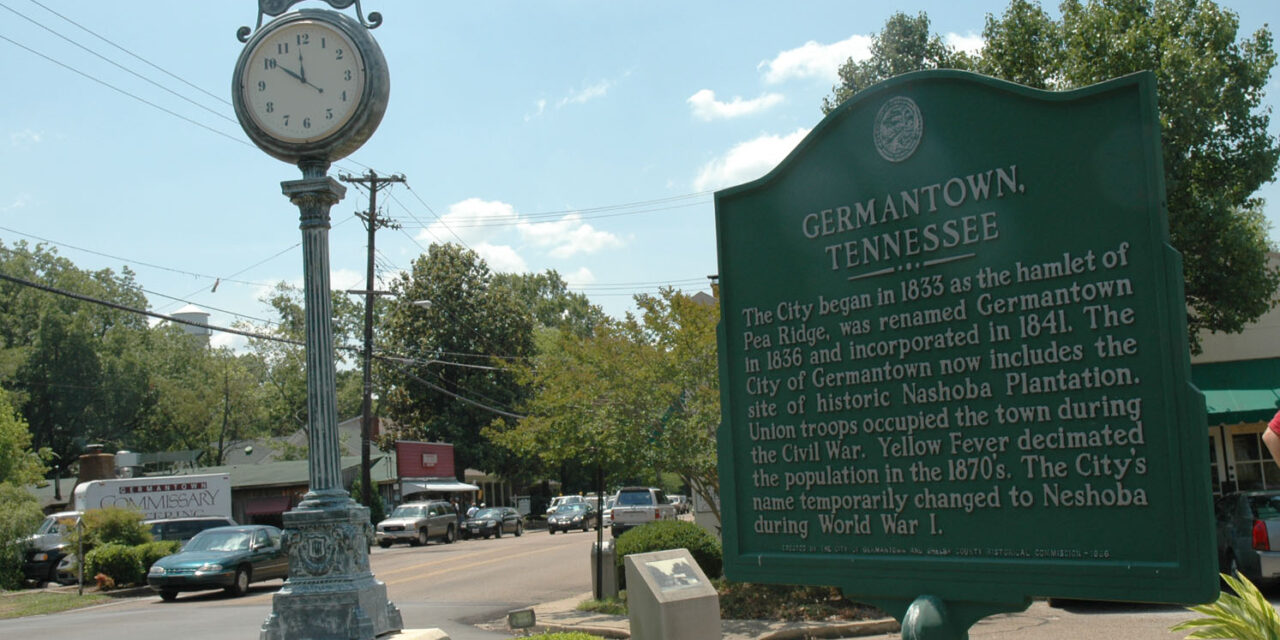
It appears that Germantown is barreling ahead to approve the first TIF tax break to developers in that city – although it has the highest median household income in Shelby County and the seventh highest in Tennessee.
At the same time, the median household income in Memphis does not rank in the top 100 highest in the state, but despite that, county taxpayers who live in Memphis will be paying the biggest share of the incentive for Germantown.
That’s because the TIF (Tax Increment Financing) incentive not only redirects the project’s increase in Germantown’s property taxes but also the county’s property taxes for the developer’s use.
The math tells the tale: the Germantown property tax rate is $1.79 but the Shelby County property tax rate is $2.69.
A Weak Market?
More to the point, the taxes are being captured for a specific development in a city that by any measurement is doing quite well and it’s the kind of place where developers should want to locate because of the market itself, not because of the lagniappe of a tax incentive.
Already, the Germantown Industrial Development Board has approved the economic impact plan for The Standard, a mixed-use redevelopment in the former Carrefour shopping center. On Monday, the Board of Mayor and Alderman will review and consider the TIF at its meeting.
The value of the 20-year TIF for the total project is $35.5 million. Germantown said the TIF being considered is for Phases 1 and II and is capped at $14.5 million for the incentive. The city’s reimbursement to the developer would be about $6 million. The balance would come from Shelby County.
Like all development projects at this point, The Standard is subject to modifications and redesign. Phase 1 of the 10-acre project will consist of about 12,000 square feet of commercial space, and Phase 2 will have 320 residential loft units and about 27,000 square feet of retail and commercial space.
Addition Through Subtraction
Already, the project’s consultant said plans for condos and office space could change. The hotel once mentioned as part of the project was no longer mentioned. The track record for projects like this is that once politicians are hooked, they push ahead for approval regardless of any changes or modifications.
Curiously, the TIF consultant Germantown hired to help with its analysis previously worked with the developers. If there’s any indication that the fix is in, that’s the tell.
Meanwhile, Henry Evans, chairman of the Germantown Industrial Development Board, disingenuously said: “I believe the vote that we are making tonight is a vote for an investment in our city. It is a vote that helps stabilize and helps grow the tax base.”
What he’s suggesting is essentially addition through subtraction. But if he truly believes that The Standard will grow the tax base, how about an arrangement in which the taxpayers of Germantown and Shelby County assume an equity position in the project?
Already, Germantown taxpayers are dealing with a 29-cent tax increase over the state certified rate of $1.4987, an increase of $328 a year for a $450,000 home. Shelby County Board of Commissioners did not increase its property tax rate over the state’s certified rate of $2.69, in effect, reducing the county rate from $3.39.
TIFs Mushrooming in County Towns
Once upon a time, Tax Increment Financing (TIF) was a special incentive reserved for neighborhoods fighting blight and disinvestment, but over the years, that focus was eroded as developers lobbied and won wording that gave them access to the money for their mixed-use developments.
In that way, Germantown is not alone.
TIF districts are mushrooming in almost every Shelby County town as public incentive for private profit. Their use should raise questions about the need for the incentives in towns whose markets appear strong enough to have attracted development on their own merits and without incentives.
Here’s how Tax Increment Financing works: after an area is designated a TIF district, its tax baseline is frozen and any increase in property taxes is placed in a fund to pay for infrastructure improvements that make the area more profitable.
For example, Lakeland’s Lake District TIF is $36 million for a real estate venture to develop 110 townhomes as well as multi-family units. Lakeland already has two TIF districts and are considering one more. The Bartlett TIF is for an addition to the Union Depot mixed-use development and to acquire the privately owned Quail Ridge Golf Course.
There are already TIFs in Millington and Arlington. There is not a TIF district in Collierville, but that town is already known for its excessive uses of PILOTs (to a factor of more than 10 when compared to the other suburban towns).
Prediction Game
Comparative property tax rates indicate the heavy reliance by the towns on county tax revenues to finance their TIF and PILOT projects:
$2.69 – Shelby County
$1.79 – Germantown
$1.66 – Bartlett
$1.13 – Arlington
$1.1157 – Millington
$0.94 – Lakeland
$2.58081 – Memphis
Business interests like to say that TIF districts (and PILOTs) are “painless” because the new taxes would not exist without the project but that’s not the full story. They are the same kinds of people who once said sprawl was economic growth, so the watchword should be “trust but verify.”
What is regularly overlooked is that TIFs rely on predictions of future gains, which in turn means diverting potential property tax growth from general public funds that would otherwise fund essential services.
It’s a truism, nevertheless, that every dollar given in an unnecessary or excessive tax break – whether TIFs or PILOTs – to a company or real estate developer is a dollar that can’t be spent on schools, criminal justice, workforce development, quality of life, public transit, and other drivers of economic success.
Enriching Some While Costing Many
Because TIF justifications rest on a “but for the TIF, this project would not happen,” the question always remains about whether developments backed by TIFs would have gone forward without them.
If the projects are not actually dependent on the TIF to proceed, they are in effect redirecting funds that would otherwise support broader public services rather than the narrow area or a particular developer.
TIF districts are not inherently good nor inherently bad. As a funding mechanism, they can, when administered wisely and under the right conditions, steer investment to the areas that need it. By design, however, TIFs often service narrow interests – developers, political constituencies, and speculative growth – and that’s why the shift to suburban mixed-use projects is troubling.
What our community should demand is not the wholesale abolition of TIFS (or PILOTs, for that matter) but an honest conversation about who benefits, who bears the risk, and what kind of growth we want. Without that, TIFs risk becoming a subsidy machine that enriches some while costing many.
As I have recommended before, in the wake of one of Collierville’s indefensible PILOTs, it’s fine if these municipalities want to dole out incentives; however, when it comes to the Shelby County portion, they should only get the percentage of property taxes that the town provides to the county’s total revenues. Let each town set its own priorities, support its own weight and not depend on all of Shelby County to help.
***
Join us at the Smart City Memphis Facebook page and on Instagram for daily articles, reports, and commentaries that are relevant to Memphis.