
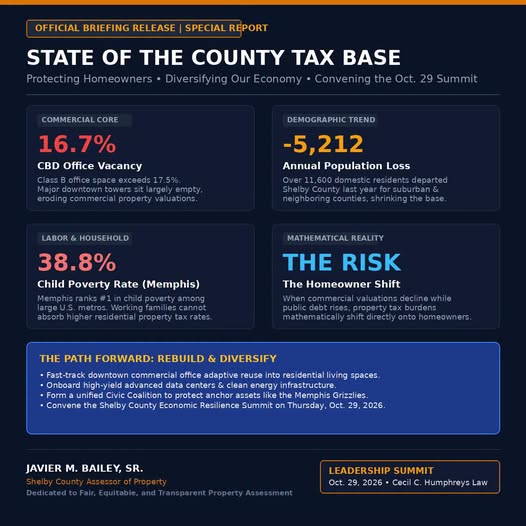
It is the responsibility of the county assessor to identify, locate, and determine the fair market value of all real and personal property in Shelby County for tax purposes.
He compiles total property values and certifies the assessment roll to other elected officials who then set tax rates, collect taxes, and prepare budgets.
The assessor is a vital source of data but when he strays beyond his primary responsibility, he runs the risk of doing something or saying something that raises questions about his objectivity or suggesting he has an agenda that can cause his fairness to be challenged in appeals.
That’s the risk newly elected assessor Javier Bailey presents with his “State of the County Tax Base” report. There’s nothing new about the data in the report, whose proverbial “bottom line” is that we have a slow growth tax base. No one knows this reality more than Memphis and Shelby County mayors and their legislative bodies.
In Mr. Bailey announcing that he is organizing a “State of the County Tax Base Summit” to “generate more income, more revenue, or get spending under control,” it seems like someone overstepping the job he was elected to do – assess property fairly and honestly.
More Context
When he states an objective of generating more revenue, it raises a question about a potential conflict of interest, because it raises undertainty about whether he will use assessments to achieve that objective, raising the issue of whether his pursuit influences the fairness of his office’s assessments.
Mr. Bailey’s report laid out a lot of data and commentary, but the context about taxes is much more nuanced and broader:
- The greatest impact on revenue growth would be a dramatic increase in home values in Memphis, but that’s a politically charged strategy because it raises property taxes in disinvested neighborhoods. The math tells the story: the median household value in Memphis is $169,000 and in Nashville it is $413,600. That differential means that Nashville receives almost $1 billion more in property taxes as a result of these high home values than Memphis and Shelby County combined.
- It was worth mentioning the dilemma that complicates tax fairness in Memphis: Tennessee has the third most regressive tax structure in the U.S. This structural disparity means that the families who earn the least pay the most. Families with the lowest 20% of income pay 13% of their incomes in taxes, but the top 1% pays only 4%.
- Like Mr. Bailey, all of us are anxious for redevelopment of downtown Memphis’s tallest – and empty – buildings: Raymond James Building, 100 N. Main Building, and Sterick Building. But redevelopment wouldn’t result in an immediate and significant stream of new taxes because each of them will receive tax breaks from Center City Revenue Finance Corporation of 25 years which would mean payments of their full tax bills remains years away.
- He implied that Memphis in May moving to the Fairgrounds was a revenue hit to local government, however, he’s relying on the festival’s economic impact reports based on assumptions and data the festival supplied to the analyst. More to the point, festival events do not produce property tax revenues and the sales tax revenue they produce is captured by the Tourism Development Zone, not local government.
- The assessor did not mention a charge that he should be leading: requiring a change in the assessment rate paid by “whale investors” who bought 7,000 single family houses in just two years and converted them into rental units. Today, they are assessed at a residential assessment rate of 25% when their fair rate should be the 40% commercial rate. There is a bill pending in the Tennessee Legislature to remedy this, but there is a school of thought that the assessor should not wait for permission and go ahead and assess the properties at the commercial rate. That would likely result in lawsuits but it would push these companies into the light to defend their business practices and their destructive impact on Memphis.
- National polls show that 70% of Americans oppose construction of data centers and there is a national movement to slow down their development. Thankfully, Memphis City Council has joined that movement but Mr. Bailey calls for fast track approval of data centers to capture the “massive” taxes they would pay. It’s a strange argument heard from a few politicians here: we should ignore the environmental and quality of life costs of a proliferation of data centers because we’re chasing the big bucks. There’s no reason to think that Memphians’ opinions are different than the national polls. Besides the obvious concerns, there is also the way that these companies buy government approvals with showers of campaign contributions and the hiring of lobbyists. There should be no indication by Mr. Bailey that data centers will be treated any differently from any other company.
The impact of the buzzword-heavy County Tax Base report is undercut by Mr. Bailey’s unwise opinions like the one that local government spending is out of control. He provides no supporting data or comparisons to comparable cities which have actually shown in the past that Memphis public services are underfunded when compared to their peer cities.
All in all, this feels like déjà vu all over again. His predecessor in the assessor’s office, Melvin Burgess, had barely settled into his job before he began to posture for a run for mayor. More than anything, this report smacks of someone positioning himself to do the same.
Meanwhile, Mr. Bailey’s LinkedIn page says that since 2008, he has been CEO and Chief Real Estate Strategist for Javier Bailey Capital Group Inc. in addition to his job is the assessor’s office. He writes: “I provide strategic analysis and operational strategies for both institutional and individual investors; including identifying undervalued assets, acquisition of undervalued assets, asset development, and asset (capital) growth through management.”
Tennessee law does not prohibit county assessors from holding other jobs or working outside their elected position as long as they abide by ethics standards but my prediction is that most taxpayers expect the assessor’s job here to be fulltime. Hopefully, he’s just failed to update his Linkedin page in the past 18 years.
Let Financial Experts Give Advice
Mr. Bailey’s data and rhetoric fall under a report heading of “One Region. One Tax Base – A Shared Strategy to Protect Homeowners & Build New Economic Engines.” It’s unclear what he means since there are today eight different tax bases and tax rates and that’s highly unlikely to change.
But here’s the thing: this issue more rightly belongs with the financial experts in Memphis, Shelby County, and suburban governments.
New Shelby County mayor has appointed experienced Brian Collins as Director of Finance to bring much-needed order and discipline to the county’s finances. For the past nine years, he’s been executive director of the $50 billion Illinois Municipal Retirement Fund with its 442,000 members, and prior to that, he was director of finance for City of Memphis from 2012-2017.
At the same time, Memphis Mayor Paul Young has appointed highly-respected Art Davis as chief financial officer for City of Memphis. He has extensive financial management experience that includes nonprofit organizations, stadium management, director of finance for the Redbirds, and more. Notably, he managed the $61 million development of Tom Lee Park on time and on budget with no money from city government and with a historic MWBE rate of 44%.
All in all, their knowledge and experience of public financing runs deep and they spend every day contemplating what needs to be done. They are professionals and are loathe to engage in political posturing and as a result, their opinions count more than anyone else’s on next steps to consider financial changes facing local governments.
That said, Mr. Bailey deserves credit for working with the state assessors’ association to develop a new special tax category for data centers so they are required to pay more taxes. It’s the most important thing he can be working on right now.
**
Join me on Facebook, Instagram, and Linkedin where these blog posts are published along with occasional articles, reports, and commentaries that are relevant to Memphis.