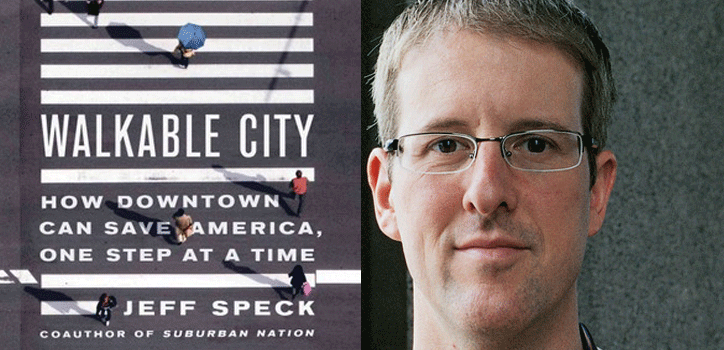
Note: This is the first of two posts. This one recaps planner and urban designer Jeff Speck’s recommendations for Memphis. The next post will be grades given for Memphis’s progress on each of the recommendations by a Memphis urbanist with in-depth planning and architectural experience. Those grades will be posted Wednesday afternoon.
***
It’s been 18 years since Jeff Speck came to Memphis with a simple proposition: if Memphis wants a better downtown, it should start by making downtown better for people.
That sounds almost embarrassingly modest. There was no $500 million megaproject attached to it, no signature skyscraper, no convention center expansion, no promise that Memphis could reinvent itself overnight.
Instead, Mr. Speck, the nationally recognized city planner and urban designer, arrived in Memphis in 2008 with something that may have been more useful: 12 modest ideas.
His presentation, 12 Modest Suggestions for Making Memphis Great, ran to 178 slides, but its underlying argument was remarkably straightforward. A successful city is one in which people choose to walk. People will still drive. They will use transit. They will park their cars. But if they do not feel comfortable walking, a city will struggle to provide the kind of quality of life that increasingly influences where people live, work, and invest.
Nearly two decades later, Mr. Speck’s ideas are worth revisiting because Memphis seems to always be talking about the future of downtown. And what is striking is how many of his recommendations still sound less like history than an unfinished agenda.
Cities For People
Mr. Speck’s first suggestion was perhaps his most important: build Memphis for humans, not just cars.
He warned against allowing traffic engineers to become, by default, the city’s urban planners. Their job is to move traffic efficiently. But a street that moves cars efficiently is not necessarily a street that makes a good city.
Mr. Speck pointed specifically to Memphis streets with 14-foot travel lanes — essentially highway dimensions in an urban environment. He argued that downtown streets should have narrower, roughly 10-foot lanes that encourage slower speeds, and in many cases, simply by restriping existing streets.
His point was not that cars are the enemy. Cars moving quickly around pedestrians are the problem.
He recommended the combination that has become almost a textbook definition of a walkable urban street: smaller blocks, fewer and narrower driving lanes, two-way traffic, parallel parking and street trees.
That is an important distinction for Memphis today. The question isn’t whether downtown should accommodate automobiles. Of course it should. The question is what kind of downtown street we want automobiles to move through.
Meanwhile, Memphis has suffered from the engineers as planners syndrome more than most cities.
Protect Economic Advantage
Mr. Speck’s second recommendation: stop demolishing the city’s economic advantage.
Memphis has an extraordinary collection of historic buildings, and Mr. Speck viewed its architectural heritage as an economic asset comparable to its musical heritage. He argued that historic buildings help distinguish Memphis from other cities and that destroying them weakens one of the things that makes the city different.
His third recommendation was deceptively simple: plant trees.
Some of the better streets are devoid of trees. Mr. Speck imagined South Main Street with a continuous canopy, pointing out that the sidewalks were wide enough to accommodate trees. More broadly, he envisioned a continuous urban tree canopy as a fundamental part of Memphis’s public realm.
The fourth recommendation was to organize neighborhoods around schools and schools around neighborhoods, restoring the walk to school as an ordinary part of childhood.
These recommendations reveal something about Mr. Speck’s approach. He wasn’t talking only about downtown beautification. He was talking about the physical structure of a city and the ways its streets, buildings, schools and public spaces influence daily life.
His fifth recommendation was more provocative: fix downtown first.
Other neighborhoods may be in greater need of assistance, but it is important to remember that a city’s downtown is the one neighborhood that belongs to every resident, wherever they live. In addition, the condition of a city’s downtown plays a disproportionate role in the city’s reputation and thus its future success. Make a resident neighborhood better and its residents benefit. Make the downtown better and the entire city benefits.
That idea has particular resonance today.
As I’ve written before, Memphis has tremendous assets downtown — Beale Street, AutoZone Park, FedExForum, South Main, the Orpheum, the riverfront, Tom Lee Park, the National Civil Rights Museum and the developing Pinch District, among others. Yet many of those assets can still feel like disconnected islands rather than pieces of one coherent urban experience.
August 13, 2026: Connecting Downtown’s Islands
Mr. Speck’s sixth recommendation, practice urban triage, was his answer to that problem.
Don’t try to make every street equally successful at the same time. Identify the places where relatively modest investments can produce the greatest increase in pedestrian activity, then concentrate resources there.
By trying to be universally good, cities end up universally mediocre. Only certain areas have the potential to attract and sustain pedestrian life. Improvements intended to attract pedestrians to other areas will only succeed at great expense. By studying existing conditions, we can see where limited investment can quickly produce significant improvements in pedestrian activity.
The seventh recommendation was to fix the Third Street “promenot.”
Mr. Speck saw Third Street between AutoZone Park and Beale Street as an obvious opportunity. Two major pedestrian attractions were already there, but the connection between them was undermined by parking lots, garage walls, ramps and blank facades. Instead of a promenade connecting two destinations, pedestrians encountered what Speck called a “promenot.”
The eighth was to heal the Main/South Main “knuckle.”
The same challenges posed by Third Street are presented at a larger scale by the stretch of Main Street from Peabody Place south to Pontotoc with two separate pedestrian-viable areas which fail to achieve synergy because they are separated by empty buildings, parking lots, and a suburban office building. One of the biggest planning errors in the history was mistaking downtown for an office park and built a huge suburban office building in the form of the MLGW headquarters, complete with deep setbacks and landscaped berms.
Monumental Places
The ninth was to build the missing monument – a recommendation subsequently fulfilled downtown with monuments at National Civil Rights Museum, for Ida B. Wells, the I Am A Man park, and the MLK Reflection Park.
The tenth was perhaps the most intriguing: “You deserve just a little urban waterfront.”
Mr. Speck believed Memphis had allowed its riverfront to become too much like infrastructure and not enough like a civic edge. The Mississippi River should not simply be something Memphis looks at. It should be something Memphis experiences.
That idea would become even more significant five years later when Mr. Speck returned to Memphis at the request of Mayor A C Wharton to examine the riverfront. After reviewing roughly two decades of previous plans, he produced six recommendations, including making Riverside Drive a complete street and substantially improving Tom Lee Park.
Thankfully, the riverfront bears no resemblance to the time when Mr. Speck made his suggestions. Today, Riverside drive is two lanes and the Memphis riverfront is now five miles of connected parks, climaxed by award-winning Tom Lee Park.
Mr. Speck’s eleventh recommendation was put cars back on Main.
At the time, that was controversial. Main Street had been converted into a pedestrian mall, and Mr. Speck argued that Memphis was repeating a pattern experienced by many American cities. He believed slow-moving cars and on-street parking on Main Street could actually support pedestrian activity and retail rather than destroy it.
The history of pedestrianized main streets in America can easily be considered a failure. Of the approximately 135 Main Streets pedestrianized in the sixties and seventies, almost all of them failed. In fact, cars now drive and park on Main Street as a matter of course. They just do it illegally.
Finally, Mr. Speck said: stop the Outer Loop.
This recommendation dealt with I-269 and unfortunately, the special interests and moneyed influences made sure this unnecessary incentive for sprawl was completed. As Mr. Speck wrote: “From a planning perspective, there is no intelligent argument to be made for the construction of the other loop. It is the exact opposite of smart growth.” Sadly, he has been proven right.
Being The Best Memphis
The remarkable thing about Mr. Speck’s 12 suggestions is not that every recommendation was right, or that every idea remains applicable exactly as he proposed it.
It is that none of them required Memphis to become another city.
Mr. Speck wasn’t asking Memphis to become Portland, Denver, or Nashville. He was asking Memphis to become more fully itself by making better use of the assets it already possessed.
That is why his advice still matters.
Memphis has spent decades producing plans. Mr. Speck himself would later say, while studying the riverfront’s twenty plans, that “the last thing the city needs is another plan.” His approach was to identify the relatively small number of physical changes capable of producing larger changes in how people experience the city.
That may be the most useful lesson for downtown Memphis today. The challenge isn’t necessarily finding another grand idea.
It may be connecting the ideas we already have.
Make streets safer and slower. Fill the gaps between major destinations. Replace surface parking where it interrupts pedestrian corridors. Put buildings and people at the edges of public spaces. Plant trees. Protect historic buildings. Make the riverfront genuinely urban. Concentrate investment where it can create the most activity.
None of those ideas is revolutionary.
Together, however, they amount to something Memphis has often lacked: a clear physical strategy for turning downtown from a collection of attractions into a connected place.
And perhaps that is what Jeff Speck was really offering Memphis in 2008. Not 12 projects. Not another master plan, but a way of thinking about the city.
Next Post: Grading Jeff Speck’s 12 Modest Proposals.
***
Join me on Facebook, Instagram, and Linkedin where these blog posts are published along with occasional articles, reports, and commentaries that are relevant to Memphis.