
A favorite economist and urban thinker here is Joe Cortright whose wisdom is regularly posted to his City Observatory website. He not only challenges conventional thinking but often obliterates it with smart research and new insights. His commentaries tackle misconceptions about cities, break down the latest urban research, and highlight innovative ideas.
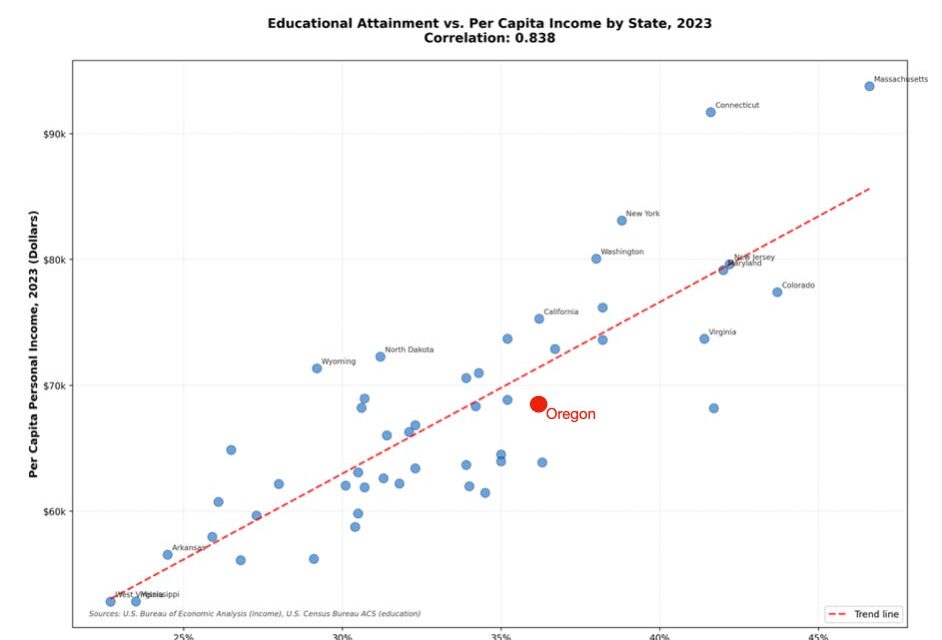
He said the following essay “challenges the business lobby’s persistent mantra that tax cuts catalyze growth; that’s a self-serving myth debunked by hard data. Economic prosperity is not bought with tax breaks for the wealthy; it is built on human capital. Educational attainment statistically explains nearly 70 percent of the variation in state economic success.”

Joe Cortright
Here’s his column:
Gov. Tina Kotek’s Prosperity Council is due to submit its recommendations later this month on how to boost business competitiveness in Oregon. Instead of focusing on cutting taxes for businesses, however, the council should focus on strengthening the qualities that made Oregon successful in the first place: educating Oregonians and assuring we have a high quality of life that retains and attracts talent.
Today, the most important factor determining economic success in this globalized, knowledge-driven economy is education. This is true for individuals and true for states. Numerous studies have shown how tightly connected the level of educational attainment is with a state’s per capita income. As Harvard economist Ed Glaeser succinctly puts it: “the most important economic development strategy is to attract and train smart people.”
Smart people fuel economic development. Today, companies grow in and move to places with abundant talent and a high quality of life that makes recruitment easy. That talent has been Oregon’s competitive advantage for two decades. It is why we have outperformed the U.S. economy in wage growth, productivity and poverty reduction. Based on my calculations of Bureau of Economic Analysis figures, Oregon had the fifth fastest growth of per capita income of any state since 2010. Going forward, education is essential to navigating the challenges of artificial intelligence and extending prosperity to all.
Don’t take my word for it. In 2007, the business-led Oregon Business Plan stated that definitively. It cautioned that in order for Oregon’s “companies and its economy to compete effectively in the global marketplace, Oregon must ramp its education achievement and workforce preparation to unprecedented levels . . . The stakes could not be clearer. Low-paying jobs will not support families or the Oregon economy. Increasingly, both low- and medium-paying jobs, are going offshore or falling to automation. All jobs that pay well increasingly require higher levels of education and work readiness.”
This business-backed push persuaded the 2011 Legislature to adopt the “40/40/20” goal to raise educational attainment: By 2025, the state would ensure that 40% of Oregon adults have a four-year-degree, 40% have a two-year-degree or technical training and the remainder has a high school diploma.
Unfortunately, we have a long way to go. Oregon’s per-student spending in higher education is about half of California’s or Washington’s. Schools at all levels are struggling: the University of Oregon, Portland State and Southern Oregon University face crippling deficits or department cuts, while Portland Public Schools faces a $56 million shortfall and other K-12 districts around the state have cut jobs and school days. We take education for granted at our peril.
This challenge is amplified by the Trump Administration’s budget and policy decisions. Nationally, the “Big Beautiful Bill” is projected to cost Oregon an estimated $5.7 billion in lost revenue for public services in the upcoming 2027–29 biennium, making it even harder to maintain basic services.
In this context, it is alarming that the Prosperity Council is missing the importance of raising educational attainment and largely ignoring these threats. Using panicky claims about Oregon’s business climate and cherry-picked data from a troubled national economy, the council seems poised to call for sweeping tax cuts for businesses and high earners to stimulate the economy. While this is an article of faith among executives, several studies show no correlation between state and local tax burdens and per capita income. Low-tax states are not more prosperous than high-tax states.
The real effect of these proposed tax cuts is to slash revenues for badly needed investments—especially in education—while shifting the tax burden onto those least able to pay.
The slowdowns Oregon is experiencing are no different than what’s happening nationally. Job growth declined 90% percent nationally between December 2024 and December 2025, and that, coupled with two bad years for two big firms (Intel and Nike) largely explains Oregon’s somewhat weaker job numbers.
Oregon businesses are right about one thing: we are in a competition with other states. But it is a competition we will win not by trying to be cheaper, but by working to be better and smarter. Cutting taxes for a favored few will undercut our efforts to educate Oregonians and will make the state less attractive to talented workers who have choices. Investing in talent is the real high road to prosperity.
***
Join us at the Smart City Memphis Facebook page and on Instagram where these blog posts are published along with occasional articles, reports, and commentaries that are relevant to Memphis.