Despite MLGW’s protests to the contrary, common sense suggests that residential customers are subsidizing industrial customers’ water bills.
What other rational conclusion should be reached by the fact that big users like xAI pay 41% less for 100 gallons of water than those of us who use the same amount in our homes – 19 cents compared to 32 cents.
This regressive discount means that large industrial users have little financial incentive to invest in closed-loop recycling or water-saving infrastructure, because it is highly economical for them to pump millions of gallons of pristine groundwater for standard cooling and manufacturing processes.
As for xAI, it drained 25 million gallons of water from the aquifer in March alone. For a company that just signed a deal to be paid $1.25 billion per month by Anthropic for computing capacity, the 13 cents difference between the industrial and residential rate qualifies as petty cash.
But when we consider that xAI isn’t even the largest user of water in Memphis, it raises questions about the impact of the lower rate on the behaviors of these companies.
Selling Memphis At A Discount
In the industrial corridor in southwest Memphis, there are also Valero Refinery, Fleischmann’s Yeast, Chemours, and Nucor Steel. They are among the top 10 MLGW water customers who cumulatively use more than three billion gallons of water a year.
All of them get preferential treatment with a discounted rate for water, and for that matter, they also get a discounted rate for electricity that is 40% less than the residential rate. Even a former TVA board chair said it was unfair and contended that families are subsidizing industry, “doing just the opposite of what the TVA Act requires.”
But back to water, the discounted rate leads to the aquifer being seen as something to be exploited instead of something to be held in the public trust. Exploitation is the common attitude among people involved in economic development who treat cheap and pure water as an incentive to be used indiscriminately to attract and keep industry in Memphis.
Meanwhile, MLGW president and CEO Doug McGowen told Memphis City Council that Elon Musk’s parent company was “committed” to building a wastewater treatment plant for its Colossus data center.
That’s cold comfort.
Policies Mirror Civic Values
After all, the company said the water treatment plant was not an immediate priority, leading to the question of who – if anyone – can require Musk to adhere to any promise that he makes, considering his reputation for ignoring regulations and promises made during negotiations.
What exactly is MLGW’s backup plan if xAI ultimately decides against building the facility?
Protect Our Aquifer and other environmental groups are right to call for a public forum to discuss the company’s treatment of the aquifer, future expansion plans, and the water treatment plant. xAI has lacked transparency and accountability from the beginning and if past is the best predictor of the future, it’s hard to expect it to get better.
If residents are constantly told to conserve water because the aquifer must be protected for future generations, why should enormous industrial users receive discounted access to that same public resource?
And if water conservation is truly a civic priority, why does the pricing system reward volume consumption instead of efficiency?
These questions matter because water pricing is not simply a technical utility issue. It reflects civic values.
Outdated Policies
In Memphis, residential ratepayers often carry the burden of rising utility costs while industries benefit from economic development incentives designed to attract investment. The talking points behind those incentives are familiar: cheap utilities help recruit employers, stimulate growth, and create jobs.
But there is a dangerous flaw in this model when applied to water.
When large users pay lower effective rates, there is less incentive to conserve. The economic signal encourages consumption instead of efficiency. Waste becomes cheaper than innovation.
That may have seemed reasonable decades ago when groundwater appeared limitless and climate pressures were less severe. But today, it feels increasingly outdated and irresponsible.
Water Stewardship
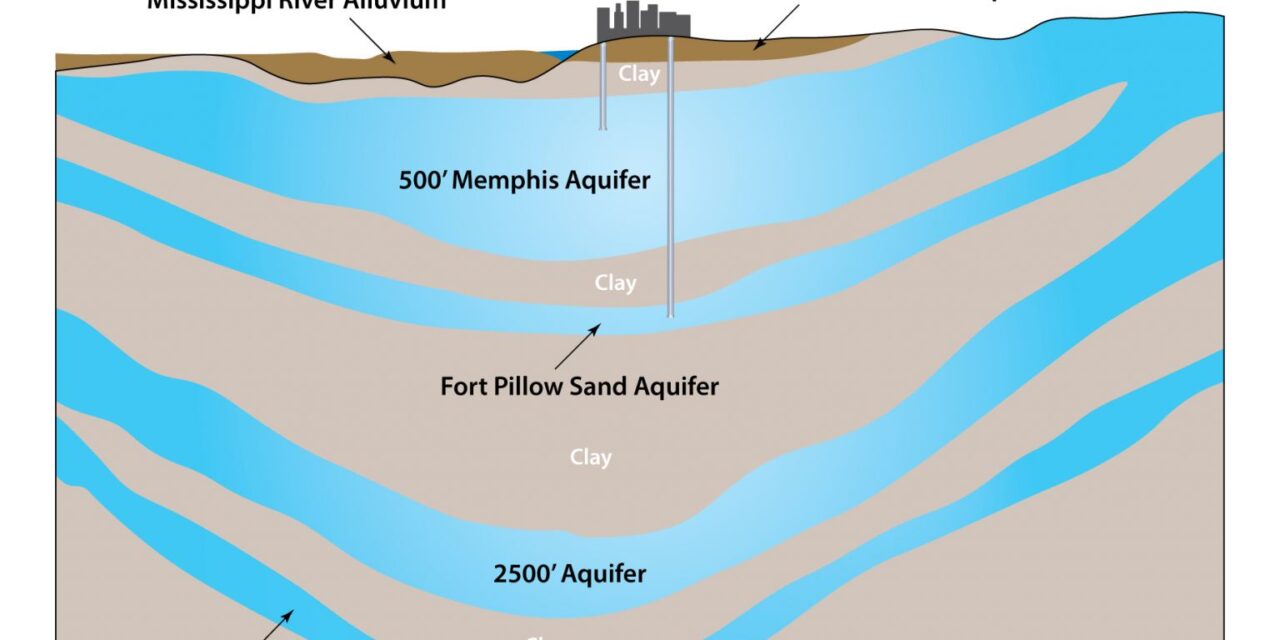
The Memphis aquifer has long been treated almost as a birthright – a vast underground reservoir so abundant that many people assume it can support endless growth without consequences. Along the way, cheap water became part of the city’s economic development brand.
But abundance can create complacency.
Aquifers are not infinite. They recharge slowly. Excessive pumping creates long-term risks, particularly when data centers are proliferating across the landscape.
Memphians have witnessed major public battles over protecting the aquifer from contamination. The fight against the proposed oil pipeline demonstrated how deeply Memphians value this resource.
And yet, a city cannot genuinely claim to value water conservation while structuring rates and incentives that reward the largest users for consuming extraordinary amounts of water.
Supporters argue Memphis must compete aggressively for transformative industries. They say cities unwilling to accommodate large-scale users risk economic irrelevance. They point to potential jobs, supplier networks, tax revenues, and national visibility.
Those arguments deserve consideration. But so do the costs.
And one of the most overlooked costs involves the long-term stewardship of public resources that belong to all Memphians, not just corporations with political influence or economic leverage.
Changing the Equation
There is also a profound fairness issue involved.
The larger the user, the cheaper the water. That is backwards.
If Memphis truly wants sustainability, its policies should encourage efficiency at every level. Industrial recruitment should not depend upon treating public resources as bargain-priced commodities.
A smarter model would reward conservation and innovation instead of pure volume usage. Industries with massive water demands should be required to adopt best-in-class recycling systems, advanced cooling technologies, leak prevention strategies, and measurable conservation benchmarks.
If companies want access to one of America’s great groundwater resources, they should help protect it.
Memphis suffers from a desperation mentality in economic development – the fear that the city must say yes to everything because opportunities are scarce.
Stewardship Anyone?
The question is not whether Memphis should pursue growth. The question is whether growth will be guided by long-term stewardship or short-term boosterism.
The irony is that Memphis already understands the language of conservation when it comes to residents. People are urged to use less water, protect the aquifer, and think about sustainability. Those principles should apply equally to industries whose consumption dwarfs that of ordinary households.
Otherwise, conservation becomes less a public ethic than a burden placed disproportionately on residents while corporations receive the benefits.
The debate over xAI is ultimately about more than one company. It is about what kind of city Memphis wants to be.
Will Memphis treat water as a public trust that must be carefully protected for future generations? Or will artificially cheap water continue to be used as a recruitment tool, even when it encourages excessive industrial consumption and undermines the very conservation principles leaders claim to support?
***
Join us at the Smart City Memphis Facebook page and on Instagram for daily articles, reports, and commentaries that are relevant to Memphis.