
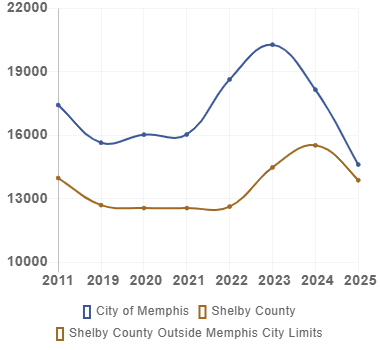
Memphis is still on the list for major cities and crime.
This time, however, Memphis is listed with cities that have dramatically reduced their crime rate.
Instead of being singled out as an outlier of civic dysfunction, Memphis is more and more being cited with cities experiencing broad crime reductions like Philadelphia, Baltimore, Miami, Kansas City, Houston, and Chicago. Memphis was included in recent reporting in Axios, Reuters, Washington Post, and Council on Criminal Justice.
It’s a remarkable change in the Memphis narrative.
It is transformed from the city called the most dangerous city in America to now becoming part of the national analysis about why violent crime is declining across the U.S. Getting in this conversation reflects something even larger than data. It suggests that Memphis may hopefully be escaping the negative narrative that has dogged it for a decade.
National headlines focused on homicides, carjackings, and violent crime rates that made the city synonymous with danger. Memphians were tired of hearing Memphis described as one of America’s most violent cities, and the sense of civic frustration deepened as crime spikes intensified fears about the city’s future.
But over the past two years, something important has happened: violent crime in Memphis has fallen sharply. And Memphis is not alone. Across the United States, major cities are experiencing substantial declines in murders, robberies, aggravated assaults, and gun violence after the extraordinary surge that accompanied the COVID-19 pandemic.
Dramatic Declines
While President Trump repeatedly takes credit for the national decreases in crime, it was actually President Biden’s American Rescue Plan Act (ARPA), the massive, post-pandemic funding for local governments and the Bipartisan Safer Communities Act, that is more responsible. It gave cities like Memphis the money for technology, violence interruption initiatives, and more effective policing.
Meanwhile, Trump claims credit for the decline because of his arrests of “violent criminal illegal aliens” although the vast majority of the immigrants thrown into detention centers do not have a criminal charge.
The change in crime rates is real, even if many residents remain skeptical or cautious.
According to the Memphis Police Department, Memphis recorded major declines in violent crime in 2025, including a 26% reduction in murders, a 22% drop in aggravated assaults, a 31% decline in robberies, and a 48% reduction in carjackings. The city recorded fewer than 200 murders for the first time since 2019. Overall Part I crime fell 27%.
The Council on Criminal Justice found that Memphis experienced decreases in nine out of ten major offense categories in 2025, including steep reductions in homicide, robbery, burglary, and motor vehicle theft.
Those improvements mirror national trends. Data compiled from dozens of major U.S. cities show that violent crime is falling across virtually every region of the country. Homicides nationally dropped about 21% in 2025, one of the sharpest annual declines ever recorded.
Improving Memphis’ Reputation
For years, Memphis appeared in national media mainly as a symbol of urban crisis — a city defined by homicide statistics, carjackings, and alarming violent crime rankings. The stories were often bleak and familiar: Memphis as America’s most dangerous city, Memphis overwhelmed by violence, Memphis as evidence of civic failure.
Nationally, violent crime has been falling sharply since the post-pandemic surge that began in 2020. Data from the Major Cities Chiefs Association shows substantial reductions across major categories of violent crime in large American cities during 2025 and early 2026. Homicides nationally fell nearly 18% in early 2026, with robberies and aggravated assaults also declining significantly.
Memphis is now part of that trend rather than standing outside it. That matters politically, psychologically, and economically.
For years, the city’s crime reputation damaged Memphis’s national image. It affected tourism, business recruitment, investment, and civic morale. Residents became accustomed to hearing outsiders describe Memphis primarily through crime statistics. The city often felt trapped in a cycle where every new ranking reinforced perceptions of inevitable decline.
The city is no longer appearing only in “most dangerous cities” lists. It is appearing in stories about improvement.
Combining Prevention with Opportunity
Memphis, in other words, may not be uniquely broken and its violence problem isn’t uniquely unsolvable after all.
The city’s challenge is sustaining progress long enough for perception to catch up with reality.
That will require more than enforcement alone. Memphis still struggles with concentrated poverty, underperforming schools, inadequate mental health systems, unstable housing, and economic inequality that leaves many neighborhoods disconnected from opportunity.
Cities that permanently reduce violence usually combine policing with prevention and opportunity.
But the fact that Memphis is even part of this national discussion represents unexpected progress. For once, the city is not being singled out solely as a warning sign. It is being included in a national trend of improvement.
The challenge now for Memphis is sustainability. Memphis cannot treat declining crime as a public relations victory lap and relax.
It’s More Than Arrests
The most successful long-term public safety strategy is not simply more arrests. It is creating conditions where fewer people become involved in violence in the first place.
That means investing in youth programs, neighborhood revitalization, addiction treatment, mental health care, workforce development, and education alongside effective policing. Cities that sustain crime declines usually combine enforcement with prevention and opportunity.
For the first time in years, Memphis is part of a story of improvement instead of collapse.
The question now is whether the city can turn a promising decline in violence into something more lasting: a safer, more hopeful future that residents can actually feel, not just measure.
***
Join us at the Smart City Memphis Facebook page and on Instagram for daily articles, reports, and commentaries that are relevant to Memphis.