
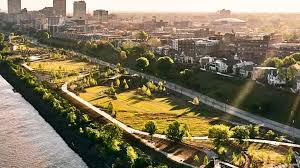
A large mature tree vanished from the bluffs overlooking Tom Lee Park a few days ago.
Although it’s not clear what kind of tree it was, it’s a safe bet it is a species on the Memphis Tree Board’s recommended public street/park trees. The Tree Board was established by Ordinance 5494 as “an advisory board and recommends policies and practices to the director of park services and neighborhoods that have positive contributions to the establishment, management, enhancement, maintenance, and conservation of public trees in the City of Memphis.”
The city ordinance prohibits anyone from “topping” a public tree and sets out the requirements that have to be met to remove one.” Unfortunately, the penalty for violating the ordinance is a maximum fine of $50, an amount that all but renders the regulations toothless.
The bluff tree that was removed was clearly a “public tree.” In fact, it was the model of a public tree – it was on publicly-owned land above a public park, Tom Lee Park.
Protecting Trees
City Hall says it was not involved in the tree’s removal and said Memphis River Parks Partnership has authority over bluff and riverfront trees. If River Parks Partnership did indeed have a role in felling this tree, its part in it would be, in a word, disgraceful.
If involved in allowing removal of the tree, it would represent a drastic shift in policy for the organization whose stewardship and responsibility for the riverfront includes protection of trees, the overall habitat of the bluffs, and the riparian habitat of the river’s edge from Greenbelt Park on the north to Martyrs Park on the south.
Since the Partnership was formed, it has faithfully responded to its duty to preserve the public good for the bluff in the face of individual preference to remove trees. Because of it, it has to act strategically and fairly in a city where transactional relationships are too often the norm for people with money and influence.
In 2019, because of individuals calling city government to remove trees, City of Memphis’ Strickland Administration asked the River Parks Partnership to develop a tree management program. Mark Follis, then Tree Board chair and arborist with his own tree care company, was hired to set out the rules and standards for trimming and removing trees from the 250 acres River Parks Partnership manages along five miles of the riverfront.
The Sense of Entitlement
The River Parks Partnership followed up the development of the tree management program with a comprehensive tree census in summer, 2022, and then followed that up in the fall with the conceptual Viewshed Management Plan which identified views that originate in the riverfront park system. It pointed out trees’ important roles in preventing bluff erosion by slowing stormwater runoff while their deep roots anchor the soil and ensure healthy nutrient cycling and habitat creation.
For example, there are 377 trees of 23 species in Greenbelt Park. They remove 15 pounds of carbon monoxide a year, 129 pounds of nitrogen dioxide, 256 pounds of ozone, and 14 pounds of sulfur dioxide. Carbon sequestration in that park alone is 1.174 pounds a year and avoided runoff of 29,104 cubic feet.
The problem has remained over time because some owners of property on the riverfront believed they unilaterally had the right to trim trees and even cut them down. Memphis is lucky to have fine residences adjacent to riverfront parks, but it seems often that the owners feel that their property lines extend into public space and they have the power to take action, as shown in a rancorous public meeting about trees adjacent to Harbor Town in Greenbelt Park.
It’s reminiscent of the time when the Bluffwalk faced intense opposition – the so-called “Battle On the Bluff” – during the 1990s, primarily from South Bluffs homeowners who argued against public access to the top of the bluff at the end of their property. It was suggested by some owners of pricey homes atop the bluff that the Bluffwalk would erode their property rights and values. It was if they had an entitlement for views that were unobstructed by people walking into their field of view.
Eventually, the highly controversial Bluffwalk openedin August, 1999, and a comment by preeminent local landscape architect Ritchie Smith in 2020 might be suggestive of how the tree last week was felled. ““It tells you a lot about the culture and politics of the city, when one or two prominent people have an opinion and they can make a few phone calls and others fall in line, almost blindly, or without any interest or stake,” he said.
Vigilante Tree-cutting
That sense of entitlement reflected in the Bluffwalk battles was transferred to bluff and river edge trees. Property owners considered that with the purchase of their million dollar homes, they had the right to have trees removed that stood between them and their views of the river. The fact that the trees were located on public land was immaterial; they treated the bluff in front of their homes as if it were theirs.
Over the years, some particularly egregious and arrogant tree removals have taken place. During the days of the Riverfront Development Corporation, an influential nonprofit business leader took a chainsaw to the tree in front of his house.
In 2021, an unauthorized tree cutting was done by the family of TV and radio personality Steve Harvey. At the time, Partnership spokesman George Abbot, said: “This vandalism and destruction of public property is heartbreaking to see as the trees that were cut — mature magnolia trees with more than 15 years of growth — are irreplaceable. Given the bluff is public property, there is a public interest in the benefits the trees deliver and given how interwoven the trees are to bluff stability, shade for the bluff walk and habitat, it’s important to take a holistic look at the bluff rather than taking isolated action on individual trees.”
Then in 2021, two months after the magnolia trees were removed from below the bluff in front of the house owned by Steve Harvey, the bluff trees along more than a 200-yard stretch of the Mississippi River below the edge of Martyrs Park were cut down. The steep slope to the river was essentially “skinned” as scores of trees were removed.
Eroding Bluff Stability
But in this case, the U.S. Army Corps of Engineers had a voice. Any alteration below the river’s high water mark requires its permit because the bank borders a navigable channel of the Mississippi River. The river’s edge was in front of the Founders Point subdivision, which had complained to City Hall for years about wanting to remove the trees. Mr. Abbott reiterated: “Just like cutting of trees on the bluff above Tom Lee Park, this cutting removes habitat and could negatively impact bluff stability.”
Bluff erosion followed the removal of vegetation from the slope.
The back-to-back controversies and River Parks Partnership’s advocacy appeared to stop vigilante tree cuttings, but it remains to be seen if River Parks Partnership was involved last week as the mature tree was first debranched and some time later cut down.
If the Partnership was involved, it would be a good time for its staff and board at the least to reacquaint themselves with their own tree management plan. And most of all, be prepared to defend it and base approvals on its guidance.
**
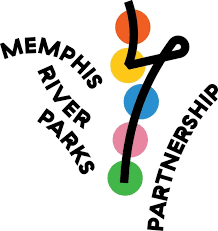 River Parks Partnership Logo
On an unrelated note, Memphis River Parks Partnership’s website suggests that someone has decided top tinker with its award-winning logo, removing the distinctive dots that acted as a “mini-map” of the riverfront’s five distinct districts along the RiverLine trail. It was a key part of the Partnership’s new brand and visual identity and projected a new and vibrant attitude for the riverfront. Without the “mini-map,” it’s just pedestrian.
It was designed by the nationally known Champions of Design (now Champions Design) and won a 2020 SEGD Merit Award. The firm has worked with Prospect Park Alliance, The New York Times the NBA, Girl Scouts of America, High Line, New York City Parks, National Geographic, Herman Miller, and more. The logo complemented the signage and with the award, it was recognized for helping to unify five miles of the riverfront, transitioning it from a series of disconnected parks into a cohesive experience.
If there’s been a decision to alter this award-winning, it is a poor reflection on decision-making at the Partnership (and that’s not even mentioning tree-cutting).




Interesting article. You don’t say if you made any attempt to contact River Parks Partnership to inquire about the tree that was removed.
I know more than I wrote.