
Smart City Memphis
 

Sign up or Login

Measuring Happiness in Cities

by SCM (RSS) | November 19th, 2012 3:10pm CDT

Tweet

From Hazel Borys, Better! Cities & Towns:

In most physical and policy planning, triple bottom line benchmarks focus on environment and economy, and tend to skim over the subject of society. That’s probably because urban design impacts are much easier to measure with respect to profit and planet than they are with respect to people.

Any good MBA professor preaches, “What gets measured gets done.” For several generations, we’ve been proving that point with our relentless focus on measuring our collective success via a host of global economic indicators. Since An Inconvenient Truth, environmental factors have joined the economic mainstream as well, sparking a whole new breed of Eco Warriors.

Now, we’re starting to get our arms around some of the bigger public health issues connecting society with the built environment, particularly on the obesity, diabetes and depression fronts. Proponents of gross national happiness to augment gross national product would like to see our society focused on conserving instead of consuming and connectivity instead of distrust.

Still, how do we measure national happiness, well-being, and social capital as they relate to the way we plan our neighbourhoods, towns and cities?

One avenue is the Legatum Prosperity Index. “Wealth alone does not make for a happy and successful society. Happy citizens are produced as much by democracy, freedom, and entrepreneurial opportunity as they are by a growing economy.” Of note, this index tracks social capital as well, starting to value people’s connections and the higher levels of trust that result from frequent interactions.

“Our gross national product, if we should judge America by that, counts [..] the loss of our natural wonder in chaotic sprawl. It measures everything except that which makes life worthwhile.” - Robert Kennedy, 1968

The Gallup-Healthways Well-Being Index tracks life evaluation, physical health, emotional health, healthy behavior, work environment, and basic access. Once our basic needs are provided for, increased wealth does not increase our happiness appreciably, nor does unemployment effect us as much as we might think. Instead, happiness is due to our sense of belonging, and not our income, confirmed by John Helliwell, professor of economics at the University of British Columbia. Public spaces that bring people together in congenial activity produce happier citizens than those – like traffic jams – that spur animosity and aggression, Professor Helliwell says.

Critical mass bikeride in Vancouver. Credit: Flickr ItzaFineDay.

Still, neither of these indices correlate urbanism to happiness. But the City of Vancouver is starting to. As one of the world’s most livable cities, Vancouver has asked itself what more it can do to provide for physical, social, emotional, and spiritual needs. In doing so, it’s added spirit to the other pillars of a healthy community: complete community (land use, density); healthy mobility (transit); healthy buildings (zero carbon); thriving landscapes (open space); green infrastructure (water, sewers, storm); healthy food systems (organic agriculture, nutrition); healthy community (facilities, programs); and healthy abundance (sustainable economic development).

Advancing the idea of ”spiritual urbanism,” Vancouver’s Healing Cities finds inspiration in the human body’s ability to rebuild, repair and regenerate, and asks what it takes for our cities to heal themselves, and in turn heal us. Oxytocin, the trust hormone, goes up with eye contact. We get a whole lot more of it while walking. Which is just the beginning of balm to the spirit fostered in walkable neighbourhoods.

And it’s interesting how some things go full circle, with a healthy society making for a healthy economy. ‎60% of East Coast developers say, “to stay competitive, they are shifting away from bigger traditional home designs to conservative pedestrian-oriented mixed-use neighbourhoods.” People get more enduring happiness from experiences in their neighbourhood than possessions in their home.

On the other end of the spectrum, what makes people the most unhappy? Not work, but commuting to work.
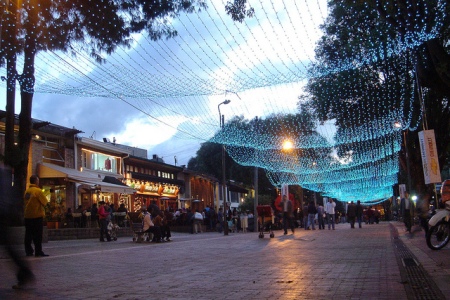
The pink zone in Bogata. Credit: Flickr Jorge Lascar

Just as Vancouver is a shining example to the developed world, Bogota’s urban happiness movement is an urban innovator of the developing world, led by former Mayor Enrique Peñalosa. “There are a few things we can agree on about happiness,” he says. “You need to fulfill your potential as a human being. You need to walk. You need to be with other people. Most of all, you need to not feel inferior.” A key to equality is providing dignified, functional transportation, which Bogota has done with a powerful version of bus rapid transit as well as extensive bike and pedestrian networks.

“When you talk about these things, designing a city can be a very powerful means to generate happiness,” Peñalosa says. By linking urban design to the economics of happiness, Bogotans have become happier. The murder rate has continued to fall, along with the number of traffic deaths. Traffic moves three times faster now during rush hour. And the changes transformed how people feel.
“A good city is like a good party – people stay much longer than really necessary because they are enjoying themselves,” per Jan Gehl, author of a City for People, and leader of Copenhagen’s transformation to a bikeable, walkable city. Gehl encourages urban design from the perspective of the five senses, taken at walking speed. This eye-level approach does much to address the needs — and the happiness — of the individual.

So I still don’t have an Urban Happiness Index. But I think it’s coming soon, to a street near you.

Hazel Borys is principal and managing director of Placemakers, a planning, coding, marketing, and implementation firm. This article originally appeared on PlaceShakers and NewsMakers. 

Categories: Planning and Urban Design

Comments RSS Feed

Comments are closed.

Green Tea, A Bill Day Cartoon

by Bill Day. Memphian Bill Day is two-time winner of the RFK Journalism Award in Cartooning. His cartoons are syndicated internationally by Cagle Cartoons. Cartoons Archive →

Photograph by Amie Vanderford

More Images

This ongoing series of photographs is intended to show the daily lives of these single mothers in order to invoke recognition of their similarities to all mothers, along with understanding and empathy from the viewer of the strengths that these single mothers possess within the challenging situations they face. My hope is that newfound empathy with these mothers’ lives will give people some pause before they condemn single mothers when discussing issues such as welfare and other politically charged hot buttons.

  • Subscribe to Posts via Email

    You can get Smart City Memphis posts right in your e-mail box. Just sign up below to begin receiving them.


  • RSS

    • Friday Fun: A Los Angeles cycling highway?

    • All aboard: Engaging the public on transport projects

    • Weaving people back into the urban fabric

    • How clean is the air we breathe in cities?

    • Friday Fun: Self-driving automobile + Bus + Taxi = Otobuxi

    • Q&A with Hernan Navarro: Lima’s El Metropolitano BRT

  • RSS

    • San Francisco’s Uber-Complicated Taxi Industry

    • New Ventilation System Keeps Buildings Fresh But Warm

    • Eight Guidelines to Keep Creativity at the Heart of Cities

    • Infographic: Cities Embracing the Green Revolution

    • The Economic and Educational Value of Retrofitting Schools

    • Greening Cities with Better Bike Lanes

  • RSS

    • Why You May Not Be Seeing Many 17-Year Brood II Cicadas

    • Replica of the Day: Building the Simpsons' Springfield in Florida

    • Toronto Mayor Rob Ford: 'I Do Not Use Crack Cocaine'

    • Flags for the Fallen

    • This Is What the Scar From a Tornado Looks Like Through a Suburban Town

    • How Waze Became the Hottest Map App Around

  • Search Posts

  • About Smart City Memphis

    This is Smart City Consulting's blog and its purpose is to connect the dots and provide perspective on events, issues, and policies shaping Memphis and its future. Smart City Memphis was named one of the most intriguing blogs in the U.S. by the Pew Partnership for Civic Change, it was voted the best Memphis blog in About.com's Reader's Choice Awards, and The (Memphis) Commercial Appeal wrote: "Smart City Memphis provides some of the most well-thought-out thinking about Memphis' past, present, and future you'll find anywhere." Our blog's editor is Tom Jones, principal at Smart City Consulting and an editorial contributor at Memphis magazine, where he writes the monthly column, City Journal. Submit blog posts, ideas, suggestions, and emails to tjones@smartcityconsulting.com.
  • Archives

    • May 2013 (24)
    • April 2013 (34)
    • March 2013 (27)
    • February 2013 (31)
    • January 2013 (30)
    • December 2012 (29)
    • November 2012 (31)
    • October 2012 (33)
    • September 2012 (29)
    • August 2012 (33)
    • July 2012 (26)
    • June 2012 (33)
    • May 2012 (33)
    • April 2012 (31)
    • March 2012 (37)
    • February 2012 (32)
    • January 2012 (35)
    • December 2011 (29)
    • November 2011 (30)
    • October 2011 (34)
    • September 2011 (33)
    • August 2011 (39)
    • July 2011 (36)
    • June 2011 (41)
    • May 2011 (36)
    • April 2011 (57)
    • March 2011 (39)
    • February 2011 (45)
    • January 2011 (56)
    • December 2010 (44)
    • November 2010 (30)
    • October 2010 (28)
    • September 2010 (24)
    • August 2010 (22)
    • July 2010 (23)
    • June 2010 (34)
    • May 2010 (28)
    • April 2010 (32)
    • March 2010 (35)
    • February 2010 (31)
    • January 2010 (43)
    • December 2009 (49)
    • November 2009 (17)
    • October 2009 (24)
    • September 2009 (23)
    • August 2009 (18)
    • July 2009 (22)
    • June 2009 (28)
    • May 2009 (23)
    • April 2009 (23)
    • March 2009 (26)
    • February 2009 (25)
    • January 2009 (36)
    • December 2008 (15)
    • November 2008 (22)
    • October 2008 (21)
    • September 2008 (25)
    • August 2008 (23)
    • July 2008 (32)
    • June 2008 (27)
    • May 2008 (35)
    • April 2008 (26)
    • March 2008 (25)
    • February 2008 (29)
    • January 2008 (33)
    • December 2007 (20)
    • November 2007 (19)
    • October 2007 (32)
    • September 2007 (25)
    • August 2007 (25)
    • July 2007 (26)
    • June 2007 (16)
    • May 2007 (21)
    • April 2007 (25)
    • March 2007 (18)
    • February 2007 (16)
    • January 2007 (17)
    • December 2006 (16)
    • November 2006 (14)
    • October 2006 (18)
    • September 2006 (21)
    • August 2006 (20)
    • July 2006 (20)
    • June 2006 (17)
    • May 2006 (12)
    • April 2006 (19)
    • March 2006 (20)
    • February 2006 (23)
    • January 2006 (16)
    • December 2005 (23)
    • November 2005 (21)
    • October 2005 (23)
    • September 2005 (19)
    • August 2005 (27)
    • July 2005 (23)
    • June 2005 (16)
    • 0 (2)
  • Categories

  • Contributors

    • Aaron Shafer
    • Andrew Trippel
    • Anthony Siracusa
    • Barry Chase
    • Brad Leon
    • Brian Stephens
    • CEOs for Cities
    • Charles Santo
    • Chris Sanders
    • Crosstown Collaborative
    • David Williams
    • Doug Imig
    • Elizabeth Alley
    • Elizabeth Lemmonds
    • Emily Trenholm
    • Eric Mathews
    • Gene Pearson
    • Gene Pearson and Louise Mercuro
    • George Lord
    • Greg Thompson
    • Gwyn Fisher
    • Janet Boscarino
    • Jim Strickland
    • Jimmie Covington
    • John Kirkscey
    • John Lawrence
    • Jonathan Flynt
    • Josh Whitehead
    • Julie Ellis
    • Kenya Bradshaw
    • Laura Adams
    • Leah Wells
    • Louise Mercuro, AICP
    • Lurene Cachola Kelley
    • Margot McNeeley
    • Mark James
    • Matt Farr
    • Matt Timberlake
    • Melissa Petersen
    • Natashia Gregoire
    • Ray Brown
    • Rev. Steve Montgomery
    • Robert Bain
    • SCM
    • Scott L. Newstok
    • Smart City Memphis
    • Smart City Radio
    • Steve Bares
    • Steve Lockwood
    • Susan Adler Thorp
    • Tom Jones
    • Tomeka Hart
    • Tommy Pacello
    • Women Unite
    • Zach Hoyt

© 20111-2013 Smart City Memphis. All rights reserved.

  • Register
  • Log in
  • RSS
  • Smart City Radio
  • Smart City Consulting