
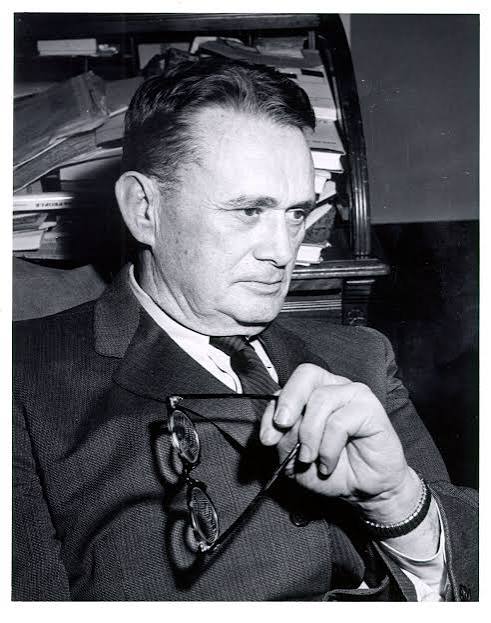
When I was a boy, I spent many summers with my aunt in Atlanta. She lived in Buckhead, just up the street from an editorial writer for the Atlanta Constitution when Ralph McGill was editor.
Each summer, it made me pay attention to the courageous editorials published in that newspaper and to conclude that Ralph McGill was the greatest newspaper editor of my lifetime. It’s an opinion that has never changed.
It was a time when Atlanta seemed to be stuck in the Civil War (every summer I had an obligatory visit mandated by my “old Atlanta” uncle to visit the Cyclorama, the 360-degree cylindrical painted panoramic of the Battle of the Atlanta that was of course sympathetic to the Confederacy). It led me once to suggest to my aunt that my uncle was going to have a heart attack when he learned his side lost the Civil War.
In those days in the 1950s and 1960s, it was little wonder that Mr. McGill’s editorials opposing segregation and supporting student nonviolent protesters produced death threats, intimidation, and crosses burned on his lawn.
The ultimate tribute to his fearlessness is that Dr. Martin Luther King Jr. name checked him in his 1963 “Letter from Birmingham Jail.” Mr. McGill was mentioned in the passage: “some of our white brothers in the South have grasped the meaning of this social revolution and committed themselves to it. They are still all too few in quantity but they are big in quality.”
The Role of Editorials
Mr. McGill was rightfully called the “Conscience of the South.” He won a Pulitzer Price for editorial writing in 1959 and a Presidential Medal of Freedom in 1964. He inspired a new tenor in the leadership of Atlanta, leading to the election of moderate mayors, one of which in 1961 coined the city’s famous motto, “the city too busy to hate.”
The power of his journalism fortified my early decision to be a newspaper reporter with the ultimate hope of someday writing editorials. He inspired me with proof that the right kind of editorials at the right time in a city’s life can be transformative.
The lesson from his example: editorials aren’t just the fulfillment of good journalism. They are in fact the fulfillment of newspapers’ civic responsibility.
Because of this background, I have despaired as daily newspapers abandoned editorials and their role in helping a city reach its best version of itself.
Today, too many newspapers, including both of our dailies, think that publishing columns by various citizens is the same as relevant editorial positions. They aren’t.
There was a time when the editorial page of a newspaper was one of the most important places in a city.
It was where a newspaper told readers what it thought mattered. It was where complicated issues were explained, public officials were challenged, conventional wisdom was questioned and, perhaps most importantly, the future of the community was debated.
The editorial page was not supposed to make everybody happy. It was supposed to make people think.
Memphis especially needs that kind of editorial page again.
Calling the Daily Memphian
The Daily Memphian has hired a new CEO, the well-liked Pierre Landaich, and his predecessor Eric Barnes will become editor-at-large whose duties are said to include broadening the news site’s opinion section.
Here’s hoping that means the Daily Memphian will create an actual editorial page in which the newspaper expresses a point of view that helps set the priorities for Memphis. Not editorials that are merely cheerleading, but editorials that shed a parochial perspective.
After all, the newspaper is wholly dependent on the local market, which raises the question of what is it doing to shape the future and when is it willing to challenge the conventional wisdom that allows a select, elite few to make decisions for the city.
These are editorials that map out the questions and opportunities that confront us – the challenges of being a majority Black city and county, the challenges of widening the circle to involve young leaders into the rooms where decisions are being made, and more. An effective editorial page informs where we go as a city, not just how we get to heaven and it has the courage to point our community to a better future.
Editorials are not merely the opinion of one person. They are the thoughtful, institutional consensus opinion of an editorial board, usually the editor in charge of editorials, the editor, the news editor, and a beat reporter for the subject of the editorial.
Points of View
Editorial boards have a point of view which the editorial themselves reflect.
The Atlanta Journal-Constitution’s editorial board has an exemplary one:
“This board will continue staking out positions aimed at making our community, state and national livable, fair and inclusive, where opportunities are available to all and the promise of equal justice is delivered. We remain fearless and fierce advocates of transparent and ethical government, safe communities, strong schools and vibrant economy. We will lead the charge in protecting our natural resources and unfailingly advocate for the protection of voting rights and accurate elections. Atlanta and Georgia’s ambitions require truth-telling, expertise, reasoned debate, accountability and good-faith compromise. This board is committed to providing a forum for this work.”
If there’s any hope for a “real” editorial page, it rests with the Daily Memphian. After all, Gannett newspapers, which owns and operates The Commercial Appeal, led the way in eliminating local editorials from its more than 300 newspapers several years ago.
Gannett argued that it made the decisions because editorials were among its least-read articles. It’s a damn poor reason to end editorials. While it was said at The Commercial Appeal that only 15% of people who bought the paper read the editorials, that was a poor measure of its impact. Policymakers, elected officials, and civic leaders read them and they shape civic conversations. Gannett has said that it instead sees its role as convening conversations, but when was the last time you’ve seen that happen here?
Never Needed More
Memphis does not suffer from a shortage of news. Every day brings stories about crime, government, schools, economic development, neighborhoods, downtown, politics, and people trying to make the city better.
But news and civic leadership are not the same thing. News tells us what happened. An editorial page should help us understand what it means – and what should happen next. That distinction is especially important for Memphis because the city is confronting challenges that cannot be solved one announcement, one development, or one election at a time.
Population loss. Persistent poverty. Economic underperformance. Public education. Neighborhood disinvestment. Downtown’s future. The condition of the city’s infrastructure. The relationship between Memphis and Shelby County. The city’s ability to attract and retain young people.
These are not isolated problems. They are pieces of the same question: What kind of city does Memphis want to become?
That is a question worthy of an editorial page. The Daily Memphian has an opportunity to define a new kind of editorial leadership.
Civic Responsibility
The Daily Memphian was created in an era when the traditional newspaper business was already under enormous pressure. Its existence itself reflects a belief that Memphis needs strong local journalism.
That creates an opportunity.
The Daily Memphian does not have to recreate the editorial page of the past. It can create the editorial page of the future.
It can use its digital platform to make editorial leadership more dynamic, more interactive, and more deeply connected to the community. It can develop a sustained editorial agenda rather than simply reacting to the day’s events. It could identify five or six issues that will determine Memphis’ future and make them recurring subjects of editorial attention.
Imagine the newspaper making population growth – or stopping population loss – a central editorial concern. Imagine a continuing editorial examination of what Memphis must do to become a city where more children grow up out of poverty. Imagine a sustained argument about what downtown should become, not simply whether the latest development is good or bad.
That would be journalism with a civic purpose. Calling for stronger editorial pages is not calling for boosterism. Memphis does not need its newspapers to tell everyone that everything is wonderful.
Rather, a newspaper’s civic responsibility includes telling uncomfortable truths.
Asking and Answering the Important Questions
The editorial page exists to provide context and make arguments.
It should be willing to say that Memphis needs a different economic strategy. It should be willing to argue that population loss deserves the same urgency as any other major civic crisis. It should be willing to demand greater accountability from government. It should be willing to challenge business leaders, philanthropists, nonprofit organizations and civic institutions when they fall short.
And it should be willing to support bold ideas. That does not mean the newspaper’s position is always right. It means the newspaper is willing to put a stake in the ground and what it sees as the city’s values and priorities.
Does this policy help reduce poverty? Does it help attract and retain people? Does it strengthen neighborhoods? Does it create economic opportunity? Does it make Memphis more competitive? Does it improve the quality of life? Does it move the city toward a bright, successful future?
Answering these kinds of questions in well thought out, persuasive, and influential editorials is an aspirational goal that the Daily Memphian should seize.
As the famous Kansas publisher William Allen White, the sage of Emporia, said: “The editorial is the soul of the newspaper. Maybe the heart and the soul. And on a good newspaper that knows and understands and loves its hometown, or its home country, the editorial is the heart of the town, or nation, as well.”
Memphis needs that heart and soul.
***
Join us at the Smart City Memphis Facebook page and on Instagram where these blog posts are published along with occasional articles, reports, and commentaries that are relevant to Memphis.



Hear, hear!
As one who sat on The Commercial Appeal’s editorial board for many years, I echo your call for an editorial ‘page’. The Daily Memphian started 8 years ago this month and did so without an editorial position then, and has shown no interest in creating one. An editorial page/board takes a lot of time to study the issues, interview candidates, et al, before publishing opinions. I doubt The DM has the appetite and resources to do that. They rely on the opinions of people in the community to offer personal editorial positions in the form of guest columns. Maybe the new owners of The Flyer will offer an editorial page. We can only hope.
they fired dan conaway for his opinion a year ago. and it turns out he was right.