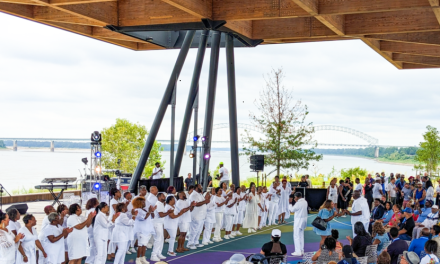
Much of what makes Memphis unique are intangible – its rhythm, vibe, culture.
Then, there are the uniquely tangible: St. Jude Children’s Research Hospital, five miles of parks on the Mississippi River that look across to a sea of green, the large urban park at Shelby Farms Park that was once a prison, and an abundance of mythic music shrines.
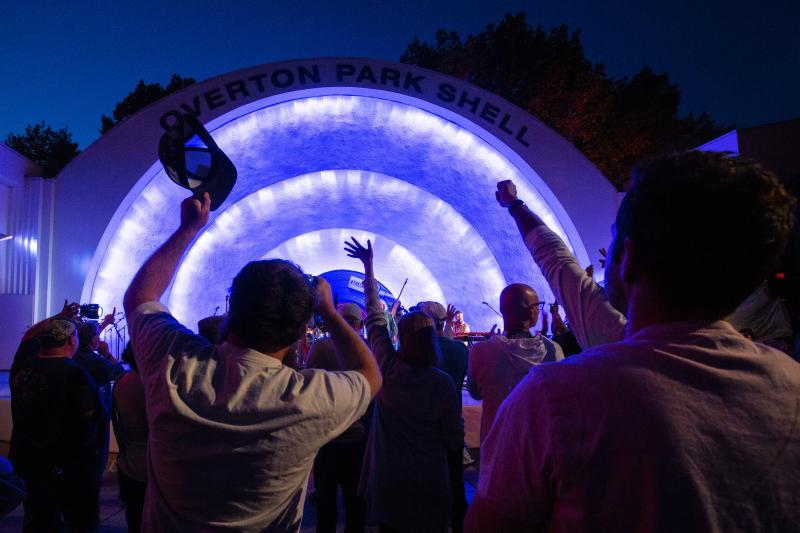
Often taken for granted is Overton Park Shell.
Similar concert venues were once plentiful across the United States, but today, ours almost stands alone as an active example of when they were important places where community was forged. “The Shell is the melting pot of the region as it uses performing arts to build community and access to the arts,” said executive director Natalie Wilson. “It is mission-powered space.”
It’s a role still performed in Overton Park, and the Shell will celebrate its 90th year in the midtown park Sept. 10-13.
It is a remarkable story – one of survival, resilience, readjustment, and service.
A Great Place
The Shell has been part of the city’s life since 1936. Built by the City of Memphis and the New Deal’s Works Progress Administration for $11,935, the Shell was designed by architect Max Furbringer and modeled on bandshells in Chicago, New York and St. Louis. Almost all of the 27 WPA bandshells are no longer standing.
But the Shell’s importance can’t be measured by its age or architecture.
Its real significance is that for nine decades it has been a place where Memphis comes together. Under the stars. On blankets and lawn chairs. With children running across the grass. With music coming from the stage and people who might otherwise never meet sitting next to one another.
The Shell is not simply an old building in Overton Park. It is one of Memphis’ great civic spaces.
It retains the spirit of Reimagining the Civic Commons and exudes the principles of creative placemaking. “We used the 19 months we were closed for COVID to develop a new chapter about how equity and inclusivity is the heart of every decision, our mission, and programming,” Ms. Wilson said.
Intertwined Stories
It is difficult to tell the story of Memphis music without telling the story of the Shell.
For 14 years after it was built, Memphis Open Air Theatre (MOAT) was home to orchestral performances, concerts by well-known vocal stars, light opera, and summer musicals. In 1954, a young Elvis Presley appeared there, opening for country star Slim Whitman. The performance is widely regarded by music historians as a pivotal moment in the emergence of rock ‘n’ roll. Johnny Cash would later join Elvis on stage.
That alone would make the Shell historically important.
But Elvis was only the beginning. Over the decades, performing on the stage were Johnny Cash, Carl Perkins, Roy Orbison, Wanda Jackson, Chet Atkins, Marty Robbins, Isaac Hayes, Furry Lewis, Rufus Thomas, Booker T. & the M.G.’s, Bonnie Raitt, Little Feat, Black Sabbath, Mavis Staples, Deep Purple, Bukka White, Big Star, Free World, Lucero, North Mississippi Allstars, Big Ass Truck, Mudboy and the Neutrons, Bo-Keys, Sensational Barnes Brothers, Cameron Bethany, and countless other artists.
In other words, some of the most important music in Memphis – and American – history was performed on a small stage in a Memphis park, and in doing it, the Shell didn’t merely reflect Memphis’ musical culture. It helped create it.
Perhaps the most remarkable thing about the Shell is the way it has repeatedly reflected the changing city around it. Music has always been Memphis’s connective tissue.
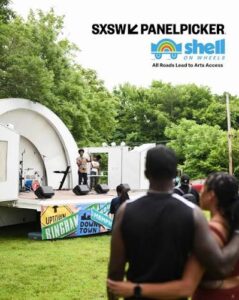
“The city has changed a lot,” said Ms. Wilson, so the Shell took to the streets with Shell on Wheels, a mobile venue half the size of the Shell itself. “The neighborhoods program it,” said Ms. Wilson. “We don’t try to tell them what to do. It is infrastructure for whatever they want and designed to brighten neighborhoods and be joyful.”
Pointing to the Future
The Shell’s survival was not inevitable. There were multiple times when the building deteriorated and faced threats of demolition, but it kept giving Memphis reasons to care.
The Shell entered an important chapter in 2005 when City of Memphis partnered with the Mortimer & Mimi Levitt Foundation to renovate it and create a nonprofit organization dedicated to presenting free concerts. The restored venue reopened in 2008. For 17 years, the venue was known as the Levitt Shell.
In 2022, it returned to its historic name: Overton Park Shell.
Its modern era has been highlighted by its commitment to a slate of free concerts and those will continue for most of its 90th anniversary celebration. The free concerts will be preceded on September 10 by a ticketed event for the incomparable and legendary Booker T. Jones.
But the most important part of the anniversary may be what happens after the celebration, and the Shell is already investing in its future. Ms. Wilson said groundbreaking will be held soon on the Terry Lynch Artist Lounge, a 2,000-square-foot facility designed to improve backstage experiences for performers and to be another source of revenue for the Shell. Completion is expected in spring 2027.
Satisfying A Need
There is a larger lesson for Memphis from the Shell, said Ms. Wilson, and it is that cities need places that bring people together, places that carry memory from one generation to the next, places where a child can hear a musician for the first time, where an old friend can be remembered, where strangers can sit together and discover that they have something in common.
Ninety years ago, the Shell was a new public works project in a city emerging from the Great Depression. Today, it is one of Memphis’ most recognizable cultural institutions.
Its history includes great Memphis performers, blues festivals and rock concerts, neighborhood musicians, and national stars. But more important is that it will continue to have tens of thousands of ordinary Memphians sit on its lawn, listen to music, and share a special evening together.
And looking toward that future may be its most important encore of all.
**
Commercial Appeal’s Bob Mehr reports that highlights from the celebration include:
- The Birthday Picnic on Sept. 11: A midday celebration of the Shell with cake, local food trucks and live music
- Sounds of the Shell on Sept. 12: 9 Decades of Delight concert presented by local author, label owner and Memphis music historian David Less
- The Gathering: Lifted By Love, Guided By Sound on Sept. 13: a concert presented by Ephie Johnson, Garry Goin, Gina Neely and Princeton James Productions
- Connecting Cables on Sept. 13: The Memphis Studio Superset celebrating Stax Records, Sun Records, American Recording Studio, Royal Studios, UNAPOLOGETIC and Sam Phillips Studio —produced by local artist Mark Edgar Stuart