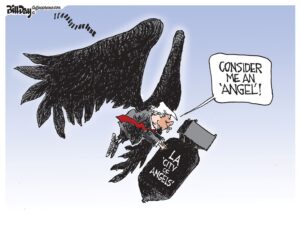
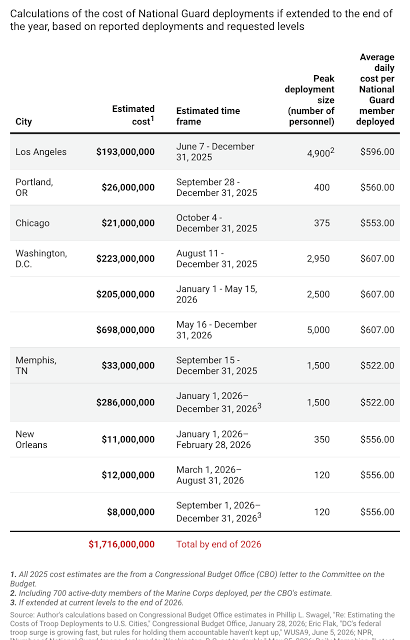
By the end of this year, the deployment of the National Guard to stroll around Memphis will have cost $319 million and resulted in a negligible impact on crime.
When President Trump deployed the National Guard, he called Memphis “deeply troubled” and claimed only he could “save” the “blue” city, labeling all Democratic-led cities “filthy, dirty…and their streets are dirty and their streets smell. Their storefronts are broken. Their trees are all gross.”
And yet, by October 20, 2025, the day of the National Guard deployment, Memphis had already achieved a 25-year low in crime as part of a broader national downward crime trend for major U.S. cities.
Recent research shows that by the end of this year, $1.76 billion will have been paid by taxpayers for the National Guard deployments in American cities and do not achieve the promised results of lowering violent crime.
The Center for American Progress’s meticulous analysis of cities where the National Guard was deployed said flatly:
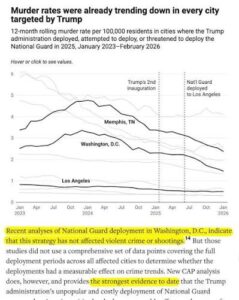
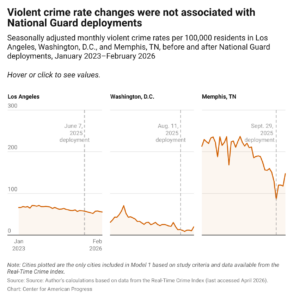
“This analysis found no statistically significant crime-reducing effect of National Guard deployment on the level or trend of seasonally adjusted weekly homicide rates across the sample. In other words, after controlling for both seasonality and city-specific trends in variance, this model estimated that none of the declines in weekly homicides reported in Washington, D.C.; Memphis; and Los Angeles could be attributed to the deployment of the National Guard.”
The National Drop in Crime
Unsurprisingly, the response by Trump to the report by the progressive group was to threaten a lawsuit for defamation. “It was the latest example of President Trump’s bid to use the legal system against those who voice unflattering facts and opinions generally protected by the First Amendment,” wrote Washington Post.
Also unsurprisingly, the president offered no rebuttal analysis or data to back his use of the National Guard to patrol American cities. In fact, nearly two-thirds of the record-breaking drop in the national murder rate from a 2021 peak happened before Trump reentered the White House.
In Washington, D.C., the National Guard was involved in only 1.3% of arrests, and some Memphis Police Department officials say that may be generous when it comes to their city.
The cost of the National Guard deployment to Memphis of 1,500 troops to the end of this year is $319 million, the equivalent of the annual salary of 4,270 Memphis police officers. MPD had 2,018 officers at the end of 2025.
Memphis was not alone in its drop in crime. It came later than the national drop, which is characteristic of the way Memphis lags national trends generally.
Trump’s Department of Justice is heavy on optics rather than results, because the keys to many American cities’ crime reduction are about innovative community violence intervention programs, reducing recidivism, and prevention of youth crime. Six months before Trump deployed federal forces to Memphis, he terminated $500 million in federal grants aimed at improving policing, prosecuting criminals, and protecting children.
Memphis’s Crime Trend Lines
The analysis by this blog of Memphis crime statistics from 2023 to this year indicate that the Center for American Progressive conclusions are correct. Placing the violent crime rate on a trend line, it shows drastic decreases from 1,357.1 per 100,000 population in 2023, 1,294.8 in 2024, and 1,089.3 in 2025. If the decline continued at the rate established in those years, the violent crime rate this year should be about 789.0 per 100,000 population. It is 746.4, an undramatic difference.
Meanwhile, homicides in Memphis have followed a pronounced downward trend line since peaking in 2023. After reaching a record high of roughly 349 murders in Memphis in 2023, the number dropped to 297 murders in 2024 and further declined to 184 by the end of 2025 – making a roughly 53% cumulative drop.
Mid-year 2026 reports show 66 murders compared to 120 at the same time in 2025. If the current trend continues, Memphis will have the lowest murder rate since 2011 – 11.8 per 100,000 population this year compared to 8.2 per 100,000 back then.
If the downward trend in murders continued at same rate in 2025, it would have resulted in a rate of 21.0 per 100,000 population. It was 20. If the decline continues at the same rate for 2026, it should be 16.7 per 100,000 population.
Police officials point out that National Guard personnel primarily provide logistical and operational support rather than conducting direct traffic stops, patrols, or arrests, meaning enforcement driving the crime numbers largely falls on the Memphis Police Department and enforcement agencies – Tennessee Highway Patrol, FBI, and U.S. Marshals – that were collaborating with MPD before deployment of the National Guard.
Bragging Rights for Police Chief and Mayor
Memphis Police Chief C. J. Davis – whose job was threatened when a hostile Memphis City Council delayed her appointment following the election of Paul Young – has proven that success is the best revenge.
It also gives Mayor Young bragging rights after the Council voted 7-6 to recommend against reappointing her January 9, 2024. She had been in the job since 2021 when named by former Mayor Jim Strickland. Ultimately, she was named interim police chief and Mr. Young said she would not be appointed unless she produced the results he wanted to see. She was later confirmed as permanent chief by the City Council on January 21, 2025.
The results Mayor Young was looking for have been delivered. Despite the national ignominy from the murder by police of Tyre Nichols and her tardiness in including the City Council ban of pre-textual traffic stops in MPD policy, all of the problems have faded away as a result of the historic decline in crime. Chief Davis also claims an 85% homicide clearance rate although in 2025, it was 43.4%, according to Murder Accountability Project, suggesting the higher clearance rate for 2026 is a result of the fewer murders.
After analyzing 11 cities, including Memphis, where the National Guard was deployed to reduce crime, the Center for American Progress (CAP) wrote: “The second Trump administration is trying to take credit for the historic drop in violent crime across America despite the fact that this trend began before it took office, and it is using these declines to justify expanding policies that are unpopular, ineffective, and costly.
“Even though the data clearly show that violent crime and homicides were already dropping in American cities in 2023 and 2024, the Trump administration has continued to threaten city and state leaders and argue that its extreme actions, such as deploying the National Guard to support law enforcement operations, are improving public safety.”
“These recent violent crime trends, predating even Trump’s second inauguration, suggest that, more than likely, violent crime would have continued trending downward in these cities by the end of 2025, regardless of any additional interventions. However, the Trump administration has ignored this fact when reporting year-over-year crime statistics to claim these extreme tactics have made Americans safer.”
The Methodology
In explaining its methodology, CAP wrote that it “conducted a three-stage interrupted time-series analysis using citywide homicide, violent crime, and gun victimization data. This approach was employed to identify any statistical changes in crime trends associated with the deployment of the National Guard in specific cities. Interrupted time-series analysis estimates the impact of a particular intervention on a treated group by comparing trends before and after the intervention takes place. This method enables analysts to determine whether a change in the post-intervention trend is attributable to the intervention itself or is more likely a continuation of the pre-intervention trend. For the purpose of this study, the intervention of interest is the deployment of the National Guard, the cities where the National Guard was deployed constitute the “treated” group, and the three outcomes of interest—violent crime rates, homicide rates, and gun victimization rates, are each analyzed in a separate stage.
“To ensure that the conclusions of this study are as robust as possible, the researchers conducted the analysis in three stages, using multiple datasets, varied observational windows, and multiple crime measures. The national infrastructure for crime data, particularly regarding gun violence, remains insufficient for analyzing near-real-time trends. To address those limitations, this analysis incorporated all available measures across multiple sources to minimize bias from any single reporting mechanism. Furthermore, the researchers controlled for citywide and seasonal trends before and after National Guard deployments, using both monthly and weekly aggregate data to test for result sensitivity. In the third and final stage of this analysis, the researchers used an approximate control group of cities to facilitate comparative analysis against a plausible counterfactual group.
“CAP’s analysis indicates that the deployment of the National Guard had no measurable effect on violent crime trends. By restricting the variables in each model and focusing only on deployment status and violent crime trend data, the researchers structured the analysis to be biased toward finding evidence of a statistically significant result, if one existed. This approach also accounts for potential influences from other federal law enforcement operations in these cities. Although this analysis primarily examines National Guard deployments, the coinciding operations of federal immigration enforcement strengthen the conclusion that there is no evidence that any of these extreme tactics have meaningfully improved public safety by reducing violent crime in the United States.”
***
Join us at the Smart City Memphis Facebook page and on Instagram where these blog posts are published along with occasional articles, reports, and commentaries that are relevant to Memphis.