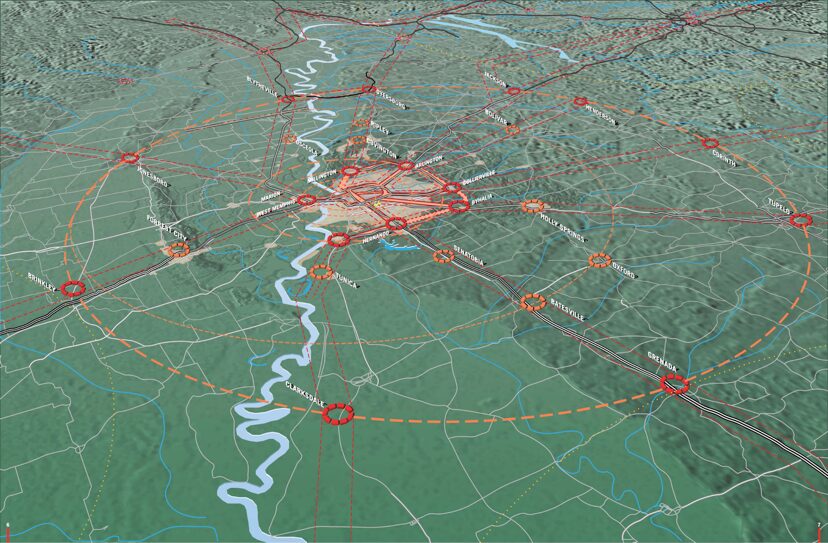
The December 1, 2025, Smart City Memphis blog post offered a historical context for the multiple efforts at regionalism that have taken place here – at least three since 2001. That said, there’s reason to be optimistic that the current attempt in regional problem-solving and priority-setting can succeed. The current process is organized and managed by the MidSouth Development District chaired by Germantown Mayor Mike Palazzola and executive director is Anna McQuiston.
Most encouraging of all is that the process is not being driven by the usual suspects but instead has many new faces from around the region and good representation of young leaders.
December 1, 2025: Another Regionalism Process Offers Renewed Hope
As previously pointed out here, the challenges facing our region are no respecters of borders and boundaries. There are not Memphis’ problems, or Bartlett’s problems, or Southaven’s problems. There are only OUR problems and key data underscore the fact that we have no margin for error.
Just one data point, the reliance on federal transfer payments indicate a significant shift in communities’ reliance on income from the federal government in the form of federal transfer payments. It’s another regional data point that indicates the need for serious discussions and shared plans of action. It also is suggestive of a fragile economy that requires this comprehensive and data-driven approach.
December 4, 2025: Our Regional Reliance on Federal Transfer Payments
The MDD process is built around roundtables focusing on key regional issues and reaching consensus on moving ahead.
In setting up the roundtables, MDD issued a mandate for action: “The MidSouth Region is at a tipping point. For years we have seen our population decline while the rest of the southeast is growing. Growing communities have one thing in common: Jobs. And in our region, we have the potential in the next 10 years to see the most rapid job growth in our history. MDD’s Regional Employment Forecast (released in late 2025) demonstrated three levels of potential job growth: Status Quo (30,000 jobs); Moderate (70,000 jobs) and High Growth (100,000 jobs).
“The difference between these goals is whether we build up the MidSouth to attract the higher levels of jobs through increased workforce training, more housing, transportation solutions and resilient utility infrastructure. To accomplish this goal, we must work together as a regional team and focus on making it easier to implement the solutions.
“The day is divided into four sessions. Each session focuses on a key issue shaping the Mid-South (workforce development, housing, transportation, and utility infrastructure), offering participants the chance to dive into the topics they care about most while benefiting from being part of a larger, interconnected network of leaders.
“By hosting these conversations side-by-side over the course of a single day, the Roundtable aims to:
-
Identify the data needed to make informed decision in the focus areas.
-
Build cross-sector relationships and networks
-
Increase accountability toward region-wide goals
-
Lay the groundwork for coordinated federal funding efforts
-
Create opportunities for insights to flow across topic areas
This Can’t Be Echoes of the Past
Yes, we’ve heard processes that sound a lot like this in the past, but as MDD says, the stakes have never been higher and the broad involvement of regional leaders offers the Memphis region its best odds for the future. The first of MDD’s quarterly roundtables was held January 8 and the minutes indicate the potential of this approach.
Here’s the shortened version of the minutes:
Over 90 regional leaders gathered for the first MidSouth Development District (MDD) Quarterly Roundtable to strengthen collaboration in four critical areas. With the region facing population decline, but also the potential for 100,000 new jobs in the next decade, the participants identified regional strategies to prepare for future growth. Below are key recommendations for future work.
1. Transportation
• Build a Regional Transportation Data Hub – A shared dashboard integrating freight, transit, and traffic data to identify unmet needs and guide investments.
• Align Regional Transportation Coalitions – Map existing groups, reduce duplication, research national best practices, and unify advocacy for funding.
2. Workforce Development
• Launch a Regional Workforce Coalition -Create an organized framework to unite education, workforce boards, employers, and nonprofits under a shared strategy.
• Conduct a Regional Skills Gap Analysis – Use data to match training programs to employer needs and strengthen career pathways.
• Address Childcare & Transportation Barriers -Coordinate cross-sector solutions to remove the region’s top barriers to workforce participation.
3. Housing
• Develop a Regional Housing Market Analysis – Quantify unit type and affordability needs, and map areas suitable for development to accommodate growth forecasts.
• Streamline Housing Regulations through Regional Forums – Bring planners, developers, and advocates together to reduce regulatory barriers for housing and align codes across jurisdictions.
4. Utility Infrastructure
• Create a Regional Utility Infrastructure Map – Integrate utility data into open source GIS to better coordinate growth planning and upgrades.
• Explore Regional Wastewater Solutions – Evaluate cost-sharing models and governance structures to improve resilience and unlock development potential.
This first roundtable demonstrated strong commitment to regional problem solving and shared advocacy. Continuing this work will help the MidSouth compete for major funding, prepare for job growth, and ultimately enhance the quality of life in the region.
Attendees:
Ken Adams – Olive Branch
Mairi Albertson – City of Memphis
Zachary Amos – Habitat for Humanity of Greater Memphis
Venard Asongayi – City of Olive Branch, MS
Kyle Atkins – MLGW
Charles Baker – Southwest Tennessee Community College
Valencia Baymon – Routes & Jobs
Sherry Bennard – City of Munford
Emmanuel Bosompem Boadi – The University of Memphis
Antwane Bohanon – U.S. Senator Marsha Blackburn
Sandy Bromley – Shelby County Division of Community Services
Rogean Cadieux-Smith – LRK Inc.
Erin Campbell – City of Bartlett
Steve Childress – City of Munford
Dwayne Cole – City of Munford
Meredy Dahlgren – LRK
Fred DeMagistris – MLGW
Vivian Ekstrom – Memphis and Shelby County Community Redevelopment Agency
Gwyn Fisher – Greater Memphis Chamber
Lessie Fisher – City of Covington
Craig Fitzhugh – City of Ripley
Jason Fleming – City of Covington
Jonathan Flynt – LRK Inc.
Maureen Fraser – Town of Collierville
Mary Freeman – Baptist Memorial Health Care
Bill Ganus – Dragonfly Studio // November 6 Investments
Angie Garvey – Pinnacle Financial Partners
Josh Gettys – Slingshot
Donnie Gladney – Routes And Jobs
Molly Glass – Covington Parks and Recreation
Sarah Goralewski – City of Germantown
Emily Harrell – City of Lakeland
Jan Hensley – City of Covington
Brent Hooks – Cornerstone Engineering
Megan Hoover – LRK
Sarah Houston – Protect Our Aquifer
Sondra Howell – Greater Memphis Chamber
Charia Jackson – CRA Memphis
Patrick Jaynes – USDA Rural Development
Eugene Johnson – Tennessee Valley Authority
Jennifer Johnson Allen – City of Germantown
Vijay Kalaga – Bank of America
Melissa Kandel – OrthoSouth
Rebecca Kaufman – AgLaunch
Andrew Kiepe – City of Memphis
Kate Lareau – Moore Tech
John Lawrence – MLGW
Katy Leopard – Asset Funders Network
Nidia Logan-Robinson – Shelby County Government
Jessica Lotz – Innovate Memphis
Paul Luker – City of Lakeland
Leigh Mansberg – Junior Achievement
Shawn Massey – TSCG
Carolyn McCormick – United Way of the Mid-South
Jordan McKenzie – Memphis and Shelby County Community Redevelopment Agency
Jackson McNeil – Innovate Memphis
Averell Mondie – CRA Memphis
Jared Myers – City of Bartlett
Ronnie Neil – City of Sommerville
Cliff Norville – Shelby County Government
Marshall Ogier – Seeding Success
Ashley Owens – TDOT
Mike Palazzolo – City of Germantown
Dan Pallme – TDOT
David Parsons – City of Bartlett
Megan Pope – City of Munford
Nicholas Pulido – City of Lakeland
Brett Ragsdale – Memphis and Shelby County Division of Planning and Development
Rosemary Rosemary – Greater Memphis Chamber
Cameron Ross – City of Germantown
Amy Schaftlein – United Housing
Amy Shead – Southwest Tennessee Community College
Abby Sheridan – Memphis Housing Lab
Anna Snickenberger – The Collective Blueprint
Logan Stafford – Office of Rep. Kustoff
Rachel Starks – Seeding Success
Blake Swaggart – TNECD
Esther Sykes-Wood – Shelby County Land Bank
Rhea Taylor – Fayette County, Tennessee Government
Aron Thompson – Urban League of Middle TN
Emmily Tiampati – TDOT
Staci Tillman – City of Germantown
Kris Tims – City of Moscow
Karen Treas – Moore Tech
Donna Turner – Covington Police Department
Emma Turri – Memphis & Shelby County Community Redevelopment Agency (CRA)
Scott Walkup – Shelby County Government Department of Housing
Jonathan White – U.S. Senator Bill Hagerty
Marc Woerner – Town of Atoka
Jasmine Worles – City of Memphis
Michelle Ye – DT Design Studio
Dorcas Young Griffin – Shelby County Government
Emily Zimmer – City of Germantown