

A favorite economist and urban thinker is Joe Cortright whose wisdom is regularly posted on his City Observatory website. He not only challenges conventional thinking but often obliterates it with smart research and new insights. His website features posts that tackle misconceptions about cities, break down the latest urban research, and highlight the innovative ideas that strengthen our communities. The following post about the economic impact of NBA teams is his latest.
**
By Joe Cortright
Rumors are that if they don’t get $600 million in public subsidies to remodel their arena, the Moda Center, the Portland TrailBlazers will decamp to some other city.
Local sportswriters claim that it will set the region’s economy back by a generation. The Oregonian’s Bill Orem writes
Economists will tell you that the Trail Blazers leaving would set Portland’s economy back by a generation. Maybe two.
While this is clearly the kind of beer-soaked, bar-stool bluster you might expect to hear dispensed at a sports bar, there’s actually no economist who agrees with that judgement. The consensus of published, peer-reviewed scholarship is that professional sports make almost no difference to long-run economic growth. In a recent article by three of the leading scholars in the field looking at 30 years worth of research, and summarizing 130 studies, concludes:
. . . recent analyses continue to confirm the decades-old consensus of very limited economic impacts of professional sports teams and stadiums. Even with added non-pecuniary social benefits from quality-of-life externalities and civic pride, welfare improvements from hosting teams tend to fall well short of covering public outlays. Thus, the large subsidies commonly devoted to constructing professional sports venues are not justified as worthwhile public investments.
Bradbury, J. C., Coates, D., & Humphreys, B. R. (2023). The impact of professional sports franchises and venues on local economies: A comprehensive survey. Journal of Economic Surveys, 37(4), 1389-1431.
To be sure, a sports team can be a civic amenity, but in an economic sense, the income generated by the club tends to come overwhelmingly from local consumers–professional sports re-allocates household spending that would happen anyway and doesn’t drive economic growth. Even the reputational and marketing factors supposedly associated with a professional sports franchise seem to have very little economic value.
Sure, there are 130 studies that confirm that, but you don’t have to read them. We actually have two natural experiments in which Portland’s peer cities “lost” their NBA franchises, so we can see exactly what impact it had on their economic trajectories. In 2001, the Vancouver Grizzlies moved to Memphis. In 2009, the Seattle Supersonics moved to Oklahoma City. Clearly, if the sportswriter’s theory of economics held any water, we’d see a precipitous and prolonged decline, or at least some stagnation, in the economies of Seattle and Vancouver. Let’s take a look at the data, shall we?
Perhaps the best and most concise way to summarize a region’ s economic performance is to look at the trajectory of per capita personal income: Over time, does the average income of area residents grow as fast (or faster, or more slowly) than the nation as a whole? For both Vancouver and Seattle, we compare their trends in per capita personal income to those of their respective nations for the period after their two NBA franchises moved to other cities.
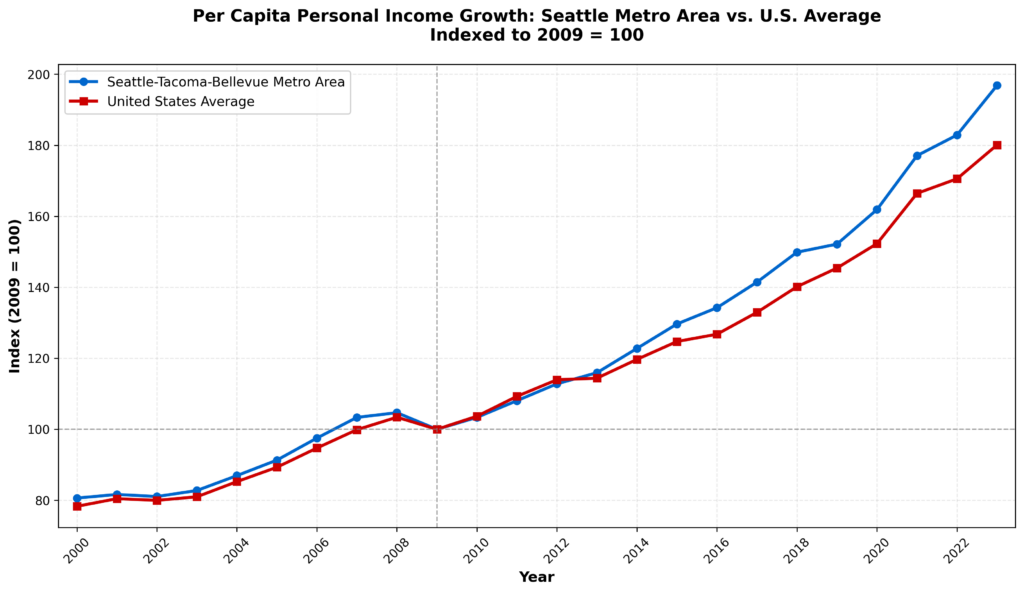
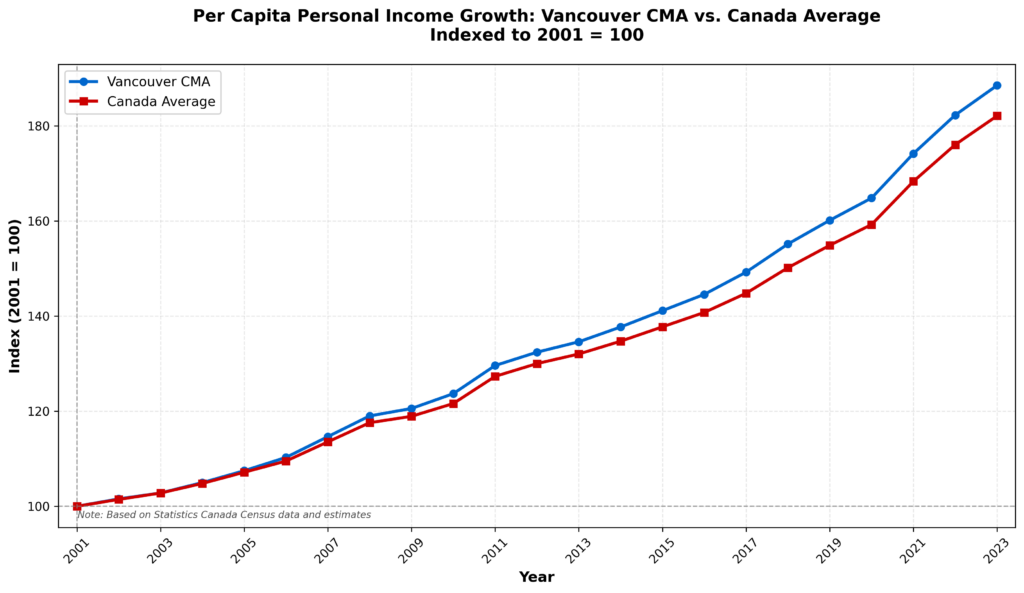
What we’ve done here is index per capita personal income to the last year in which the NBA franchise played in each city (2001 for Vancouver, 2009 for Seattle), so we’re comparing the subsequent growth in per capita income to those base years. For the record, both Vancouver and Seattle have incomes considerably higher than their respective national averages, so what we’re looking to see is whether the change in income after the loss of an NBA franchise underperformed (or over-performed) income growth in the nation.
Here’s the data for Seattle. Seattle’s growth in per capita personal income (blue) significantly outstripped that of the nation in the years following the loss of the city’s NBA franchise. The underlying data are from the US Bureau of Economic Analysis.
The same pattern holds for Vancouver, BC. Here we’re using Stats Canada data for the Vancouver Metropolitan Area compared to the national average for Canada. Again, Vancouver’s income (blue) increases faster than that for the rest of Canada after the Grizzlies leave town.
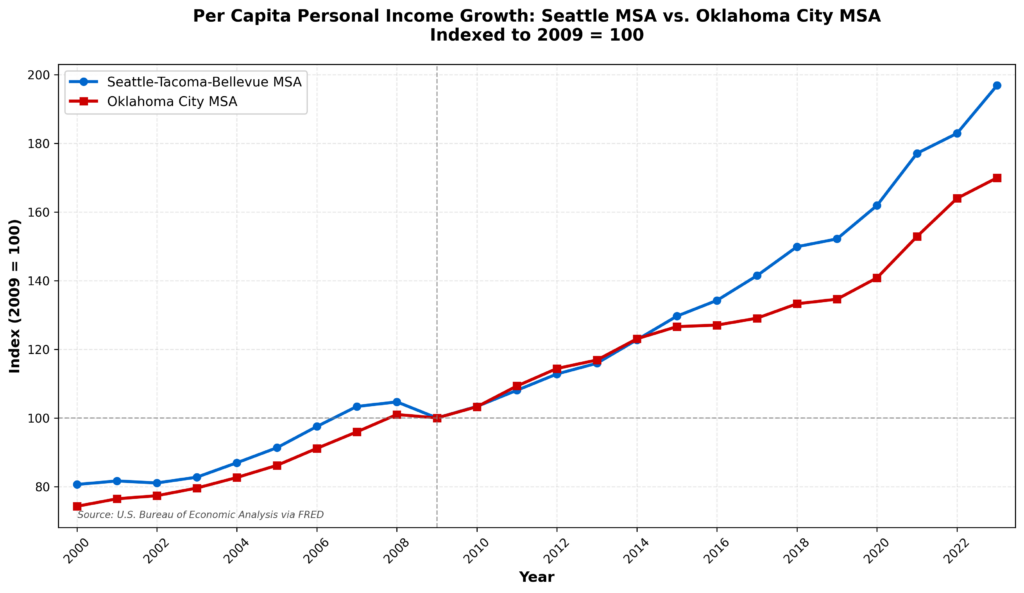
If getting an NBA franchise was such an economic boon, and losing one was a disaster, you’d expect to see some pretty disparate outcomes for the gaining and losing cities. So let’s compare the Seattle and Oklahoma City metropolitan areas in the years after the Sonics became the Thunder. Did the movement of the franchise cause Oklahoma City to outperform Seattle? Again, we’ve indexed both city’s per capita income to its 2009 level, and looked at growth in income. These data show that Oklahoma City’s per capita income was actually growing somewhat faster than Seattle’s prior to 2009 (the red line is catching up to the blue line), and that the two metropolitan areas performed just about the same from 2009 through 2014, but the data show Seattle’s income increasing much more rapidly over the next decade. If anything, Oklahoma City’s economy was doing better, relative to Seattle, before it got the NBA franchise.
Of course, reasonable analysts will say, but Amazon (or Microsoft or Starbucks or Boeing) to explain Seattle’s success. And one could add a host of other factors as well, including the region’s great quality of life, robust higher education institutions and thriving urban center. But that’s exactly the point: Regional economic prosperity doesn’t hinge on the presence or absence of a sports franchise–there are host of other factors that are much more important. There’s no denying that a sports team can be a civic amenity, but the evidence doesn’t show that its a make or break factor for long term regional economic prosperity.
The point for Portland is, we’ve essentially run the experiment of suddenly depriving a Pacific Northwest metropolis of its National Basketball Association franchise to see what happens to its economy. As it turns out–and pretty much exactly as all the economic studies conclude–pretty much no negative effects on prosperity.
Editor’s Note:
- Historical Gap: In 2000, Memphis per capita income was about 90% of the national average. By 2020, this figure had decreased slightly to approximately 86.8%.
- Volatility: Memphis experienced a significant ranking drop among U.S. metros between 2008 and 2014, falling from rank 216 to 250 in per capita income.
- Post-2020 Recovery: Since 2020, both Memphis and U.S. have seen sharp nominal increases, with Memphis reaching $60,083 and the U.S. average reaching $69,956 by 2023.
Between 2000 and 2020, per capita personal income in the
grew by approximately 87.2%, increasing from $27,419 to $51,329. During the same period, the United States average per capita personal income grew by roughly 94.8%, rising from $30,369 to $59,160.
| Year | Memphis Metro Area (MSA) | U.S. Average |
|---|---|---|
| 2000 | $27,419 | $30,369 |
| 2005 | $33,700 (est.) | $35,904 |
| 2010 | $37,700 | $40,545 |
| 2015 | $43,500 (est.) | $48,990 |
| 2020 | $51,329 | $59,160 |
**
Join us at the Smart City Memphis Facebook page and on Instagram where these blog posts are published along with occasional articles, reports, and commentaries that are relevant to Memphis.







Good article. I have done several economic impact studies over the years — never for sports, usually for academic institutions. They all indicate that new additions have an impact of the economic life of the town. But it is a micro impact — even with something as important as an educational institution, the trend of a regional economy tends to be steady in a certain direction. But these studies of the sports team might also remind us that new things rarely change the nature of the local economy. Right now, the great excitement is over the data centers here and across the River. Their impact — while important in a small scale — will have almost no impact on the overall direction of the Memphis regional economy.,