
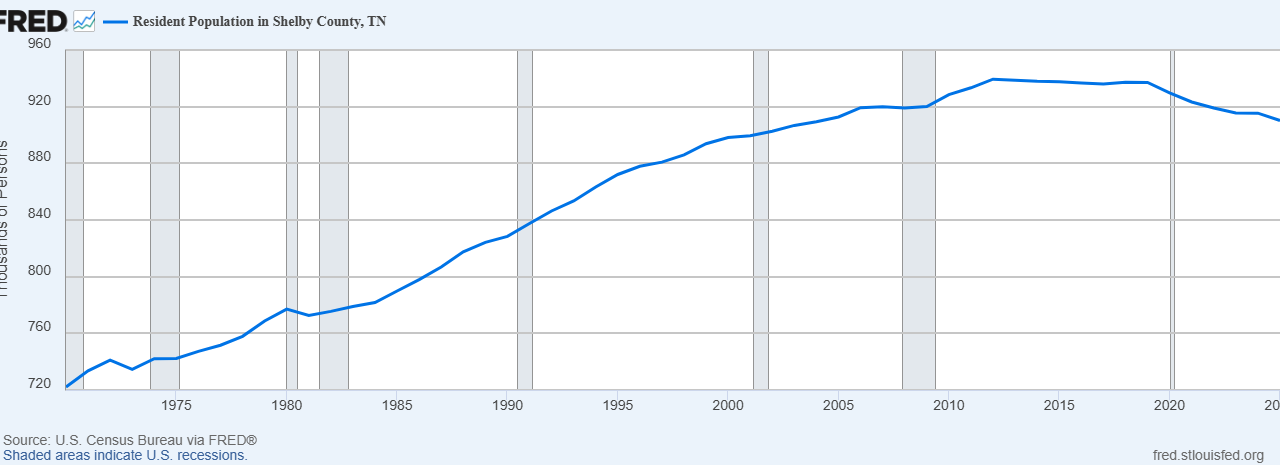
Population is not a vanity metric. It is a scorecard.
When people move to a city, it is an act of confidence about their futures there. When they move away, it is an expression of doubt.
Because of it, population change is not merely a demographic trend. It is a scorecard — on a city’s quality of life, economic opportunity, and confidence.
People vote with their feet.
For decades, Memphis has wrestled with a variety of civic problems: poverty, crime, educational outcomes, neighborhood decline, stagnant wages, and uneven economic growth. Population loss is not just one more problem among many because it makes every other problem harder to solve.
It’s obvious that population loss has been top-of-mind on this blog lately, as shown in posts showing where Memphians are moving, the Memphis cost of living bargain, and surveys about what makes a city “sticky.”
Urgency To Act
So, today is the summation to the jury.
Every city loses people from time to time. Economic recessions happen. Industries disappear. Neighborhoods change. But when population decline becomes persistent and normalized over decades, it fundamentally changes the trajectory of a city.
That is where Memphis, Shelby County, and the metro find themselves.
For generations, Memphis grew because people believed opportunity existed here. The city offered jobs, affordable housing, upward mobility, and an optimism that the future would be better than the present.
Today, the story is different. More people are leaving than moving in. Young adults are leaving and not returning. Too many college graduates pursue careers elsewhere. Retirees leave to be closer to family, to seek lower taxes and services, and to feel safer.
There are cities which should inspire us to an urgency of action. While we draw inspiration from Detroit which has increased its population for three consecutive years to 649,095, it’s important to remember that its population was once 1,849,568.
After decades of steep population loss, Detroit focused on downtown revitalization, entrepreneurship, public spaces, talent attraction, and neighborhood stabilization. The city still faces formidable challenges, but it has demonstrated that decline can be slowed and confidence can be rebuilt. The same can be found in Pittsburgh. After 70 years of steady decline, Pittsburgh’s population has grown for three straight years to 307,632 after falling from its high of 676,806.
Their examples prove that fighting population loss is not easy – or immediate. It requires sustained strategies that focus on answering the same question for every investment and every policy decision: Will this make more people want to live in Memphis?
It’s Logic 101
There’s no better time to begin than now, because the cumulative effect of population loss is profound. When residents leave, they take purchasing power. They take entrepreneurial energy. They take civic leadership.
The numbers are sobering so I’ll not belabor them again here.
Suffice it to say, Memphis has lost tens of thousands of residents since reaching its population peak 25 years ago. Shelby County has experienced years of net domestic out-migration since its population peaked 14 years ago. The population of the Memphis MSA – which includes surrounding counties in Tennessee, Mississippi, and Arkansas – reached its apogee seven years ago and has increasingly struggled to keep pace with peer metros across the South.
Here’s why growth matters so much: More residents mean a larger workforce, a broader tax base, stronger housing demand, more entrepreneurial activity, and greater consumer spending. Growth creates momentum. Momentum attracts investment. Investment generates jobs.
Population decline does just the opposite. As residents leave, demand weakens. Public infrastructure costs must be spread among fewer taxpayers. Schools lose enrollment. Housing values stagnate. Employers become more hesitant to expand. Civic confidence erodes.
In other words, when it comes to economic decline, population loss becomes both a symptom and a cause.
Memphis’s Best Day – In Front or Behind
Many of the people leaving are younger adults, college graduates, and households with rising incomes. Their departure represents not only a loss of population but also a loss of talent, leadership, entrepreneurship, and tax revenue.
Cities can survive slow growth, but few cities thrive while losing their most mobile and economically productive residents.
National trends suggest the future will be even more challenging. By 2032, 18 million college-educated workers will leave the labor force while fewer than 14 million will enter it, leaving a gap of 4.6 million workers. College enrollment is down, the birthrate is down, and a sharp reduction in immigration will complicate population growth in America and will be a factor in our community.
Generally speaking, people leave because of a combination of factors that collectively create a sense that opportunities and quality of life are better elsewhere. For many young professionals, the paramount issue is career mobility. Memphis has notable strengths in logistics, healthcare, transportation, and distribution, but it lacks the breadth of high-growth industries found in many competing cities.
For families, concerns often center on public education, neighborhood conditions, and perceptions of safety. For entrepreneurs, Memphis frequently lacks the density of capital, networks, and support systems available in faster-growing markets. For many residents, there is also a broader issue: lack of confidence (which is what makes it so painful to read comments on Daily Memphian and television news’ social media pages).
Too many people believe the city’s best days are behind it. That perception may not always be fair, but perceptions influence decisions just as much as facts.
21st Century Economic Development
To state the obvious, nothing matters more than jobs.
Memphis needs a clearer and broader economic development plan of action focused on growing industries that offer higher wages and stronger career pathways. We continue to rely too much on logistics and distribution. Advanced manufacturing, technology, clean energy, life sciences, and entrepreneurship must become larger components of our economy.
The economic development model of the twentieth century focused heavily on recruiting companies. The economic development model of the twenty-first century increasingly focuses on recruiting and retaining people. Hundreds of cities are competing for mobile talent, entrepreneurs, young families, and college graduates; however, it feels here like we are still focused on recruitment of companies.
Companies follow talent. Talent follows quality of life, opportunity, safety, education, amenities, and confidence in the future.
The conversation about xAI is a case in point. In promoting it, the Greater Memphis Chamber emphasized – and still emphasizes – how much capital investment it creates.
But here’s the thing: regularly ignored are actual people and answers to the question: How will xAI improve the lives of Memphis workers and will it attract new residents to live in Memphis?
We Lack A Broadly Growth Plan
Memphis is spending millions recruiting companies while neglecting the people who make the companies successful. Memphis should place equal emphasis on talent attraction and retention. That means stronger connections between universities and employers. It means creating opportunities for graduates to remain in the region. It means developing leadership pathways for young professionals and entrepreneurs.
Most importantly, it means opening civic decision-making to a broader and younger group of leaders. Too many of them feel excluded or ignored from the conversations shaping priorities and strategies for the community’s future.
There are many who are engaged – and want to be more deeply engaged – at Memphis Urban League Young Professionals, Chamber’s Young Professional Council, New Memphis, and others.
At the risk of my beating this drum too often, the challenge facing Memphis is not economic. It is cultural. The city lacks a broadly shared vision of where it is going. Too many conversations focus on managing decline rather than boldly pursuing growth. Too many debates become arguments over scarce resources rather than discussions about creating abundance.
Cities that succeed generally have a compelling narrative about their future.
Memphis needs one. Not a marketing slogan. Not another strategic plan. A genuine civic consensus about what kind of city Memphis wants to become over the next twenty years, one that is shaped by involving young professionals and the college students we need to stay.
In this conversation, population loss can no longer be viewed as merely another statistic in a government report. It is a warning signal.
People Move Toward Futures
Summed up, a city that loses people is ultimately losing confidence, investment, and opportunity.
The encouraging reality is that Memphis possesses extraordinary assets: a global logistics platform, world-class medical institutions, a unique cultural identity, abundant water resources, affordable housing, major philanthropic capacity, and a strategic location at the center of the country.
The city’s future is not predetermined. But neither is success inevitable.
Population growth will not occur because Memphis hopes for it. It is about creating a city where more people believe their future can be found in Memphis than anywhere else.
The city talks frequently about its history, and rightly so. Memphis possesses one of the richest cultural legacies in America. Music, civil rights, healthcare, logistics, and entrepreneurship have shaped the nation.
But history alone does not recruit a software engineer from Chicago, a medical researcher from Boston, or a young entrepreneur from Atlanta.
People move toward futures, not memories.
That’s why the question facing our city, county, and region is: Can our community become a place where people increasingly run toward rather than a place were too many continue to leave behind?
***
Join us at the Smart City Memphis Facebook page and on Instagram where these blog posts are published along with occasional articles, reports, and commentaries that are relevant to Memphis.