
Sometimes, Memphis has a habit of mistaking familiar ideas for good ones.
There’s the unimaginative idea of resurrecting the Sunset Symphony, which Memphis in May eliminated in 2015 after a 39-year run.
There’s the notion that downtown barbecue contests, bolstered by exaggerated economic impact studies, can only be held in Tom Lee Park.
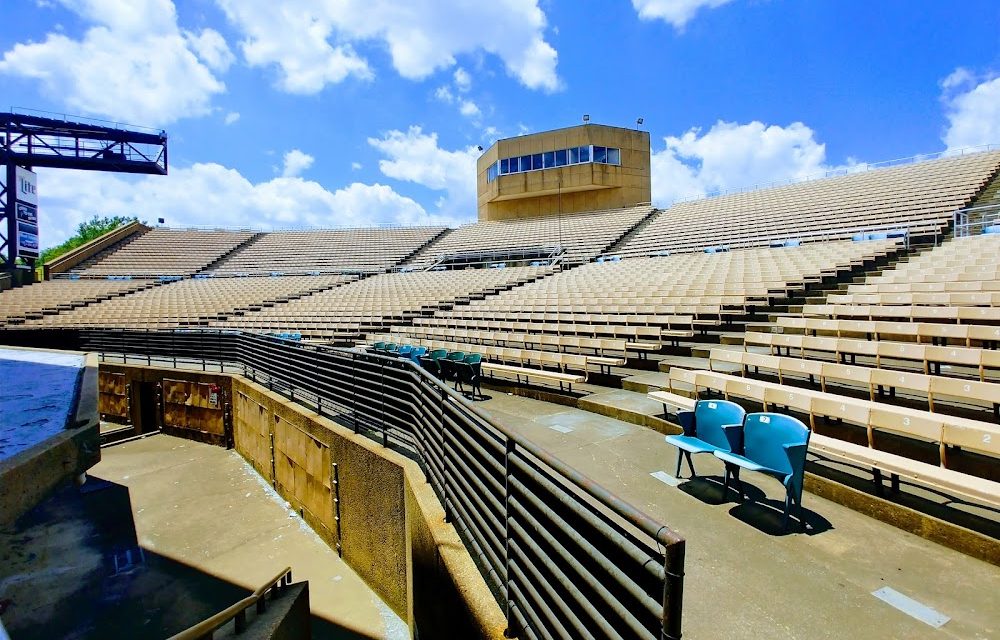
Then too, there’s the scheme that a pop-up concert in April will be proof positive that the out-of-date Mud Island Amphitheater deserves to be brought back from the dead.
Answering the Right Questions
All of these ideas are examples of how we default to outdated concepts when there are larger questions that should be defining and driving decisions:
1) Rather than staging our grandparents’ symphony on the riverfront, what new event would send the message that will attract the attention of young professionals?
2) Is a barbecue contest really the best use of award-winning Tom Lee Park when it takes it out of public use for weeks in May when it should be teeming with school groups? Why can’t this signature park just be a park?
3) Where would $20+ million from City of Memphis be most wisely spent: to improve a 44-year-old amphitheater or to use the money as an incentive for an islandwide reboot that attracts private investment?
It appears that as a result of the current negotiations reported here last week, the usual suspects, who self-selected as decisionmakers, default back to the past rather than insisting that the results speak to Memphis’ ambition and future.
December 23, 2025 – Negotiations Seek Breakthrough With Milestone Agreement
Getting On Target
Memphis in May eliminated the Sunset Symphony almost 11 years ago because it was losing money and ultimately the festival decided to concentrate on its two money-makers – the Beale Street Music Festival and World Championship Barbecue Contest. Now, without the MIM connection, the Sunset Symphony takes place at the Overton Park Shell, where it attracts 8,000 people.
As for a barbecue contest, reports from the negotiations suggest it’s highly unlikely there will be one in Tom Lee Park this year but the people in the negotiations (apparently there is no public input) hope for it to return in 2027 as Memphis in May’s World Championship Barbecue Contest, but organized and presented with Forward Momentum whose context sensitive layout in the two previous Mays was not damaging to the park. There are other locations downtown that deserve consideration but have been too summarily dismissed over the years. That in turn prevents a serious discussion about Tom Lee Park’s optimal role in the life of the city.
Finally, there is the misplaced obsession with Mud Island Amphitheater. Every so often, the same idea resurfaces: What if we just fixed Mud Island Amphitheater?
The changes that are needed – new seating, better sound systems, improved building safety, structural repairs, load-in, and more – are said to cost more than $20 million, but those fixated on the out-of-date, aging venue keep saying the same thing: restoring the amphitheater is the key to unlocking Mud Island’s potential.
Wrong.
Getting The Right Focus
The repeated fixation on the amphitheater by a vocal minority is a distraction from the real challenges—and opportunities—facing Mud Island as a whole and for that matter, from Memphis itself.
After all, Mud Island itself has $20 million in deferred maintenance, testament to what happens when city government builds a $62 million project ($208 million in today’s money) and thinks its job is done. Since its opening in 1982, Mud Island has received little city government funding to make sure it was property maintained over time.
Mud Island’s problems have never been about a single venue. They are about access, scale, connectivity, and public purpose in support of a 52-acre solution. Focusing on the amphitheater allows civic leaders to avoid grappling with the harder questions.
And yet, it sounds like the nagging by some people is leading to a popup concert to be approved by City Hall for April. The administration will be spending what has been said to be a few hundred thousand dollars to address the most severe safety issues.
The Problems
It was only a year ago that the administration of Mayor Paul Young denied the request for a concert because an architectural report noted significant safety concerns such concrete displacement, ADA non-compliance, broken elevators, and damaged railings that made it unsafe. And yet, proponents cling to the idea that volunteers can deal with these issues and manage a concert by Memphis bands without incident.
The last concerts at the amphitheater were held in summer, 2018, and the power of nostalgia has been on full display ever since. The power of the amphitheater as clickbait for the media coverage has relied on pithy talking points but lost in the glib coverage were cost estimates, realistic understanding of the rapidly changing realities for entertainment, and the fact that in the last years of its concert life, the market had spoken – the amphitheater was hosting only a handful of events a year (five in 2018, three in 2017, and five in 2016, and three in 2015).
Mud Island Amphitheater was conceived in the early 1980s, when cities across the country were chasing festival marketplaces and large outdoor concert venues as symbols of urban revival. For a time, it worked in a different era. The amphitheater hosted major acts and helped brand Mud Island early on.
But the live music economy has fundamentally changed. Touring patterns, production requirements, insurance costs, weather risks, and artist preferences all favor indoor venues or purpose-built outdoor spaces with adjacent parking, highway access, and private control. Mud Island has none of those advantages.
The idea that a modest renovation will suddenly make the amphitheater competitive with modern venues ignores these structural realities. Memphis already struggles to fill existing music spaces. Adding another expensive, seasonally limited venue does not solve that problem—it compounds it.
It’s About Mud Island, Not the Amphitheater
Another reason the amphitheater remains politically attractive is that it offers a familiar script: invest a little money, promise a flurry of events, project overstated revenue, and declare victory.
It sounds decisive. It feels measurable.
But Mud Island is publicly owned land. The question should not be how to extract the most concert revenue from it, but how to maximize its public value. That means asking what serves Memphians year-round, not just ticket buyers on a few summer nights.
Memphis has limited civic capacity and limited capital. Choosing to concentrate on the amphitheater is not neutral—it crowds out better ideas and delays necessary decisions about Mud Island’s future.
As for that future, Baron Von Opperbean and the River of Time, which opens March 7, offers more exciting opportunities for national and word of mouth branding, economic vitality, and a representation of Memphis inventive and creative spirit.
When leaders run out of imagination—or courage—the amphitheater gets dusted off, its past impact is overstated, and it’s presented as the answer to Mud Island’s long-standing decline and the key to its future.
It isn’t. And continuing to pretend it might be is a failure of leadership.
Part 2 of this blog post will be published Wednesday afternoon.
Coming Up: Orion Amphitheater has been held up as inspiration for Mud Island amphitheater, but Huntsville newspaper headline said “Orion Amphitheater spent $4 for every $1 it makes,”
**
These commentaries are also posted on the Smart City Memphis Facebook page and on Instagram along with occasional articles, reports, and commentaries that are relevant to Memphis.



So do you think that Memphis needs an amphitheater, and if so, where should it be located?
I’ve always thought that where Memphis missed the boat was in not having an “outdoor sheds” like the ones so successful in other cities. For example, the one in St. Louis has 11,000 but can handle crowds as large as 20,000. But to get talent that can attract those kinds of crowds, Memphis needs some big-time promoters who believe this is a market where they can make money. A conversation of what Memphis needs – amphitheater or whatever – should begin with them since they will determine if it’s successful.
A Music City without a venue on the Riverfront is misplaced advice. We have been spending time in St. Louis, New Orleans, Oklahoma City, and Nashville for Concerts. Now we are looking forward to Chrystal Bridges and the Walmart AMP in Arkansas. Memphis continues to miss the mark, the income, opportunity, and priorities that Memphis is best suited for.
Anonymous: Do all of the cities you cited really have an outdoor concert venue on the river? And here’s the main thing: are they clearly part of a downtown ecosystem rather than isolated and disconnected from their downtowns?
Maybe if the city didn’t spend $22 million to buy a hotel that lined the pockets of City Council members, they would have the money for the amphitheater. You are giving terrible, and obviously biased, advice.
Big difference. With the hotel, it renovates an asset that will spin off money and private investment will handle $250 million renovation. Spending $20M or more to have what is likely to be five concerts a year is imprudent.