
This post originally appeared at Campaign for America’s Future (CAF) at their Blog for OurFuture:
Many people don’t understand our country’s problem of concentration of income and wealth because they don’t see it. People just don’t understand how much wealth there is at the top now. The wealth at the top is so extreme that it is beyond most people’s ability to comprehend.
If people understood just how concentrated wealth has become in our country and the effect is has on our politics, our democracy and our people, they would demand our politicians do something about it.
How Much Is A Billion?
Some Wall Street types (and others) make over a billion dollars a year – each year. How much is a billion dollars? How can you visualize an amount of money so high? Here is one way to think about it: The median income in the US is around $29,000, meaning half of us make less and half make more. If you make $29,000 a year, and don’t spend a single penny of it, it will take you 34,482 years to save a billion dollars. . . . (Please come back and read the rest of this after you have recovered.)
What Do People Do With SO Much?
What do people do with all that money? Good question. After you own a stable of politicians who will cut your taxes, there are still a few more things you can buy. Let’s see what $1 billion will buy.
Cars
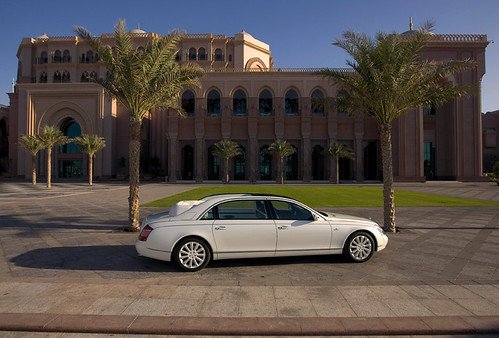
This is a Maybach. Most people don’t even know there is something called a Maybach. The one in the picture, the Landaulet model, costs $1 million. (Rush Limbaugh, who has 5 homes in Palm Beach, drives a cheaper Maybach 57 S — but makes up for it by owning 6 of them.)
Your $1 billion will only buy you a thousand Maybach Landaulets.
Here are pics of just some of Ralph Lauren’s collection of cars. This is not a museum, this is one person’s private collection. You don’t get to go look at them.
Luxury Hotels


This is the Mardan Palace Hotel in Turkey, Burj Al Arab in Dubai.
Here is a photo gallery of some other expensive hotels, where people pay $20-30,000 per night. Yes, there are people who pay that much. Remember to send me a postcard!
A billion dollars will buy you a $20,000 room every night for 137 years.
Yachts
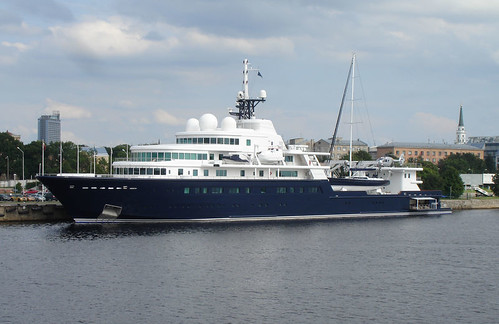
Le Grand Bleu – $90 million.
Some people spend as much as $200 million or more on yachts.
You can buy ten $100 million yachts with a billion dollars.
Private Jets
Of course, there are private jets. There are approx. 15,000 private jets registered in the US according to NBAA. (Note: See the IPS High-Flyers study.)

This is a Gulfstream G550. You can pick one up for around $40 million, depending. Maybe $60 million top-of-the-line.
Your billion will buy you 25 of these.
Private Islands
If the rabble are getting you down you can always escape to a private island.
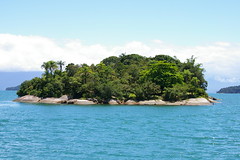
This one is going for only $24.5 million – castle included. You can only buy 40 of these with your billion.
Mansions
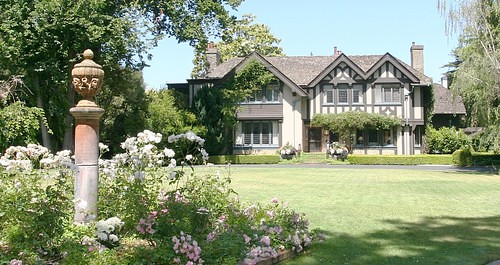
This modest home (it actually is, for the neighborhood it is in) is offered right now at only about $8 million. I ride my bike past it on my regular exercise route, while I think about how the top tax rate used to be high enough to have good courts, schools & roads and counter the Soviet Union and we didn’t even have deficits.
I ride there but that neighborhood is not like my neighborhood at all. While there is one family in that house, I live closer to the nearby soup kitchen that serves hundreds of families. One family in a huge estate and hundreds at a soup kitchen roughly matches the ratio of wealth concentration described below.
Here are a few nearby homes up for sale.
You can buy 125 houses like this one with your billion.
Luxury Items
Here is an article about ten watches that are more expensive than a Ferrari.

The one in this picture costs more than $5 million. You can buy 200 of these with your billion.
Medieval Castles

Just for fun, this is Derneburg Castle. Do you remember the big oil-price runup a few years ago that too the price of a gallon at the pump up towards $5? One speculator who helped make that happen got a huge bonus paid with government bailout money. He owns this castle. He has filled it with rare art. You can’t go in and see any of the rare art.
Click here to see the layout in an aerial view. That’s as close as you’re going to get, peasant.
Let’s Go Shopping
So you say to yourself, “I want me some of that. I’d like to place the following order, please.”
- One Maybach Landaulet for $1 million to drive around in. (Actually to be driven around in.)
- One $100 million yacht for when I want to get seasick.
- One Gulfstream G550 private jet for $40 million.
- One private island for $24.5 million (castle included) for when I want to escape the masses.
- One $8 million estate for when I have to go ashore and mingle with the masses (but not too close.)
- One $5 million watch so I can have one.
- Total: $178.5 million.
My change after paying with a billion-dollar bill is a meager $821.5 million left over. I might be hard up for cash after my spending spree, but I can still stay in a $20,000 room every night for 112 and 1/2 years.
So, as you see, $1 billion is more than enough to really live it up. People today are amassing multiples of billions, paying very little in taxes and using it in ways that harm the rest of us.
How Extreme Is The Concentration?
Now you have a way to visualize just how much money is concentrated at the very top. And the concentration is increasing. The top 1% took in 23.5% of all of the country’s income in 2007. In 1979 they only took in 8.9%.
It is concentrating at the expense of the rest of us. Between 1979 and 2008, the top 5% of American families saw their real incomes increase 73%, according to Census data. Over the same period, the lowest-income fifth (20% of us) saw a decrease in real income of 4.1%. The rest were just stagnant or saw very little increase. This is why people are borrowing more and more, falling further and further behind. (From the Working Group on Extreme Inequality)
Income VS Wealth
There are a few people who make hundreds of millions of income in a single year. Some people make more than $1 billion in a year But that is in a single year. If you make vast sums every year, after a while it starts to add up. (And then there is the story of inherited wealth, passed down and growing for generation after generation…)
Top 1% owns more than 90% of us combined. “In 2007, the latest year for which figures are available from the Federal Reserve Board, the richest 1% of U.S. households owned 33.8% of the nation’s private wealth. That’s more than the combined wealth of the bottom 90 percent.” (Also from the Working Group on Extreme Inequality)
400 people have as much wealth as half of our population. The combined net worth of the Forbes 400 wealthiest Americans in 2007: $1.5 trillion. The combined net worth of the poorest 50% of American households: $1.6 trillion.
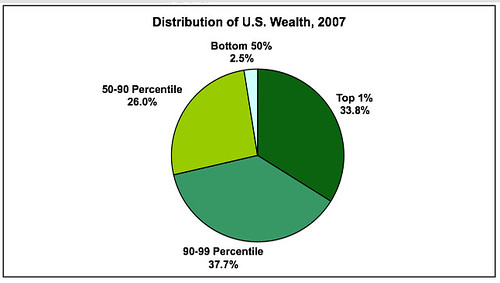
Corporate wealth is also personal wealth. When you hear about corporations doing well, think about this chart:
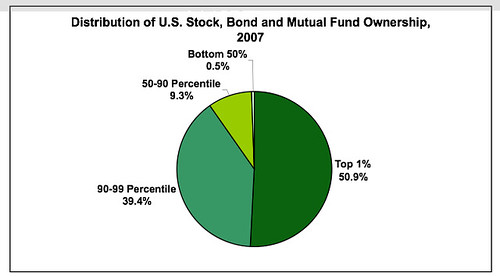
The top 1% also own 50.9% of all stocks, bonds, and mutual fund assets. The top 10% own 90.3%.
Worse Than Egypt
In fact our country’s concentration of wealth is worse than Egypt. Richard Eskow writes,
Imagine: A government run by and for the rich and powerful. Leaders who lecture others about “sacrifice” and deficits while cutting taxes for corporations and the wealthy. A system so corrupt that rich executives can break the law without fear of being punished. Increasing poverty and hardship even as the stock market rises. And now, a nation caught between a broken political system and a populist movement that could be hijacked by religious extremists at any moment.Here’s the reality: Income inequality is actually greater in the United States than it is in Egypt. Politicians here have close financial ties to big corporations, both personally and through their campaigns. Corporate lawbreakers often do go unpunished. Poverty and unemployment statistics for US minorities are surprisingly similar to Egypt’s.
The Harmful Effect on The Rest Of Us
This concentration is having a harmful effect on the rest of us, and even on the wealthy. When income becomes so concentrated people who would otherwise think they are well off look up the ladder, see vastly more wealth accumulating, and think they are not doing all that well after all. This leads to dissatisfaction and risk-taking, in an effort to get even more. And this risk-taking is what leads to financial collapse.
For more, click here.



As long as the wealth was gained legitimately … I don’t care how much money a wealth person has.
I made my way and I’m content.
This does nothing but foster the politics of envy.