
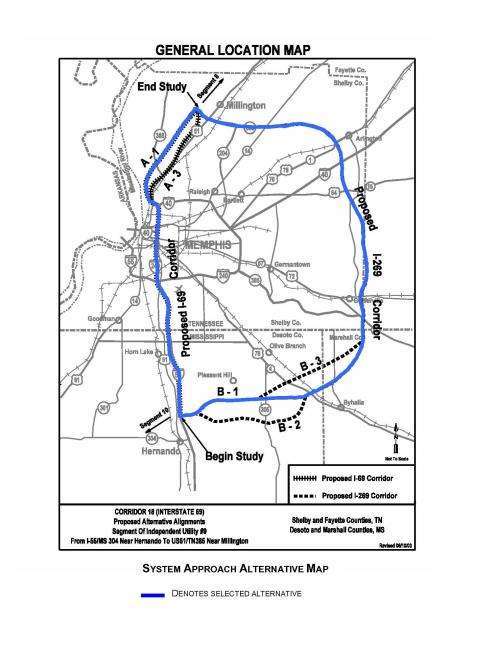
The reason we are so exorcised about I-269 and other sprawl-inducing highway projects are because they deepen the economic segregation that holds back Memphis’ progress.
Memphis is #1 in economic segregation among the largest 50 metros in the U.S.
Here’s the kicker: sprawl is a major cause of economic isolation, and economic isolation in turn exacerbates poverty and creates obstacles for residents to connect with the social networks that are often essential to employment and improved lifestyles. So we hope all the cheerleaders for an unnecessary interstate looping around Shelby County will forgive us, but their justifications are strained and their promises for thoughtful planning along its route are vague and hyperbolic.
Well-connected cities have less division between economic groups, and based on the recent decibel level here, it shouldn’t be too surprising that we are at the top of the list of economically segregated cities. Nashville is #38.
Cross Purposes
Meanwhile, the economic segregation results in concentrated poverty that is the seedbed for our city’s most serious problems and derails our best efforts to address them. Projects like I-269 promise only to make them worse, because every problem becomes harder to deal with in cities that are economically segregated.
In other words, at the precise time when every city, county and state agency should be focused on encouraging infill redevelopment that revives and stabilizes Memphis neighborhoods, our transportation investments hollow them out, and leaders appear unable to turn the tide and abandon the idea that sprawl is “growth.”
At the same time, the cause and effect — connecting the dots — between sprawl, the climbing Memphis tax rate, and an economically polarized city are overwhelmed by the influence of those who drive these transportation projects.
The inattention to the urban center that fuels our regional economy is symbolized by I-269, but its impact will be real and immediate. It will further produce an economically polarized city where fewer and fewer Memphis workers are paying more and more in taxes — including those spent for services and amenities that are in truth regional.
Green-washing
Let us say this clearly and unequivocably: there is no economic or social benefit to City of Memphis as a result of I-269. Don’t believe the propaganda or the breathless media headlines.
Wrapping I-269 in a shroud of terms like smart growth, knowledge economy jobs, New Urbanism and open space protection, supporters of the interstate suggest with straight faces that Memphis will benefit from new economic growth and development that the interstate will provide. If our past teaches us anything, it is that the I-269 corridor will be characterized by unwalkable, car-centric sameness.
Someone from North Mississippi said in an article in The Commercial Appeal that the task now is to apply smart growth principles to I-269. We’re not sure when we’ve heard such a contradiction of terms. It reminds us of the story on NPR about the developer proudly boasting of the region’s most sustainable residential development – green energy, walking trails, etc. There was only one problem: it was an hour commute to New York and an hour and half commute to Philadelphia.
It’s the kind of green-washing that’s being done by developers and economic development types to try to put a pretty face on projects that are clearly unsustainable.
Making It Worse
Here’s the thing: Memphis’ ability to compete in the new economy is undercut by the hollowing out of the middle class, by the worst economic segregation of the 50 largest metros, by the quickening loss of college-educated 25-34 year-olds, a 15% house vacancy rate that’s doubled since 2000 and 20% of Memphis families living on less than $8,700 a year.
These are the forces driving Memphis’ trajectory and defining our future. There is nothing in I-269 that does anything to improve these trends that are threatening the future of our city. More to the point and despite the denial by our suburban cities, the trends of Memphis will in fact determine the future of the entire region.
If Memphis must live with the problems that are exacerbated by I-269, we must do more than all pledge our commitment to regional planning. More to the point, we must change policies so that the interstate does in fact mitigate its negative impact.
For example, we’re said previously that I-269 and Tennessee 385 should be toll roads. They would produce more than $100 million a year that could be invested in strategies to strengthen our core city and to make Memphis a city of choice.
Nontraditional Thinking
There are other innovations like a higher sales tax along the route to establish a tax-sharing program that could direct money into the improvement of Memphis neighborhoods. Or perhaps there’s a way to pass impact fees and sustainability guidelines for development along the interstate route, to set up land trusts and to require the same level of public investments in public transit.
In a perfect world, our local and state officials would simply turn down the federal money for I-269, calling Mississippi’s bluff as it is faced with the interstate version of an oxbow lake. Perhaps, it’s not too late to call on our leaders to say enough is enough and make the most important decision facing them – doing what’s right for Memphis.
But, I-269 exists because of politics. That’s why we think the answer needs to be found in the same place.
These are difficult times for the Memphis metro – let’s say it again, metro. Unlike most other metro areas, the cancerous problems that threaten our economic health are regional and not just the problems of the city. Unless we start to figure out how to avoid self-indulgent projects like I-269 and make the investments that strengthen our entire region so that it is prepared for the fundamental restructuring of the economy that is well under way, we will prove that the road to hell is indeed paved with intentions that aren’t always good.
In the end, it’s not great roads that will draw jobs to Memphis. It’s great quality of life, a culture of creativity and a willingness to support dreamers and entrepreneurs that will attract the talented people that in turn attract jobs to our community. The blind pursuit of more lanes and more roads without the fuller context for community in time creates an incomplete plan for transportation and replicates the same mistaken policies of the past.



In case anyone is tempted to argue with SC about this, I am attaching links to two documents.
http://stlouisfed.org/publications/br/articles/?id=706
http://www.utexas.edu/research/ctr/pdf_reports/0_4420_1.pdf
The Cost of Sprawl in the Memphis MSA is a brief report to the Federal Reserve Bank of St. Louis understandably summarizing the effects of expansion through the year 2000 and its influence on things like regional taxes, government expenses, law enforcement, commute time, road construction and education. It is a frightening look at things… because it is ten years old.
TECHNIQUES FOR MITIGATING URBAN SPRAWL: GOALS, CHARACTERISTICS, AND SUITABILITY FACTORS is an easier read than it sounds. This document, produced by the University of Texas Center for Transportation Research for the Texas DOT, has a fabulously brief explanation of the highway system’s influence on sprawl but also gives a laundry list of mitigation techniques including:
Ten Transportation Efficient Land Use & Development Strategies
Seven Pricing Strategies for Automobiles, Roadways and Transit
Fifteen Alternative Mode Support Strategies
Six Worksite Based Strategies
Three Objectives Based Incentives
A Fix-It-First Strategy for Roadway Investment
Six Plan Coordination & Integration Strategies
Twenty-Seven Strategies for Urban Containment & Revitalization
Ten Natural Resource Preservation Strategies
Ten Facility Adequacy, Timing & Budgeting Strategies
Thirteen Coordinating Assignments
I’m not sure how the currently finished portions of this route relate to the funds for an official “I-269”, but it seems inevitable and we must do something to encourage infill of the beautiful downtown and inner loop areas with FAMILIES and entrepreneurs. Our metro area needs to be ONE Memphis. There are three colleges locating into downtown this year – life is continuing to spring back, let’s find a way to direct some of the I-69/269 money towards drawing the travelers INTO our vibrant and diverse city center. Maybe the I-69 portion at least could improve the exits and further showcase some of our inner assets along its path, especially from I-55 junction to 240’s turn eastward.
Let us keep in mind that I-269 is not the reason that Memphis is CURRENTLY #1 in economic segregation. It is the pro-ridiculous sprawl policies of the City and County gov’t. Annexation is the only way that the city has actually grown in population! We need like 2 million new residents in the City of Memphis just to justify the size of the current city.
I am just not sure that I-269 will make it much worse than it already is
This year’s County mayoral election will be very important in curbing sprawl. I hope SCM will put each candidate under a microscope and then post the results.