
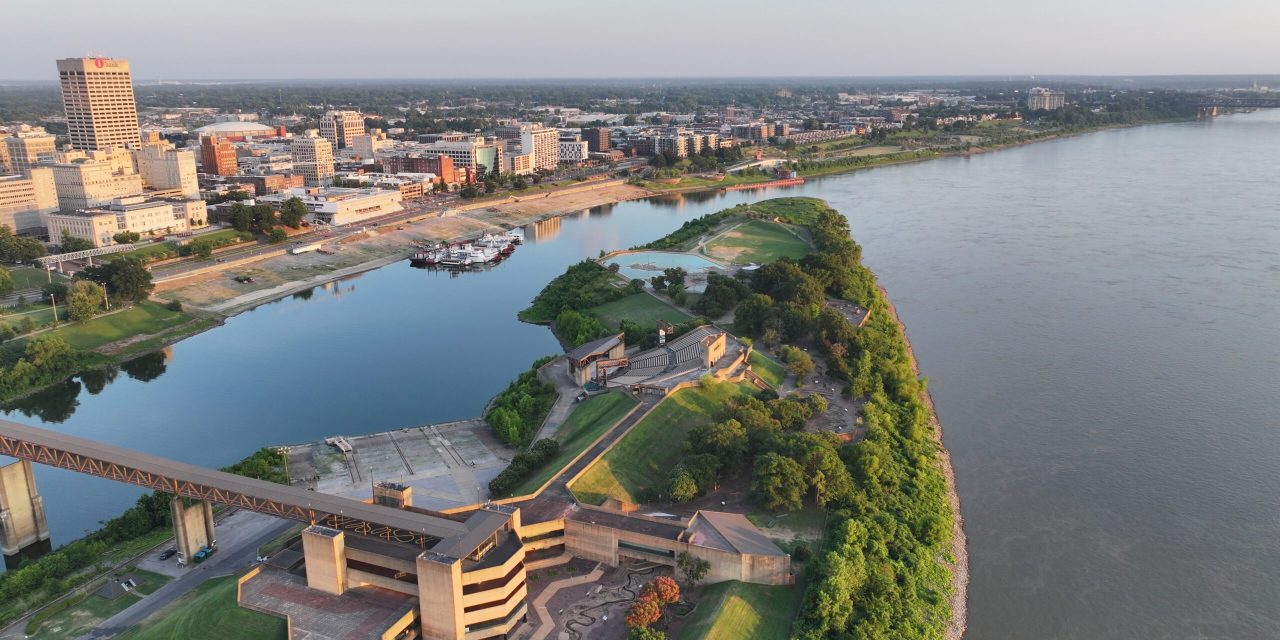
Mud Island Park has been called many things, but most of all, it should be called a cautionary tale.
Opened to a gala celebration on the Fourth of July, 1982, its 52 acres have confounded city officials for decades with a history equal parts nostalgic and troubled.
There are many lessons to be learned from its 44 years: lessons about overly optimistic financial and attendance projections, about over-promising impact, about emphasizing tourists over residents, and about city government failing to approve regular payments for upkeep.
It’s become a place where ideas go to die — remember the plans for a major freshwater aquarium, a zip line, luxury camping, a pedestrian bridge on the south end, and an extension of Bass Pro Shops?
Nostalgia flows from memories of concerts at the amphitheater, with the panoramic city skyline as dramatic backdrop. Today, though, that amphitheater is outdated and according to a national promoter, it is even located in the wrong place.
Then, too, there are memories of family visits centered on the lure of splashing in the detailed 2,000-foot scale model of the Lower Mississippi Valley. Pressure-washing burnished the river model’s appearance a few months ago, but there was no water in it during a recent visit. There are still directions to a monorail that hasn’t worked in years and the park’s forlorn state lacks for TLC and is embarrassing as tourists arrive there as a result of online sites that fail to reflect its current state.
The Brutal Truth
The one-star review on tripadvisor from a tourist from Cincinnati is typical: “A complete and total waste. Their website does not mention that there are renovations going on. The museum is closed. The Mississippi River Model is dry. The grounds aren’t being kept. None of the food vendors are open. For all this, the ‘paid parking available’ that the website mentions is $40. The city of Memphis has no shame, and it shows.”
The review was before the BVO immersive adventure world opened. It gave new reasons to visit Mud Island; however, the attraction created by Memphis’s most creative minds deserves a better maintained setting for its intriguing interactive storytelling. Clearly, City of Memphis, which owns the property, and Memphis River Parks, which manages it, are asleep at the switch in ensuring the condition of Mud Island is a positive reflection of Memphis.
October 16, 2025 – BVO: An Experential Adventure on Mud Island
Its present forsaken state belies its once-positive image. There was once the entertaining mile-long ride on the monorail to Mud Island that promised the special experiences ahead. Featured in the 1993 film The Firm starring Tom Cruise, it projected an image of a modern and innovative city — but the monorail was shut down seven years ago when parts were no longer available to maintain its vintage suspension railway technology (although one local architect has said the new generation of batteries invented for electric vehicles could offer a solution, raising the question of whether city government or River Parks would investigate this suggestion).
City Council Criticism
Nostalgia about Mud Island overshadows another inconvenient fact of its history: The park was considered a problem by city government almost from the beginning.
Within a few years from its opening, it was called a “white elephant” by City Council because it was not producing enough revenues to cover its operating costs, much less the cost of the bonds to build it. In those days, there was an entrance fee, there were two restaurants and a concession stand, a river museum (with its own admission fee), fish tanks, a music revue, and the water om tje scale river model was adjusted daily to match Mississippi River levels.
Only seven years after it opened, Mayor Dick Hackett, looking for a way to remove the cumulative $12.5 million in operational losses from the city’s books, turned to Sidney Shlenker to manage Mud Island after the latter claimed he would raise $110 million to create a theme park there called Rakapolis, a mixture of Memphis music and Egyptian mysticism that was to include the Pyramid. By 1991, Shlenker was bankrupt, he left Memphis in disgrace, and his name had become a verb.
In 2000, the City of Memphis turned over operations for riverfront parks, including Mud Island, to the then-newly created Riverfront Development Corporation. In 2018, that organization gave way to Memphis River Parks Partnership. City government remained responsible for capital funding, but over four decades, there was no regular appropriations to keep the park current and well-maintained. It became a testament to what happens when city government builds a $62 million project — $214 million in today’s money — and thinks its job is done.
Finally, four years ago, Memphis City Council approved $10 million in capital funding for Mud Island improvements — but shortly afterward took $5 million back and spent it elsewhere. About the same time, city government put $17.6 million in its 2027-2029 capital improvement budget for updates to the amphitheater. (However, the current online CIP budget no longer includes this funding.)
City officials said the outdated facility posed safety risks and liability concerns. About a year and a half ago, the administration of Mayor Paul Young denied the request by Downtown Neighborhood Association for a pop-up concert. An architectural report by city government noted significant safety concerns, including concrete displacement, ADA non-compliance, broken elevators, and damaged railings.
Throwback to Another Time
In today’s outdoor amphitheater market, it is a dinosaur. It doesn’t meet present market standards. It needs new seating, improved building safety, better sound systems, structural repairs, load-in improvements, and more.
Frustration about the slow pace of redevelopment on Mud Island routinely is more about the amphitheater than the rest of the park. The $17.6 million was less than what’s needed for the amphitheater’s resurrection. A major concert company even suggested a new amphitheater should be built on the south end of the park. In addition to the amphitheater, a conservation projection of $20 million has been given for refurbishing the rest of the park.
Mud Island’s problems have never been about a single venue. They are about access, scale, connectivity, and public purpose in support of a 52-acre solution. It’s little wonder that city officials are eager to find anyone with deep pockets and new ideas for developing the real estate.
The brochure for the opening of Mud Island — it was called Volunteer Park back then — claimed it would offer the prime venue for experiencing the river. But that’s hardly the case now. Memphis has a five-mile connected riverfront with 11 parks and miles of trails, culminating with the award-winning Tom Lee Park.
In the place of Mud Island’s original day fine-dining restaurant, River Terrace, today, there is another one, Mahogany River Terrace, that opened about 21 months ago. The former “Great Museum of the Mississippi River” has been transformed into Baron Von Opperbean and the River of Time (BVO). Meanwhile, the Memphis Yacht Club will celebrate its 125th anniversary this year but it can’t be seen from the opposing bank of Wolf River because City of Memphis does not cut down the weed trees that block the view.
All three deserve a better environment for their investments.
The Right Context for Answers
Mud Island cries out for a future that is bold, ambitious, and authentically Memphis rather than just selling it off to the highest bidder. In a 2022 report paid for by City Council, HR&A Advisors, a leading real estate and economic development consulting firm, laid out a clear-eyed framework for what works, what doesn’t, and what it will take to turn Mud Island into a functional part of the city again.
Best of all, the advisers began with the right question: “What can you do on Mud Island that will be self-sustaining, distinctive, and add to the quality of life in Memphis that you can’t do anywhere else in Memphis or downtown?”
It begins with letting go of what Mud Island has been and looking at not only what it can be but what is likely to be successful for the future. “The key to places like this is to start from a place of real, direct honesty about opportunities and challenges,” said HR&A partner Jonathan Meyers. His firm recommended the expansion of development on the north end, creating destination entertainment, commercial, and recreation activities, river research and education uses, and emphasizing nature and the impact of the river.
Other advice: Any potential use must occupy a large footprint of the 52 acres. It should take advantage of the island’s limited access (not fight it). It should embrace some form of public access. It should not compete with downtown. It should have curb appeal from I-40 and downtown. It should not rely solely or principally on government money. It should produce enough revenue to cover Mud Island operations — and it should have a viable plan B if plan A fails or falters.
It’s a tall order and needs vision, investment, and most of all, patience. But in the meantime, while waiting for that use to materialize, City of Memphis and Memphis River Parks should do something to at least get the basics right on Mud Island so it reflects positively on Memphis while they wait for a bigger solution.
**
This post is an expanded version of the City Journal column in October, 2025, Memphis magazine.
**
Join me at the Smart City Memphis Facebook page and on Instagram where these blog posts are published along with occasional articles, reports, and commentaries that are relevant to Memphis.