As the United States approaches the 250th anniversary of the Declaration of Independence on July 4, 1776, the White House should be preparing for what should be one of the most reflective civic moments in our history.
The semiquincentennial should be about commemorating the founding ideals that have animated the American experiment: liberty, constitutional governance, rights afforded every citizen, freedom of the press and of and from religion, and the notion that political authority ultimately rests with the people.
But amid the banners, parades, and patriotic programming to come, an uncomfortable question hangs in the air: Will the United States still function as a democracy by the end of its 250th year?
It is a question that once would have seemed absurd – but then too was the idea of U.the election of Donald Trump as president.
The durability of American democracy has long been treated as a historical fact rather than a fragile achievement. The U.S. survived civil war, world wars, economic collapse, and waves of political turmoil. Yet the present moment feels different—not because conflict is new, but because the foundational rules of the system themselves are under direct assault by the man in the position whose responsibility is to protect them.
At the center of that tension is Donald Trump, a president whose relationship with democratic norms has been adversarial from the start and whose rhetoric and actions increasingly challenge the constitutional framework that has governed the country for two and a half centuries.
The danger is not simply that this president is polarizing. American history is full of polarizing leaders. The deeper issue is the open hostility toward the guardrails that keep democracy functioning: the rule of law, separation of powers, and the legitimacy of elections.
When a president frames courts, legislatures, and elections themselves as illegitimate whenever they produce outcomes he dislikes, the result is much more than mere political theater. Whenever the news media reports facts he doesn’t like, they are the enemies of the people and should be tried as traitors. Whenever colleges and university emphasize freedom of thought and expression, they are blackmailed into paying ransoms to the Trump Administration. Whenever the federal system is dominated by corruption to profit the president, his family, and his friends to drive public policy, it is decaying the system at its roots.
These are erosions of the shared agreement that democracy requires to survive.
The American system depends on losing candidates accepting defeat. It depends on institutions operating independently even when their decisions are politically inconvenient. And it depends on the understanding that the presidency is constrained by the United States Constitution.
When those constraints are treated as obstacles rather than safeguards, the entire system begins to shake.
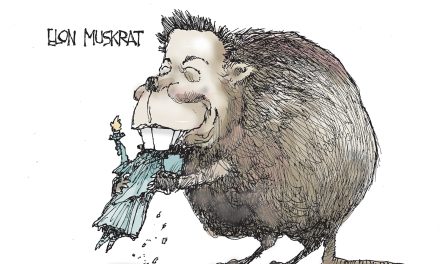
What makes the current moment particularly surreal is the juxtaposition between this constitutional tension and the spectacle-driven culture that increasingly surrounds the Trump Administration. There’s the idea of staging professional wrestling matches at the White House as a form of cultural programming, all while he unilaterally razes the East Wing, applies his name to the Kennedy Center, puts his face on the $1 coin commemorating the 250th anniversary, hangs his “dear leader” banners on government buildings, mobilizes the machinery of government to attack opponents, deploys paramilitary forces on our cities’ streets, manages concentration camps, and defaces the White House with egomaniacal tributes to himself.
On one level, it sounds like a sideshow. After all, American politics has regularly had an element of spectacle. But symbolism matters, especially when it comes from the presidency and particularly when it comes in this celebratory year.
The White House has historically served as a symbol of civic gravity and gravitas. It is where presidents addressed the nation during war, signed landmark legislation, and welcomed global leaders in moments that defined the country’s trajectory. It is not simply a residence or stage set. It is a physical representation of constitutional authority. It is sacred ground.
Turning it into a venue for professional wrestling might seem like harmless fun to some, and yet, it also captures something unsettling about the current political environment and this president: the blurring of governance and performance.
And it’s all powered by his “I can do whatever I want” attitude about the federal government, enabled by the sycophants in Congress who abandon their duties to secure his praise and avoid his tantrums.
Democracy requires seriousness. It requires respect for institutions even when political combat becomes fierce. When political leadership instead embraces spectacle and grievance as governing philosophies, the incentives change. And they have.
Politics becomes less about persuasion and more about dominance. Less about institutions and more about personalities. Less about governing and more about entertaining a political base.
The shift has consequences.
One of the hallmarks of democratic erosion around the world is the gradual normalization of attacks on institutional legitimacy. Leaders frame courts as corrupt, elections as rigged, and opposition parties as enemies rather than competitors. Over time, citizens lose faith not only in their leaders but in the democratic process itself.
The system does not collapse overnight. Instead, it slowly transforms into something else—something that may still hold elections but lacks the safeguards that make those elections mean anything. (Think Hungary, which Trump envies.)
Political scientists often describe this transition as “democratic backsliding.” It is rarely dramatic. It usually happens incrementally, through a series of steps that each appear survivable in isolation.
But taken together, those steps can reshape a political system.
The United States has historically assumed it is immune to that pattern. The country’s size, federal structure, and long democratic tradition have been seen as buffers against authoritarianism.
Yet history offers little evidence that any democracy is permanently immune. Present events should be lesson enough.
Nations with strong democratic traditions—from Hungary to Turkey and to Israel—have experienced rapid democratic deterioration when leaders decided the rules of the game no longer applied to them.
The United States now faces its own version of that stress test.
To be clear, the outcome is not predetermined. American institutions have shown resilience before. Courts have pushed back. Elections have been administered despite intense pressure. Civil society organizations continue to mobilize in defense of democratic norms.
But resilience should not be mistaken for invincibility because the persistence of the authoritarian and his minions are relentless.
The 250th anniversary of American independence should be an opportunity for national reflection. The founders themselves were acutely aware of the fragility of the system they were creating. That why they designed a structure full of checks and balances. They understood the temptations of power.
They also understood that no constitutional framework could survive without a public commitment to democratic principles.
As the country celebrates its founding, Americans may find themselves confronting a paradox. The same nation that declared in 1776 that governments derive their “just powers from the consent of the governed” must now decide whether it still believes that principle strongly enough to defend it.
Anniversaries invite nostalgia. But they also invite accountability.
Two hundred and fifty years after the founding of the republic, the most important question may not be how grand the celebrations are or how many fireworks fill the sky.
The real question is whether the country still embodies the democratic ideals that made the celebrations meaningful in the first place and if they can survive a president and oligarchs determined to warp these founding ideals into a system then can control and which operates for their power and greed.
***
Join us at the Smart City Memphis Facebook page and on Instagram for incidental daily articles, reports, and commentaries relevant to Memphis.