
About every 10 years or so, Memphis discovers regionalism.
That seems once again to be where we are today.
That’s not to say that regionalism isn’t important. It is after all the competitive unit of the global economy, but here, the subject seems to come and go with little discernible impact.
The Greater Memphis Chamber of Commerce is involved in the emerging discussions that promote regionalism as an opportunity for the Memphis MSA. Since the late 1990s, at least three regional plans have been rolled out with fanfare but gained little traction and produced few results.
The Chamber’s own candid and useful indicators for our region should be wake-up calls for how our MSA lags behind other regions we used to lead. The indicators are clear: our economy continues to lag behind comparable rivals, and as pointed out in last week’s post, Shelby County Compared to Other Tennessee Counties, our county has structural challenges when even compared to the 94 other counties in the state.
A New Group for New Progress
This is not to say that regionalism is not worth the attention it is once again receiving, and hopefully, this time around, its potential will translate into tangible positive benefits. In truth, in the past, Memphis and Shelby County have always given more than they got from past efforts.
Gnarly issues like public transit have been an afterthought – if thought of at all – while transportation discussions have been dominated by how much faster we can move boxes and regional economic development planning treats low-wage, low-skill jobs as our destiny.
In truth, while Memphis is often seen as the drag on our economy, as you travel outside Shelby County, the regional economic hub with most of the MSA’s GDP and jobs, the shared problems of low educational attainment, slow per capita income and GDP growth, economic segregation, poverty and the working poor, and the heavy reliance on federal transfer payments should motivate regional leaders more than previously.
And yet, hope springs eternal when it comes to regionalism in its convening, planning, and thinking.
Amid the current resurrection of regionalism as a shared priority, the emergence of the MidSouth Development District (MDD) is the most promising development in the present discussion.
Creating New Momentum
For decades, as MATCOG (Mississippi Arkansas Tennessee Council of Governments) and MAAG (Memphis Area Association of Government), the federally-mandated organization was moribund and serving little purpose. It was required by the U.S. Department of Commerce Economic Development Administration to create a Comprehensive Economic Development Strategy which was developed and released without causing a ripple. It seemed to accept that its primary purpose was signing letters of endorsement that were required for projects by its members to receive federal funding.
That all changed when MDD was renamed and Anna McQuiston was hired as executive director two years ago. In short order, she has transformed the revamped organization into an organization that matters.
With members in six counties and 38 municipalities, MDD has launched an energetic program of work, it’s asking the right questions, it’s hiring the advice of experts, and it just held its first State of the Region session. While some of the presentations seem to be about subjects we have talked about for decades – say, the war for talent – the past lethargy on the doing something on the subject should not foreclose a fresh conversation about it.
Its outlook and tone appear to be decidedly hopeful but earnest with emphasis on housing, infrastructure, tourism, transportation, and workforce development. But best of all, her ability to convene more than 20 mayors from across the region and to ask pertinent – and provocative – questions gives her organization special power to drive real change.
MDD’s high-powered board of directors includes both Memphis and Shelby County mayors, and it is chaired by Germantown Mayor Mike Palazzolo, who brings strong communications skills and an ability to talk across partisan and county borders.
Tipping Point
The objective of MDD is summed up on its website as it sets the stage for its MidSouth Regional Roundtables in 2026:
The MidSouth Region is at a tipping point. For years we have seen our population decline while the rest of the southeast is growing. Growing communities have one thing in common: Jobs. And in our region, we have the potential in the next 10 years to see the most rapid job growth in our history.
MDD’s Regional Employment Forecast (released in late 2025) demonstrated three levels of potential job growth: Status Quo (30,000 jobs); Moderate (70,000 jobs) and High Growth (100,000 jobs). The difference between these goals is whether we build up the MidSouth to attract the higher levels of jobs through increased workforce training, more housing, transportation solutions and resilient utility infrastructure.
To accomplish this goal, we must work together as a regional team and focus on making it easier to implement the solutions.
As it begins its work, we are confident that Ms. McQuiston and MDD and its members recognize the challenges ahead. They need only look to the past to understand them.
The last regional plan was unveiled in March, 2019. It was launched in a public meeting of the Memphis & Shelby County Regional Economic Alliance attended mostly by the usual suspects and was provoked by the outburst of tensions last year between EDGE and Greater Memphis Chamber although the former’s president and the latter’s chairman of the board did not attend the kickoff.
Déjà vu All Over Again
It had only been six years since the previous plan, A Roadmap for Transforming the Memphis Economy, that was developed during the term of Memphis Mayor A C Wharton Jr. in collaboration with county government, EDGE, Greater Memphis Chamber, University of Memphis, FedEx, and more. It pointed out how much the local economy lagged behind those of the U.S. and peer cities, and it targeted startups and entrepreneurship, global logistics, international trade, workforce development, and regional governance. It is difficult to point to any real movement that flowed from the plan.
About seven years earlier, in 2006, the Memphis Fast Forward economic development plan was unveiled, led by Memphis Tomorrow which had been asked by Memphis Mayor Willie W. Herenton Jr. and county mayor Wharton to develop it. Subsequently, it was called a model collective impact process by a national consulting group. Greater Memphis Chamber and dozens of other local organizations participated in the process which was as much about establishing the infrastructure – or backbone organizations – to improve the factors affecting economic outcomes as setting specific priorities. It did set specific goals for jobs creation which fell short despite considerable funding from the private sector.
In 2001, the most ambitious plan of all was developed by the Governor’s Alliance for Regional Excellence and funded to the tune of more than $250,000 by the Chamber. The initiative was the brainchild of the administration of Shelby County Mayor Jim Rout and it had the backing and involvement of the governors of Tennessee, Arkansas, and Mississippi.
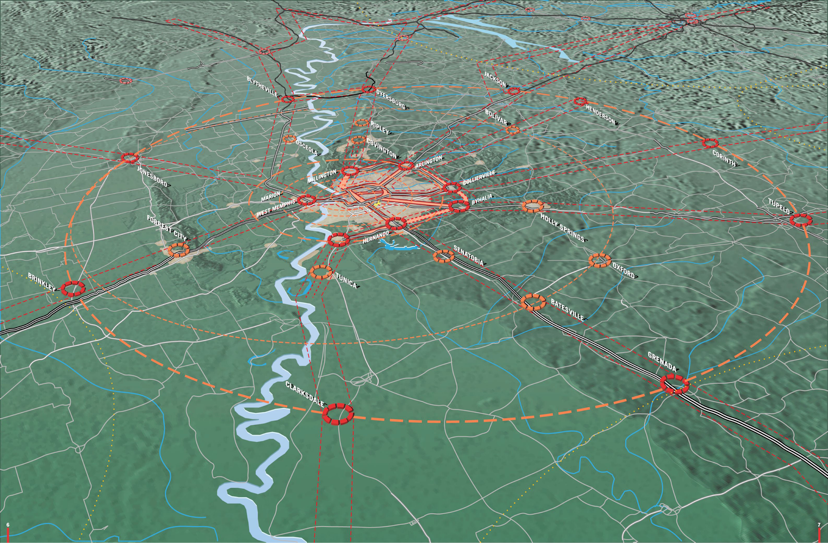
It produced the elaborately designed Memphis Sourcebook which was released as the definitive regional economic development plan. With Charlotte, NC-based Michael Gallis of Gallis & Associates as consultant, it was arguably the most aspirational and meticulous plan ever undertaken in our region and perhaps its approach was too “big picture” and visionary for the regional appetite. It never produced the kind of change in thinking that it should have sparked.
The Challenge Is Sustainability
Truth be told, none of the earlier plans provided the disruptive innovations that were needed to fundamentally change the trajectory of the Memphis economy or the forces that define it. As a result, there was no discernible improvement in key economic indicators for the Memphis MSA, which continued to lose ground.
Each of the plans largely existed in isolation rather than building on the one that came before or becoming the scaffolding on which all economic development efforts were built. More to the point, because they also seemed content to build on the existing economic order, they have done little to close the income inequality gap, whose closure represents the single biggest opportunity to expand the metro GDP, or reduce the poverty rate – despite the Memphis MSA having the highest poverty rate for any region with more than one million people.
All that said, we return to what really matters: a structure that sustains the plan for more than a few years of heightened attention and a process that reports to the public on whether it is achieving its goals.
The challenge is not to develop a plan – we’ve gotten experienced at that – but to root it deeply enough that the sense of urgency that created it does not pass but inspires a new burst of determination to significantly fuel and upgrade the trajectory of the regional economy.
We should not be Pollyannish about the difficulty of this work, but with flagging economic indicators, loss of population, and slow economic growth, it’s clear we have already wasted decades without dramatic progress.
That’s why we are counting on MDD to act with the philosophy that our region has no margin for error. It appears strongly positioned to deliver the kinds of results we have always hoped for.
**
These commentaries are also posted on the Smart City Memphis Facebook page and on Instagram along with occasional articles, reports, and commentaries that are relevant to Memphis.



I still have my copy of the Memphis Sourcebook somewhere in my office. It was clearly the neatest output of that effort. The graphics were stupendous. I am not an optimist about the future at the moment. We are a trade-based economy — and the on-again-off-again tariff regime of the past year is likely to do great damage to the regional economy, including the agricultural sector. Also, the erratic domestic policies of the national government could harm both the educational and heath/medical sectors of the regional economy. Finally, the US has decided to abandon its effort to mitigate climate change — surely, that will spell doom for the Blue Oval development. An additional finally, the WSJ publishes an article almost every day about the dangers present in the AI construction bubble — we have plants in Memphis, West Memphis and Southaven that could be negatively affected in the next 2-3 years. Maybe regional development needs to be renamed Regional Defense.