Smart City Memphis
 

Sign up or Login

Electoral College Chicanery

by SCM (RSS) | February 13th, 2013 3:00pm CDT

Tweet

From Citiwire, by Neal Peirce:

It’s the most overt effort to rig elections for president of the United States that I’ve seen in a half century of analyzing and writing about our electoral college system.

Perhaps you’ve seen the news – the bids, recently mounted in Virginia and Pennsylvania and being widely discussed in Michigan, Ohio and Wisconsin, to cast all but two of a state’s electoral votes based on votes in individual congressional districts. Facing broad opposition, chances of the measures seem to be dwindling. But they’re markers of dangerous meddling with the already imperfect presidential election system.

Constitutionally, any state legislature can decide how to cast the state’s presidential elector votes. But note: The five states involved with this year’s maneuvers have turned “blue” presidentially – all were carried by President Obama in 2008 and again in 2012. But all were redistricted – critics charge “gerrymandered” – by Republican-controlled legislatures following the 2010 Census and the Republicans’ big win in mid-term elections.

The clear intent of the redistricting was to create as many Republican-leaning congressional districts as possible. Why else would Republican National Chairman Reince Priebus be urging presidentially “blue” states like Virginia and Pennsylvania to consider splitting their electoral votes by district – but not “red” Texas or Louisiana?

So what’s wrong with casting electoral votes by congressional district? The answer: It’s a system that automatically skews the results to the political right. And there’s a simple reason: Democratic voters – even short of gerrymandering – tend to be concentrated heavily in cities and older suburbs, while Republicans are spread out more territory, winning their seats by somewhat smaller margins.

What would have been the outcome if the district allocation idea had been in effect nationwide last year? Mitt Romney would have had 277 electoral votes to 261 for Obama. He’d be sitting in the White House today, even though he lost the popular vote by close to 5 million votes.

The reality: One or two states, by adopting a district system when other states don’t, can determine the presidency.

That’s precisely the fatal flaw of the American presidential election system that I highlighted in a 1968 book, The People’s President. There was nothing sacred about the electoral college system, I found: it was thrown together rather carelessly at the Constitutional Convention of 1787 – in times when slavery held sway, and women and unpropertied whites couldn’t even vote.

Yet even today, our ideas of democracy and equity far advanced, the essential fault remains: Whether one counts a state’s electoral votes as a block (as most states do), or by congressional districts, or a proportion of the popular vote, or blindfolded legislators drawing marbles from a bowl, there is no assurance that the candidate that most Americans vote to be president will actually become our chief executive.

Misfires – popular vote winners losing the presidency – occurred in the elections of 1824, 1876, 1888 and 2000. I also discovered strong evidence that more popular votes were cast for Richard Nixon than for John Kennedy in the 1960 election.

Sometimes population and electoral vote patterns favor one party over another. Currently, New York Times experts are saying, today’s state partisan alignments actually give Democrats a substantial electoral vote advantage in a close election. But history confirms: The pendulum (and chance of electoral misfire) keeps swinging back and forth between the parties.

What’s indisputable: The American people want this system abolished. A Gallup Poll taken Jan. 8-9 found 63 percent of us favor shifting to a direct popular vote system. Democrats, Republicans and independents – all voted overwhelmingly for a pure popular vote (as they have over 69 years of Gallup surveys on the topic).

Such a move would quickly end the current-day “swing state” phenomenon in which candidates ignore most of America. In the 1960 election, John Kennedy campaigned in 49 states, Richard Nixon in 50. But in 2012, Obama and Romney limited their appearances to just 10 “swing” states, and spent 95.7 percent of their television budgets in just nine states between April 11 and election day. The remaining 40 states, and their interests, were effectively ignored.

There’s a clear political way out – the “National Popular Vote” initiative, a compact among the states to cast their electoral votes for the popular vote winner nationwide (regardless of the outcome in their own state). So far the compact proposal – guaranteeing election of the popular vote winner, but bypassing the cumbersome process of a constitutional amendment – has been approved by legislatures of nine states which control, cumulatively, 132 electoral votes. That’s 49 percent of the total (270) needed to elect a president. When the total passes 50 percent, the compact will swing into effect.

Most of the approving states, at least so far, have been Democratic-controlled. But Republicans could benefit too: Their future presidential candidates would also be protected against “losing while winning.”

Ultimately, why should any American’s vote for president have more weight than any other citizen’s? I’ve been asking that question for 45 years – and have never heard a rational answer.


Categories: Uncategorized

Comments RSS Feed

Comments are closed.

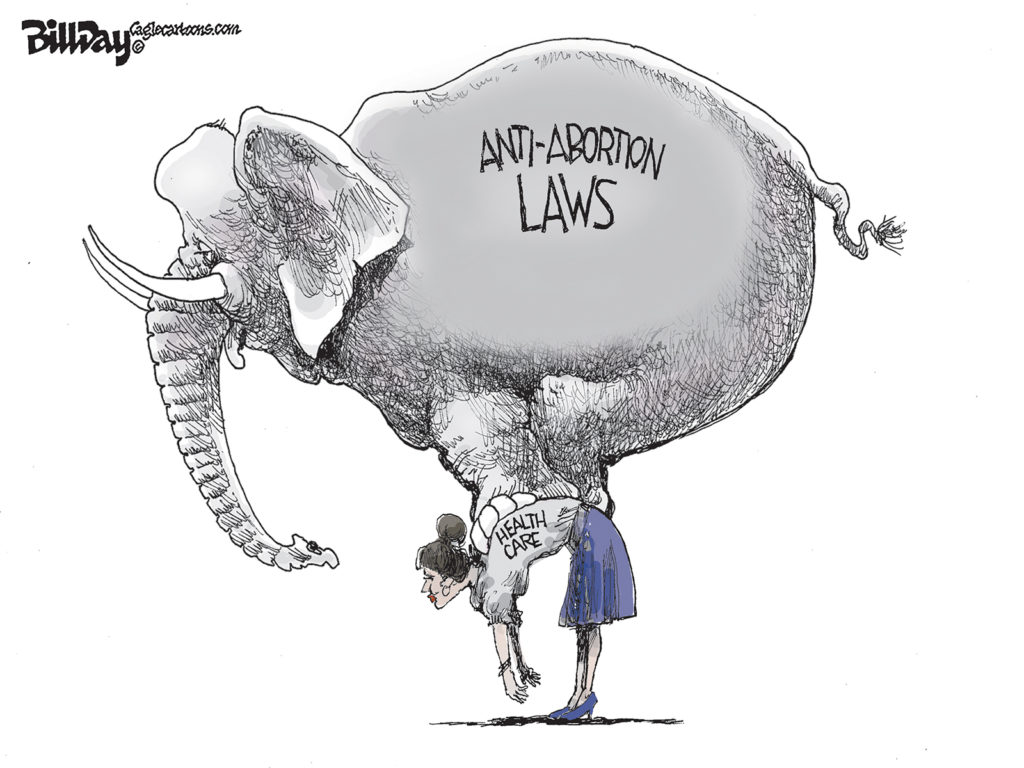
Green Tea, A Bill Day Cartoon

by Bill Day. Memphian Bill Day is two-time winner of the RFK Journalism Award in Cartooning. His cartoons are syndicated internationally by Cagle Cartoons. Cartoons Archive →

Photograph by Amie Vanderford

More Images

This ongoing series of photographs is intended to show the daily lives of these single mothers in order to invoke recognition of their similarities to all mothers, along with understanding and empathy from the viewer of the strengths that these single mothers possess within the challenging situations they face. My hope is that newfound empathy with these mothers’ lives will give people some pause before they condemn single mothers when discussing issues such as welfare and other politically charged hot buttons.

  • Subscribe to Posts via Email

    You can get Smart City Memphis posts right in your e-mail box. Just sign up below to begin receiving them.


  • RSS

    • Friday Fun: A Los Angeles cycling highway?

    • All aboard: Engaging the public on transport projects

    • Weaving people back into the urban fabric

    • How clean is the air we breathe in cities?

    • Friday Fun: Self-driving automobile + Bus + Taxi = Otobuxi

    • Q&A with Hernan Navarro: Lima’s El Metropolitano BRT

  • RSS

    • San Francisco’s Uber-Complicated Taxi Industry

    • New Ventilation System Keeps Buildings Fresh But Warm

    • Eight Guidelines to Keep Creativity at the Heart of Cities

    • Infographic: Cities Embracing the Green Revolution

    • The Economic and Educational Value of Retrofitting Schools

    • Greening Cities with Better Bike Lanes

  • RSS

    • Replica of the Day: Building the Simpsons' Springfield in Florida

    • Toronto Mayor Rob Ford: 'I Do Not Use Crack Cocaine'

    • Flags for the Fallen

    • This Is What the Scar From a Tornado Looks Like Through a Suburban Town

    • How Waze Became the Hottest Map App Around

    • The Feds Are Fighting Forest Fires Wrong

  • Search Posts

  • About Smart City Memphis

    This is Smart City Consulting's blog and its purpose is to connect the dots and provide perspective on events, issues, and policies shaping Memphis and its future. Smart City Memphis was named one of the most intriguing blogs in the U.S. by the Pew Partnership for Civic Change, it was voted the best Memphis blog in About.com's Reader's Choice Awards, and The (Memphis) Commercial Appeal wrote: "Smart City Memphis provides some of the most well-thought-out thinking about Memphis' past, present, and future you'll find anywhere." Our blog's editor is Tom Jones, principal at Smart City Consulting and an editorial contributor at Memphis magazine, where he writes the monthly column, City Journal. Submit blog posts, ideas, suggestions, and emails to tjones@smartcityconsulting.com.
  • Archives

    • May 2013 (24)
    • April 2013 (34)
    • March 2013 (27)
    • February 2013 (31)
    • January 2013 (30)
    • December 2012 (29)
    • November 2012 (31)
    • October 2012 (33)
    • September 2012 (29)
    • August 2012 (33)
    • July 2012 (26)
    • June 2012 (33)
    • May 2012 (33)
    • April 2012 (31)
    • March 2012 (37)
    • February 2012 (32)
    • January 2012 (35)
    • December 2011 (29)
    • November 2011 (30)
    • October 2011 (34)
    • September 2011 (33)
    • August 2011 (39)
    • July 2011 (36)
    • June 2011 (41)
    • May 2011 (36)
    • April 2011 (57)
    • March 2011 (39)
    • February 2011 (45)
    • January 2011 (56)
    • December 2010 (44)
    • November 2010 (30)
    • October 2010 (28)
    • September 2010 (24)
    • August 2010 (22)
    • July 2010 (23)
    • June 2010 (34)
    • May 2010 (28)
    • April 2010 (32)
    • March 2010 (35)
    • February 2010 (31)
    • January 2010 (43)
    • December 2009 (49)
    • November 2009 (17)
    • October 2009 (24)
    • September 2009 (23)
    • August 2009 (18)
    • July 2009 (22)
    • June 2009 (28)
    • May 2009 (23)
    • April 2009 (23)
    • March 2009 (26)
    • February 2009 (25)
    • January 2009 (36)
    • December 2008 (15)
    • November 2008 (22)
    • October 2008 (21)
    • September 2008 (25)
    • August 2008 (23)
    • July 2008 (32)
    • June 2008 (27)
    • May 2008 (35)
    • April 2008 (26)
    • March 2008 (25)
    • February 2008 (29)
    • January 2008 (33)
    • December 2007 (20)
    • November 2007 (19)
    • October 2007 (32)
    • September 2007 (25)
    • August 2007 (25)
    • July 2007 (26)
    • June 2007 (16)
    • May 2007 (21)
    • April 2007 (25)
    • March 2007 (18)
    • February 2007 (16)
    • January 2007 (17)
    • December 2006 (16)
    • November 2006 (14)
    • October 2006 (18)
    • September 2006 (21)
    • August 2006 (20)
    • July 2006 (20)
    • June 2006 (17)
    • May 2006 (12)
    • April 2006 (19)
    • March 2006 (20)
    • February 2006 (23)
    • January 2006 (16)
    • December 2005 (23)
    • November 2005 (21)
    • October 2005 (23)
    • September 2005 (19)
    • August 2005 (27)
    • July 2005 (23)
    • June 2005 (16)
    • 0 (2)
  • Categories

  • Contributors

    • Aaron Shafer
    • Andrew Trippel
    • Anthony Siracusa
    • Barry Chase
    • Brad Leon
    • Brian Stephens
    • CEOs for Cities
    • Charles Santo
    • Chris Sanders
    • Crosstown Collaborative
    • David Williams
    • Doug Imig
    • Elizabeth Alley
    • Elizabeth Lemmonds
    • Emily Trenholm
    • Eric Mathews
    • Gene Pearson
    • Gene Pearson and Louise Mercuro
    • George Lord
    • Greg Thompson
    • Gwyn Fisher
    • Janet Boscarino
    • Jim Strickland
    • Jimmie Covington
    • John Kirkscey
    • John Lawrence
    • Jonathan Flynt
    • Josh Whitehead
    • Julie Ellis
    • Kenya Bradshaw
    • Laura Adams
    • Leah Wells
    • Louise Mercuro, AICP
    • Lurene Cachola Kelley
    • Margot McNeeley
    • Mark James
    • Matt Farr
    • Matt Timberlake
    • Melissa Petersen
    • Natashia Gregoire
    • Ray Brown
    • Rev. Steve Montgomery
    • Robert Bain
    • SCM
    • Scott L. Newstok
    • Smart City Memphis
    • Smart City Radio
    • Steve Bares
    • Steve Lockwood
    • Susan Adler Thorp
    • Tom Jones
    • Tomeka Hart
    • Tommy Pacello
    • Women Unite
    • Zach Hoyt

© 20111-2013 Smart City Memphis. All rights reserved.

  • Register
  • Log in
  • RSS
  • Smart City Radio
  • Smart City Consulting