Smart City Memphis
 

Sign up or Login

So, Who Can Really Vouch for the Latest Magic Answer?

by Smart City Memphis (RSS) | January 24th, 2013 12:12am CDT

Tweet

No public service attracts more magic answers, more instant experts, and more doctrinaire debate than urban public education.

Sadly, much of the discussion about public education is always anchored in two ideas: 1) public schools are bad, and 2) any program that takes students out of them is good.  As a result, there are more superficial conversations about schools than any other public service, and rarely do the media call for the research that justifies the latest big idea that’s purported to solve all of the problems of public schools.

We’re not saying that we shouldn’t experiment with innovations in education or saying that many of the advocates for specific changes aren’t sincere or that they don’t care about the future of students and schools. However, many times these people, who are willing to have serious, thoughtful discussions, are overwhelmed by those with politically-driven agendas.

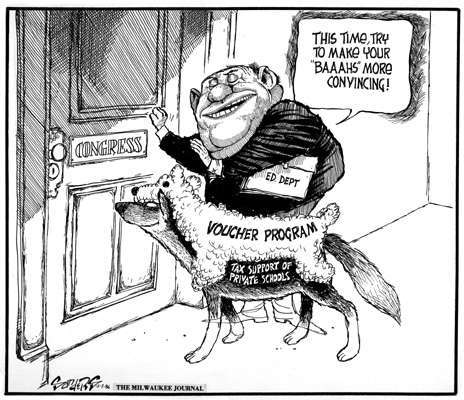
The latest example of this is vouchers, which are being pushed to implementation as a result of action by state politicians inspired by their right-wing agenda despite research that questions vouchers’ effectiveness.  As a result, in the face of one of the most massive changes to take place in the history of Tennessee schools, there hasn’t been the discussion – engaging educators and academicians – that is needed so that educational policies are based on the facts and proven results.  Rather, it’s been driven by the anti-urban school politicians who have now adopted new, palatable rhetoric about helping poor children get better education.

Consider the Source

Their sincerity requires, in the words of Samuel Taylor Coleridge, a willing suspension of disbelief and it’s awfully hard to do it in this case because of the political dogma that propels it.  After all, while the politicians pushing vouchers talk passionately about doing something to help poor students, they are simultaneously doing whatever they can to cut programs for the same families.

As a result, it’s hard to take them at their word (particularly since one of them once compared city schools to slavery) and even Stevie Wonder could see that their real purpose is to take aim on teachers’ unions (which to them, it is the scapegoat for all that they don’t like in public schools) and it is difficult not to be suspicious that the program providing vouchers for the poor is intended as a gateway to subsidies for the politicians more well-to-do constituents.

The Commercial Appeal opines that school districts must embrace school reform to succeed, but it begs the seminal question: what strategies should that school reform agenda contain?  Rather than rush headlong with vouchers, why doesn’t state government take the time to test its talking points with a pilot program to test the theories that they claim will increase classroom results

What has always been remarkable about the new Tea Party majority in Nashville is how their actions so rarely reflect their allegedly ironclad principles.  After years of extolling the evils of intrusive big government, state legislators are charging into every part of Tennesseans’ lives, but their school policies are particularly egregious.

Hard to be Trusting

They have already proven that they see public schools as vehicles to inculcate students with their doctrines, including  mandates for teachers to teach religious beliefs rather than science, abstinence-only sex education that prohibits the discussion of almost anything related to sexual relations, and to ban the word, gay, from Tennessee classrooms.  It’s hard to imagine that this group’s interest in vouchers is truly motivated only by their passion for the power of education.

It gives rise to suspicions that the vouchers, more than anything, are a way for state government to support religiously oriented private schools.

When it came time for a decision to be made about vouchers, it was made by state politicians rather than as a result of statewide discussions to determine if vouchers do in fact accomplish what the right wing rhetoric suggests.  Instead, driven by political power rather than educational policy, they quote hyper-conservative research that sets out to prove a preconceived political position.

The research by nonpartisan, nonpolitical research institutes hardly suggest a clear victory for vouchers.   According to the independent  Center on Education Policy, a review of the past decade of research on school vouchers has found “no clear advantage in academic achievement,” and mixed outcomes overall, for students who attend private schools using vouchers.

Research Results

The report reviews and summarizes major studies on school vouchers from the past decade, and also summarizes current publicly funded school founder programs.  According to the report, the scope of voucher programs and proposals has broadened over the past decade beyond serving just low-income students in low-performing schools to serving middle-income or suburban families.   We suspect this is Chapter 2 in the Tennessee voucher plan.

In general, the report finds, several prominent voucher studies released since 2000, examining voucher programs in Cleveland, Milwaukee and Washington, D.C., have concluded that achievement gains for students receiving publicly funded vouchers are similar to those for comparable public school students.

“We have a great body of research about the effects of vouchers that policymakers should draw on to inform current debates,” study co-author Alexandra Usher said in a statement. “Before state legislators and Congress move quickly to enact new voucher programs, they should consider the evidence from programs already in place for several years to ensure they understand the impacts their policies would have.”

The report notes that many recent voucher studies have been carried out or sponsored by pro-voucher organizations, and recommends steps to ensure that studies are designed, conducted and reported in an objective manner.  “We were surprised to find so many studies done by pro-voucher groups,” study co-author Nancy Kober said. “While this doesn’t mean researchers with definite positions on vouchers can’t be objective, it speaks to the need for outside scrutiny of study methods and guidance from objective expert panels.”

It’s exactly the kind of outside scrutiny that Tennessee legislators are so resolutely avoiding.

Categories: Education

Comments RSS Feed

Comments are closed.

Green Tea, A Bill Day Cartoon

by Bill Day. Memphian Bill Day is two-time winner of the RFK Journalism Award in Cartooning. His cartoons are syndicated internationally by Cagle Cartoons. Cartoons Archive →

Photograph by Amie Vanderford

More Images

This ongoing series of photographs is intended to show the daily lives of these single mothers in order to invoke recognition of their similarities to all mothers, along with understanding and empathy from the viewer of the strengths that these single mothers possess within the challenging situations they face. My hope is that newfound empathy with these mothers’ lives will give people some pause before they condemn single mothers when discussing issues such as welfare and other politically charged hot buttons.

  • Subscribe to Posts via Email

    You can get Smart City Memphis posts right in your e-mail box. Just sign up below to begin receiving them.


  • RSS

    • Friday Fun: A Los Angeles cycling highway?

    • All aboard: Engaging the public on transport projects

    • Weaving people back into the urban fabric

    • How clean is the air we breathe in cities?

    • Friday Fun: Self-driving automobile + Bus + Taxi = Otobuxi

    • Q&A with Hernan Navarro: Lima’s El Metropolitano BRT

  • RSS

    • San Francisco’s Uber-Complicated Taxi Industry

    • New Ventilation System Keeps Buildings Fresh But Warm

    • Eight Guidelines to Keep Creativity at the Heart of Cities

    • Infographic: Cities Embracing the Green Revolution

    • The Economic and Educational Value of Retrofitting Schools

    • Greening Cities with Better Bike Lanes

  • RSS

    • Why You May Not Be Seeing Many 17-Year Brood II Cicadas

    • Replica of the Day: Building the Simpsons' Springfield in Florida

    • Toronto Mayor Rob Ford: 'I Do Not Use Crack Cocaine'

    • Flags for the Fallen

    • This Is What the Scar From a Tornado Looks Like Through a Suburban Town

    • How Waze Became the Hottest Map App Around

  • Search Posts

  • About Smart City Memphis

    This is Smart City Consulting's blog and its purpose is to connect the dots and provide perspective on events, issues, and policies shaping Memphis and its future. Smart City Memphis was named one of the most intriguing blogs in the U.S. by the Pew Partnership for Civic Change, it was voted the best Memphis blog in About.com's Reader's Choice Awards, and The (Memphis) Commercial Appeal wrote: "Smart City Memphis provides some of the most well-thought-out thinking about Memphis' past, present, and future you'll find anywhere." Our blog's editor is Tom Jones, principal at Smart City Consulting and an editorial contributor at Memphis magazine, where he writes the monthly column, City Journal. Submit blog posts, ideas, suggestions, and emails to tjones@smartcityconsulting.com.
  • Archives

    • May 2013 (24)
    • April 2013 (34)
    • March 2013 (27)
    • February 2013 (31)
    • January 2013 (30)
    • December 2012 (29)
    • November 2012 (31)
    • October 2012 (33)
    • September 2012 (29)
    • August 2012 (33)
    • July 2012 (26)
    • June 2012 (33)
    • May 2012 (33)
    • April 2012 (31)
    • March 2012 (37)
    • February 2012 (32)
    • January 2012 (35)
    • December 2011 (29)
    • November 2011 (30)
    • October 2011 (34)
    • September 2011 (33)
    • August 2011 (39)
    • July 2011 (36)
    • June 2011 (41)
    • May 2011 (36)
    • April 2011 (57)
    • March 2011 (39)
    • February 2011 (45)
    • January 2011 (56)
    • December 2010 (44)
    • November 2010 (30)
    • October 2010 (28)
    • September 2010 (24)
    • August 2010 (22)
    • July 2010 (23)
    • June 2010 (34)
    • May 2010 (28)
    • April 2010 (32)
    • March 2010 (35)
    • February 2010 (31)
    • January 2010 (43)
    • December 2009 (49)
    • November 2009 (17)
    • October 2009 (24)
    • September 2009 (23)
    • August 2009 (18)
    • July 2009 (22)
    • June 2009 (28)
    • May 2009 (23)
    • April 2009 (23)
    • March 2009 (26)
    • February 2009 (25)
    • January 2009 (36)
    • December 2008 (15)
    • November 2008 (22)
    • October 2008 (21)
    • September 2008 (25)
    • August 2008 (23)
    • July 2008 (32)
    • June 2008 (27)
    • May 2008 (35)
    • April 2008 (26)
    • March 2008 (25)
    • February 2008 (29)
    • January 2008 (33)
    • December 2007 (20)
    • November 2007 (19)
    • October 2007 (32)
    • September 2007 (25)
    • August 2007 (25)
    • July 2007 (26)
    • June 2007 (16)
    • May 2007 (21)
    • April 2007 (25)
    • March 2007 (18)
    • February 2007 (16)
    • January 2007 (17)
    • December 2006 (16)
    • November 2006 (14)
    • October 2006 (18)
    • September 2006 (21)
    • August 2006 (20)
    • July 2006 (20)
    • June 2006 (17)
    • May 2006 (12)
    • April 2006 (19)
    • March 2006 (20)
    • February 2006 (23)
    • January 2006 (16)
    • December 2005 (23)
    • November 2005 (21)
    • October 2005 (23)
    • September 2005 (19)
    • August 2005 (27)
    • July 2005 (23)
    • June 2005 (16)
    • 0 (2)
  • Categories

  • Contributors

    • Aaron Shafer
    • Andrew Trippel
    • Anthony Siracusa
    • Barry Chase
    • Brad Leon
    • Brian Stephens
    • CEOs for Cities
    • Charles Santo
    • Chris Sanders
    • Crosstown Collaborative
    • David Williams
    • Doug Imig
    • Elizabeth Alley
    • Elizabeth Lemmonds
    • Emily Trenholm
    • Eric Mathews
    • Gene Pearson
    • Gene Pearson and Louise Mercuro
    • George Lord
    • Greg Thompson
    • Gwyn Fisher
    • Janet Boscarino
    • Jim Strickland
    • Jimmie Covington
    • John Kirkscey
    • John Lawrence
    • Jonathan Flynt
    • Josh Whitehead
    • Julie Ellis
    • Kenya Bradshaw
    • Laura Adams
    • Leah Wells
    • Louise Mercuro, AICP
    • Lurene Cachola Kelley
    • Margot McNeeley
    • Mark James
    • Matt Farr
    • Matt Timberlake
    • Melissa Petersen
    • Natashia Gregoire
    • Ray Brown
    • Rev. Steve Montgomery
    • Robert Bain
    • SCM
    • Scott L. Newstok
    • Smart City Memphis
    • Smart City Radio
    • Steve Bares
    • Steve Lockwood
    • Susan Adler Thorp
    • Tom Jones
    • Tomeka Hart
    • Tommy Pacello
    • Women Unite
    • Zach Hoyt

© 20111-2013 Smart City Memphis. All rights reserved.

  • Register
  • Log in
  • RSS
  • Smart City Radio
  • Smart City Consulting