
In the midst of public policy debates, nothing is as astonishing as how little people really know about government budgets and taxation.
We were reminded of again this week with the police union reflexively opposing any discussion about public salaries and benefits while some downtown leaders opposed a proposal for a Tax Increment Financing (TIF) district although they clearly haven’t done the most basic homework about it.
The TIF District has spawned a blizzard of emails – including some unsourced ones – that profess to be asking questions but the clear intent seems to be to kill a TIF district to pay for the development of Memphis Heritage Trail, inspired by similar projects in Washington, D.C., and Boston and which would appeal to the African-American tourism sector that we have too long ignored. It would include redevelopment of the Foote Homes housing project, the last remaining old-style housing project in Memphis.
In one recent email, the Downtown Neighborhood Association bulleted several concerns and every one of them had a factual error, and to top it off, a former DNA president said in The Flyer: “Downtown Memphis is known for its diversity, and if they do this (create a downtown TIF district) I can see development come to a crawl.
The Goose and the Gander
What the TIF would do to reduce diversity is unclear. After all, it would fund improvements of an adjacent neighborhood to downtown now declining and a deteriorating public housing project within a stone’s throw of Beale Street and FedExForum. Some people have expressed concern about TIF’s impact on government budgets, which seems strange since downtown is built on government subsidies, tax freezes, and direct funding for special projects.
A TIF district was created for Harbor Town/Uptown without this concern, and if downtown is in fact known for its diversity, it should be passionate about improving the lives of the residents of the neighborhood that runs from the South Forum area (where the SoFo plan has languished for years) and then generally eastward up Martin Luther King Avenue toward Southwest Tennessee Community College.
It’s also unclear why, in the words of the former DNA president, that a TIF would “see development coming to a crawl.” If that is the case, why did the Center City Commission itself seek a downtown TIF district in 2003? More than anything, it would seem that downtown development would be more robust if we had more than one main tool – PILOTs – in its toolkit, not to mention more money available to pay for much-needed improvement projects like the Downtown Streetscape Plan, Beale Street entertainment district, South Main District plan, and Convention Center improvements.
Few things have provoked as much misinformation as quickly as the TIF discussion. Contrary to some of the emails from downtown interests, the TIF does not collect all property taxes (it collects the increment in property tax increases). It does not prevent PILOTs from being approved inside the TIF district, it does nothing to produce more eminent domain powers for city government, it does not in fact capture sales tax revenues, it does not give the Community Redevelopment Agency (CRA) new authority over downtown (it’s the same structure as when the Center City Commission proposed a TIF nine years ago), and the CRA would not produce a downtown master plan (Downtown Memphis Commission would remain responsible for a downtown master plan).
Popular Redevelopment Tool
More to the point, dozens and dozens of TIF districts certainly haven’t done anything to hamper development of downtown Nashville and Chicago, where they are the favored vehicles for redevelopment. Meanwhile, TIF has also been used in Knoxville and Chattanooga, and the fact that the other cities have a complete toolkit is one reason that they have avoided the same overreliance on tax freezes that we have here. When your only hammer is a tax freeze, it’s remarkable how most development projects seem to be a nail.
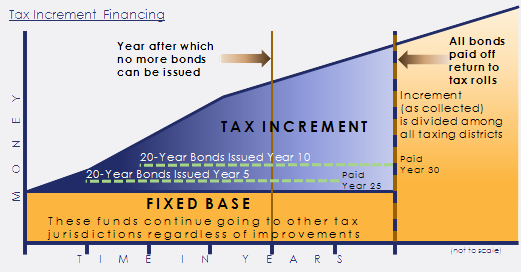
Put simply, TIF works generally through the following steps:
- • a geographic area is designated the TIF district;
- • a plan for specific improvements in the TIF district is developed;
- • bonds are issued and the proceeds are used to pay for the planned improvements;
- • the improvements encourage private development and thus raise property values above where they would have been without the improvements;
- • with higher values, property tax revenues rise; and
- • property tax revenue from increased assessments over and above the level before the TIF project began (the tax increment) is used to finance the debt.
Slumming in Downtown Memphis
Finally, some downtown interests seem offended that a TIF district would require that downtown is determined to suffer from slum and blight (as has been done in other Tennessee cities), but any walk around downtown provides proof positive that only a cock-eyed optimist would argue that the description doesn’t fit.
Meanwhile, police union members are at it again, confusing the difference between operating funds and capital funding in their complaints that City of Memphis is providing $1 million for the new Hattiloo Theatre in Overton Square that could have instead been used for salaries and benefits. Of course, the $1 million for Hattiloo Theatre couldn’t have been spent on salaries or benefits because it was capital funding, which is paid at a rate of about $65,000 a year in debt service.
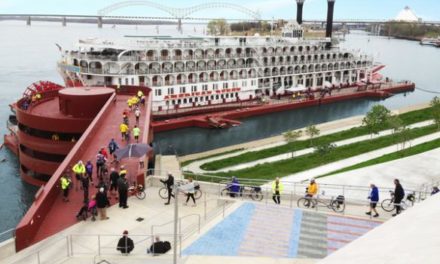
Remember, the union mangled the same facts about city financing in a TV ad during budget hearings earlier this year when it cited as wasteful the Overton Square garage with a price tag of $18 million, disregarding completely that the majority of the funding was spent on a flood detention basin. The ad mentioned things like the Pyramid, which does not use any city tax money, and American Queen headquarters, which has its own revenue streams.
In the real world, the choice isn’t between police cars and Fairgrounds or Pyramid improvements, because if Memphis never spent another dollar on the Fairgrounds or Pyramid or if it never redeveloped the Pinch District or improved the Convention Center, it would not free up any money to spend on public safety because the taxes that fund these projects are not property taxes and legally can’t be spent on anything like policemen’s salaries or new police cars.
At a time when Memphis couldn’t ever get the myopic, anti-Memphis, irrational Tennessee Legislature to give us anything resembling our fair share of state revenues, we can use Tourism Development Zone laws to collect the state’s sales taxes and pay for improvements without spending any city tax money. It’s a largely an untold story that the City of Memphis should be crowing about, and instead of the niggly commentary by the police union, they should be patting city elected officials on the back for investing in new jobs and economic growth without threatening the fire and police budget.


Stop confusing me with the facts! They ruin the story I want to believe.
Hearing it from both sides…somehow I feel in the middle. PR disaster in the making…. Just the facts…just the facts. This person will continue to study~ Thanks!
Re: the police force and its union-
This is why Camden disbanded its department as a mean to create a countywide force, or as the NYTimes put it:
“The reason is that generous union contracts have made it financially impossible to keep enough officers on the street. So in November, Camden, which has already had substantial police layoffs, will begin terminating the remaining 273 officers and give control to a new county force. The move, officials say, will free up millions to hire a larger, nonunionized force of 400 officers to safeguard the city, which is also the nation’s poorest”.
The MPD would do well to learn a lesson regarding their position as public servants of a city where the tax base and the population is in decline.
Like MCS, surrender the police and fire charter? I’ll watch the political fall out of that. THere is more than one way to create a consolidated government.
Not suggesting it’s the correct move- yet. However, seeing as austere municipal budgets are becoming the new normal, it would behoove the unions of the various municipal agencies and the members to begin considering the reality of their positions where services and compensation are concerned.
the poor and lower middle class who now live in that area will not be able to afford the new homes.
The plans include housing for those income brackets and there are incentives that are available for those families, as we understand it. Or at least that’s been the case with the previous HOPE VI projects.