
Great news. Downtown Memphis Commission President Paul Morris is interested in the suggestion made on this blog earlier this week that City of Memphis should seek compensation for blocked sidewalks – a la the fence at the Hickman Building – or blocked streets – a la Madison Avenue.
Mr. Morris said he is following up and will be looking into it. We’re sure he’ll report back and when he does, we’ll let you know.
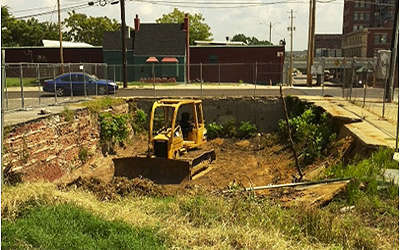
Since taking over at the helm of the Downtown Memphis Commission, he has been notable in his pursuit of more assertive enforcement of the anti-neglect ordinance and perhaps it too can be a tool in our campaign against ugly fencing and blocked access downtown. Latest evidence of the new approach at the Commission is the filling of the hole at G.E. Patterson and Front (site of the original downtown Blue Monkey). Signs of urban indifference do matter, so we’re encouraged that the Commission is taking these kinds of issues seriously.
Back to the Hickman Building and fining owners for blocking public spaces, here’s what Urbanut said that prompted this idea:
The Hickman Building is an especially interesting case. The building serves as a high rise neighbor to an elementary school. Aerial photographs show that the annex structure to the north of the Hickman building now lacks a roof and the interior is open to the elements. Adjacent sidewalks are blocked by chain link fences presumably in order to safeguard the public from falling debris. That in and of itself should be reason to move against such owners in court. If a building presents a risk that warrants such a barrier and closing of the public domain, then should the owners not be financially responsible for their own negligence? In this case, the same records reflect that the building is not owned by a some financial institution or some absent landlord. No, we can find that the Hickman Building is owned by a local resident located in East Memphis. I for one would be very interested to understand such an individual’s motive in purchasing such a property and facilitating its continued decay and endangerment to the public.
Seeing as a common element and practice of owners that are incapable of maintaining their properties is to simply erect a chain link fence to absolve themselves of the risks inherent in the structure, I would propose the city enact a hefty right-of-way fee be enforced where any structure requires the closing of a sidewalk or street (or any public right of way) due to negligence or lack of maintenance for the property owner’s structures. If a daily fee is assessed for these situations we might see owners take more interest in their properties. Simple maintenance would be far cheaper than the daily fee and a lack of fencing would risk a lawsuit should someone be injured by these properties.
Seeing as we are starting a new thread here, I will repost some info I also placed under the previous topic:
So finding existing ordinances pertaining to the closure or blocking of sidewalks did not take as long as I thought it would. Specifically reference the requirement in Sec. 12-28-5, Sub-paragraph A “…to keep clean and open”. Follow up post to define fines and punishment. Thank goodness for the internet…
Sec. 12-28-5 – Notice to property owner to build, repair or clean.
A. Whenever it is made to appear to the city engineer, or his or her lawfully authorized representative, that there has been a failure on the part of the owner of property to build, repair, or keep clean and open for public passage any sidewalk or walkway abutting on or adjacent to such property, the city engineer, or his or her duly authorized deputy, shall give notice to such owner, or his or her duly authorized agent, of the failure of such owner to build, repair, or keep clean and open for public passage such sidewalk or walkway.
B. Such notice may be given either by personal service on the owner or his or her duly authorized agent, or by certified letter addressed to the last known place of residence of such owner, or his or her duly authorized agent, and proof of the mailing of such registered letter by the city engineer, or his or her duly authorized deputy, shall be a complete compliance with this provision.
C. In the cases of nonresident or unknown owners, a publication of the notice by one insertion in a daily newspaper published in the city shall be a complete compliance with the provisions of this section as to notice.
D. The notice in each case shall specify what is required of the owner with respect to the sidewalk. The notice shall advise the owner that unless the requirement is carried out within thirty (30) days of the date of service, mailing or publication of the notice, the necessary work will be done by the city at the expense of the owner.
(Ord. 3590 § 1(12), 9-2-86; Code 1985 § 34-156; Ord. 894 § 1, 4-6-71; Code 1967 § 36-99)
Charter reference— Authority to compel property owners to build, repair and clean sidewalks, §§ 571, 572.
Sec. 12-28-6 – Failure of property owner to comply with notice.
A. Failure to comply with the provisions of this chapter and Chapter 12-24 shall be a misdemeanor subject to punishment as provided in Section 1-24-1 of this code.
B. Further, upon the failure, refusal or neglect of any person notified to comply with the terms and orders of a notice given pursuant to Section 12-28-5, the city engineer is authorized to build, repair, and keep clean and open for public passage any sidewalk or walkway abutting on or adjacent to the property of the person owning or controlling it. The cost of such work shall be a lien on such property, and may be enforced by suit in any court of competent jurisdiction.
C. As an additional and cumulative remedy, the city engineer may certify to the city treasurer the cost of such work. It shall be the duty of the city treasurer to place the amount so certified on the bill for city taxes assessed against the property abutting on or adjacent to the sidewalk or walkway laid. It shall be the duty of the city treasurer to collect, as a special tax, the amount so certified, which is declared to be a special improvement tax on the property abutting on, or adjacent to, such sidewalks or walkways. This special tax may be collected in the same manner as other general taxes are collected by the city.
What is “punishment as provided in Section 1-24-1” you might ask? This might be our problem, it amounts to little more than a financial slap on the wrist:
Sec. 1-24-1 – General penalty—Continuing violations.
A. Whenever in this Code or in any ordinance of the city any act is prohibited or is made or declared to be unlawful or an offense or a misdemeanor, or wherever in such code or ordinance the doing of any act is required or the failure to do any act is declared to be unlawful, and no specific penalty is provided therefor, the violation of any such provision of this Code or any such ordinance shall be punished by a fine of not more than fifty dollars ($50.00) for each separate violation; provided, however, that the infliction of a fine under the provisions of this Code or of any ordinance of the city shall not prevent the revocation of any permit or license for violation of any provisions hereof where called for or permitted under the provisions of this Code or of any ordinance. The city judges shall fix the amount of any fine to be levied under the provisions hereof as his or her discretion may dictate. Each day that any violation of this Code or of any ordinance continues shall constitute a separate offense.
B. Where any act of the General Assembly of the state provides for a greater minimum penalty than one dollar ($1.00), the minimum fine or penalty prescribed by the state law shall prevail, and be assessed by the city judges.
C.1. In addition to the provisions of subsections A and B of this section, and any court costs established by any city ordinance or state statute, the city is authorized to create and collect penalties, pursuant to T.C.A. Section 6-54-306, and in conformance therewith, to set a schedule specifying code section violation and penalty amount, and instituting a general penalty fund from which moneys may be disbursed.
2. The city comptroller shall be authorized to disburse allocations from the general penalty fund budget annually as approved by the council for implementing and maintaining programs as may be instituted for correction of ordinance violation. Each day constituting a separate offense and fine as set out in subsection A of this section, shall also be constituted as a corresponding separate penalty.
3. Penalties may be waived at the discretion of the judge; however, unless waived, penalties shall be assessed in the amount set out below:
Each code section violation for which a fine has been imposed, shall automatically carry a penalty of up to two hundred dollars ($200.00), except the following designated sections shall carry a minimum penalty of two hundred dollars ($200.00): This sections does not include blocking a sidewalk, thus I am assuming that the fine is capped at $50 as mentioned in section A.
I think the question is- seeing as the penalties for such infractions are so inconsequential- do we as a group think there would be traction for proposing a harsher penalty to be applied where negligence on the part of a property owner requires the closing of a sidewalk or any other public right of way?
James Owens added: @Urbanut: I think that would be a good start. We should also probably look at the laws and ordinances of other cities as well to see how they deal with the owners of neglected properties and see if we can apply those same rules here.
And that’s what James Owen did. Here’s his latest:
Okay, I did a little research on ordinances regarding neglected properties and found something that was recently done about a year ago in Tulsa, Oklahoma:
I also looked up Tulsa’s Code of Ordinances as well:
http://library.municode.com/index.aspx?clientID=14783&stateID=36&statename=Oklahoma
Title 24, Chapter 1 had some information relative to nuisances and neglected properties (Section 103), but one of the things they added was a stiff penalty of up to $1000 per day as well as jail time (Section 106).
There may be some other codes, but this was the first one I was able to find relative to our discussion.
SCM: It proves once again that we aren’t boasting – we’re just stating the facts – when we say we have the smartest readers in town.


$1000 per day fines just MIGHT get the attention of owners of 118 Madison, the Hickman Building, Hotel Chisca, and other offenders.
Here are some of Portland, Oregon’s city codes (for comparison and reference):
=============================
Title 29 Property Maintenance Regulations
http://www.portlandonline.com/auditor/index.cfm?c=28193
—
29.20.010 Outdoor Maintenance Requirements.
(Amended by Ordinance Nos. 176381, 180330 and 183534, effective July 1, 2010.) It is the responsibility of the owner of any property, improved or unimproved, to maintain the outdoor areas of the property and adjacent rights of way in a manner that complies with the following requirements:
[clip]
K. Obstructions to sidewalks, streets, and other rights of way. Keep the adjacent rights of way free of anything that obstructs or interferes with the normal flow of pedestrian or vehicular traffic, unless specifically authorized by permit or ordinance to do otherwise. This responsibility includes, but is not limited to, removal of earth, rock, and other debris, as well as projecting or overhanging bushes and limbs that may obstruct or render unsafe the passage of persons or vehicles. This responsibility also includes, but is not limited to, the obligation to maintain all rights of way referenced in this subsection to meet the following minimum clearances:
1. Sidewalks. All sidewalks must be clear of obstructions by earth, rock, or vegetation from edge to edge and to an elevation of 7-1/2 feet above sidewalk level. For example, bushes that encroach on or over any part of a sidewalk area must be cut back or removed and limbs of trees that project over the sidewalk area at an elevation of less than 7‑1/2 feet above the sidewalk level must be removed.
2. Improved streets. All improved streets must be clear of obstructions to vehicle movement and parking from edge to edge and to an elevation of 11 feet above street level. For example, bushes that encroach on or over any part of a street must be cut back or removed; limbs of trees that project over a street at an elevation of less than 11 feet above street level must be removed; and no wires or other things shall be maintained over the street level at any elevation less than 11 feet.
3. Alleys and unimproved rights of way. All alleys, unimproved streets, and other public rights of way must be clear of obstructions that may hinder the normal flow of traffic or render the right of way unsafe for its current and necessary use.
—
29.40 Dangerous and Derelict Structures
29.40.005 Generally.
No property shall contain any dangerous structure or derelict building as described in this chapter. All such structures shall be repaired or demolished.
(EDITORS NOTE: this one has lots of definitions (which I won’t copy and paste here) of dangerous and derelict which would seem to apply to Memphis’ (and the Hickman building as described in this blog post). Essentially, Portland city code 29.40 makes it illegal to keep a building in a dangerous or derelict state, and authorizes the city to impose fines and to demolish or repair at the owners expense.
—
ENFORCEMENT FEE AND PENALTY SCHEDULE
http://www.portlandonline.com/auditor/index.cfm?a=81841&c=38353
Binding City Policy
BCP-ENB-14.10
[clip]
Code Enforcement Fees
[clip]
Properties With Only Non-Residential Use: $583 per month
Properties in violation for 3 months from initial notice of violation: Twice the amount stated above
[clip]
Demolition or Repair
Administrative Charges: 40% of the demolition or repair cost
Civil Penalty: $612
Demolition or Repair Charge: Cost to demolish or repair building
[clip]
Chronic Offender Fees
First Occurrence: $540
Second or Additional Occurrence $1,080
[EDITORS NOTE: There are also a *lot* of administrative fees related to the whole processing of violations, which would apply in addition to the ones I quoted above. This schedule is adjusted annually by City Council, so the costs do rise with inflation and whatnot.]
Judge Potter recently requested (and the County Commission agreed) to impose financial penalties (capped at $1,000 per violation) upon those who fail to pay the initial, paltry fines for failure to clean up or maintain.
http://www.commercialappeal.com/news/2011/jul/26/commission-ups-ante-on-code-violations/
Although Commissioner Harvey worried the fines might make violators sad, reason prevailed in the end.
Now to the real meat of the matter… enforcement.
SCM- Thank you for the repost. It is very gratifying to see that Morris has taken interest in this issue and is exploring its use downtown.
James, Portland and everyone else- not that you need me to tell you this- but thanks for the continued research and input on the topic. The fact that other communities as varied as Portland and Tulsa have imposed harsher penalties proves the importance and viability of such action at the civic level.
Joe Spake is right, just do it.
It’s frustrating that these property owners sit on these buildings forever without maintenance. I know it’s expensive to fix these properties, but if you can’t afford it, you can always sell to someone who can. However, letting it slowly fall apart should be met with fines.