
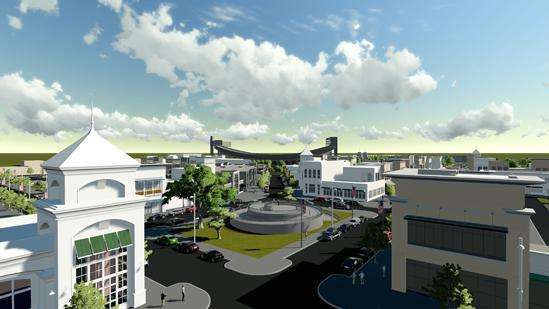
As the City Council begins to debate the idea of investing in the infrastructure necessary to create a new neighborhood at the former Fairgrounds, it’s worth defining what “urban village” really means. It’s not a shopping strip, or a mall, or even the small town simulation known as a lifestyle center. Instead, an urban village is a truly great neighborhood composed of a well-defined and appropriately scaled network of walkable, comfortable streets, sidewalks, and open spaces.
At its heart lies an attractive and compelling central open space surrounded by compatible uses that define and energize it. In this “civic living room”, neighbors regularly meet to celebrate, recreate, and relax. It’s designed to reflect the story of the place and its people. It might contain a landmark feature, or even a building of civic importance.
A great neighborhood includes places to live, work, shop, learn, and play. It has a distinct central business district with shops that satisfy daily needs such as a cleaners, a grocery, a bank, and places to eat and drink, and to casually come across friends and neighbors. It is featured in city guidebooks and websites.
It’s clean, comfortable, convenient, lively, and walkable. It is vibrant during both daytime and evening hours. It includes abundant landscaping, natural features, and public art. It is its own destination, and encourages visitors to stop, get out of their cars, and walk around.
Like a small village a great neighborhood feels friendly, familiar, welcoming, amiable, and safe. However, it also offers diversity, excitement, choice, and urbanity. Great neighborhoods are the basic building blocks of great cities. They enhance the lives of their current residents, as well as attracting new residents, especially those who can live in whatever city they choose.
Memphis already has urban villages. Harbor Town is one, Cooper-Young is another. Any neighborhood where people walk to a central area in which they regularly bump into and engage people they know in a pleasant, active public realm is an urban village. However, where some succeed, others may not. The difference often lies in providing a positive experience that the overall market values in tangible ways, such as enhanced property values or premium prices.
The quality of a place is measured almost entirely by the quality of the human experience it offers. For example, Disney has always recognized that its visitors will return if they have had a memorable and universally positive experience. Great cities and great neighborhoods offer the same kind of opportunities for positive experiences, and the resulting increased and return traffic, although the precise nature of the experience may vary substantially from place to place.
The conventional wisdom that drives suburban development dictates that retail stores go where their potential customers are already living. In successful city neighborhoods, the opposite is often true. Neighborhood business districts not only can thrive, but also can drive surrounding development by offering something unique in a regional market. The retail mix sets the tone, character, and theme of a place, the elements of experience. It can be geared to a particular market segment such as upscale shoppers, families, empty nesters, or young singles.
One example can be found in the emerging Broad Street Arts District. Although still in its relative infancy, the Broad Street area is beginning to attract a series of retailers and restaurants compatible with the arts theme. Like most successful districts, it offers a unique collection of similar uses supported by regular programmed festivals and activities in the public realm, in this case, the street itself. Although it will take time to grow and evolve incrementally, it has already unified the existing neighbors, and is attracting investment.
The Fairgrounds can become Memphis’ next great neighborhood, built around a specific collection of stores, restaurants, and activities that meet a particular unmet need of the Memphis market. If designed with the characteristics that define the term urban village, this new great neighborhood can generate premium prices for the surrounding real estate, attract new residents to Memphis, enhance our civic pride, repurpose underused land at the city’s heart, generate jobs and additional tax revenues, and point the way to a brighter future for all. That would be an investment worth making.



Urban ‘villages’ seen to be a waste given the expanse and well-rooted trend of suburban development. I believe it makes more sense to embrace a loosely connected collection of ‘suburban villages’, afew of which are already flourishing well-outside the city-sentre.
Reverse migration will never become in vogue, en masse in Memphis, TN. That ‘culture’ seems anathema to Memphis’ land mass and already dispersed population.
The viability of Memphis urban villages seems more of dreams of a few czarist bookworms and self-indulgent urban-planning geek….sort of like “concept vehicles” at the Paris Auto Show….most of which never get built.
Ray- great overview.
There are definitely questions yet to be answered concerning the specific Fairgrounds proposal. My primary issue regards the actual nature of the project and its impact on surrounding neighborhoods. There remains a limited number of retail and office vacancies in the nearby neighborhoods of Cooper Young, Lenox and the Union Avenue corridor. Alongside these limited number of available spaces are several opportunities for urban infill development albeit to a smaller scale than discussed for the Fairgrounds. While I am supportive of the concept of creating a “new neighborhood” at the Fairgrounds, I hesitate where its impact on the retail market for the Midtown area. What impact will this project have on the potential inherent in existing neighborhoods surrounding the Fairgrounds? Will this project bolster or depress the area’s market? Certainly there are larger uses that are not suitable for the existing neighborhoods, but are we really discussing a Target location or a collection of retail and office spaces? The entire metropolitan area suffers from a glut of retail space. While market studies have identified Midtown as being underserved, it is scarcity that can elevate rental rates to a point that we begin to see not only renewed development but also gain the leverage to ensure that new development takes on a more urban form.
Anonymous: Baloney. More excuses for unsustainable land use, both environmentally and financially. There is no future but climbing county tax rates and bankrupt county government if we continue to do what we’re doing.
More to the point, this urban village approach works in so many other cities and there is reverse migration in cities with even worse density than us, but for some reason, as usual, we give ourselves an excuse that “we’re too different” to get it done.
When will we quit the excuses and do the hard work of building a great city?
Urbanut:
You’re right: U of M studies quantify the significantly underserved retail needs of midtown, and the plans for the urban village includes better connections and improvements to Cooper-Young and Beltline to create the linkages that support those neighborhoods. The plan is for a junior box retail and then smaller retail spaces with a hotel and housing that are needed by CBU for some of its funcitons. In this way, and with the combination of the sports venues, this project doesn’t seem designed to be a midtown retail site, but a larger metro site that could hopefully pull back some of the customers out in lifestyle centers like the one in Collierville. Best of all, experience in other cities seem to show that the pie is made bigger.
Also, we’re just excited to show that we can be smarter in the way that we develop a “real” mixed use project.
Building a ‘great city’ ? Give me a break. You won’t live long enough to ‘enjoy’ some suggested future ‘greatness’.
You have to be blind not to understand that most future growth will continue on the periphery as well.
Residents aren’t going to reverse migrate from Germantown, Collierville, East Memphis, Eads, Arlington, Bartlett, Olive Branch, etc etc.
Sorry, but you’re fooling yourself. Residents in the burbs don’t want to be huddled into some high density psuedo-urban fake village within the city.
Some like the idea of it all, others simply laugh and continue to gravitate past the perimeter highways….er, EAST BOUND.
We shouldn’t fear that obvious trek eastward. It’s been in place since the 1960s really. The motion started decades ago. Those trends are not going to die just because some academic suggests the urban model is universally preferable…..it’s not….not in Memphis, TN, and a bunch of other cities….duh.
Sure, we can consider these urban models as well…but our collective future will be a blend of approaches…and the suburban approach is well rooted. That’s unmistakable to anybody that is not drunk.
Give up on the grandiose urban revamp..some of it might work for a small population, but Memphis has a history and foundation of expansive suburban developemtns.
There is nothing evil with suburban planning and intelligent managed growth. It’s not going to be halted.
SCM, thanks for the reply.
Too true- the audacity of actually combining residential units with retail programming is a real mile marker. As long as the retail component pursues those uses which cannot otherwise be accommodated in the existing area, the pie will indeed grow larger. A positive for both nearby neighborhoods and the city as a whole.
On a separate not, personally I would prefer that the individuals taking on the Crosstown redevelopment could somehow incorporate a large retailer to enter that space. Instant high profile space for certain national retailers and the financial leverage to really fuel the projects launch. One can dream.
I agree with Urbanut. There’s a very real risk that the retail at an “urban village” at the Fairgrounds could drain momentum from infill development opportunities in Midtown and elsewhere within the city limits (even downtown). I’m not convinced experience in other cities demonstrates that the development of urban retail centers necessarily creates a larger pie. For example, a study is out this week showing that TOD development along new urban transit lines has had great success in some areas and less-than-expected success in others. For the urban retail pie to get larger in Memphis, either median income has to go up, total residents go up, or the trade area extends outside of the city, drawing non-city residents in for retail experiences. Building denser, likely multifamily, residential and creating new demand thereby seems, to me, to be the best way to begin to increase the urban retail pie in Memphis. From that perspective, they might be somewhere close to starting out on the right foot. The trick, however, since this lesson has been learned all over the country as well, is to not over-retail a mixed-use project. An over-retailed mixed-use development at the Fairgrounds (depending on scale of the project and total square footage) could potentially drag down mixed-use retail demand in the city for years, just like high-rise condo towers created condo gluts in cities across the country that will take years to absorb. That would be a disaster and the risks are such that I’m not sure this project should receive broad support unless it can be determined that such scenario won’t occur.
I would much prefer a Memphis model in which multiple, smaller real estate players, investors, entrepreneurs and business owners develop and re-develop smaller-scale, newer economy, urban infill mixed-use spaces across the city over time to, what in this case looks like, a city administration with an unhealthy concept of urban finance and real estate market dynamics deciding that something needs to be done with a massive unused space in the middle of the city and trying to enter into the game of real estate development with a massive scale retail project.
Robert Lipscomb at one point alluded to the Fairgrounds becoming a Millennium Park of Memphis. Millennium Park and an urban retail village have little in common. I’d like to see the idea of a beautiful, multi-functional public space revisited, expanding upon the success of a Campus Martius-type project in Detroit. Ideally, however, the city would bring in a firm like Foster+Partners to put together a master plan like the Milan Fair Masterplan of 2003, that would incorporate dense residential and landscaped public park space, then RFP that to developers capable of realizing it.
Charette! Charette!
bring on the brown paper and birkenstocks!
free Starbucks!
We’ll draw up some plans, and force the evil developers to follow em!
o.k. that’s fixed. What’s this about schools something or other?
Although I admit to being something of a bookworm and urban-planning geek (not sure czarist applies), I also believe in both choice and practicality. It’s true that many Americans prefer the suburban lifestyle, and good for them, I say. New and improved city neighborhoods may not draw such people back to the city. They’re not intended to.
Instead, they may give people considering a move to Memphis another reason to make that move. Many of them are young people who prefer city life. Many of those people are the children of parents who themselves migrated to the suburbs. Their kids are looking for something more authentic and interesting, something more urban. So creating better urban neighborhoods fosters more choice.
It’s also a practical strategy for moving non-taxable land back onto the tax rolls, bringing in more revenue and therefore helping keep taxes low for the rest of us. As Herodotus says, more residents in greater density means more customers for both existing and potentially new businesses. Rather than fear a new neighborhood, existing businesses should welcome new customers. Any strategy that brings new residents to Memphis, and that adds value to property, is good for the financial interest of everyone who already lives anywhere in area.
Despite the impression some may have, the urban village concept is not a shopping center. It is a true city neighborhood where stores grow up organically to serve unmet needs, and where construction occurs in phases as demand increases. The City’s investment is limited to what it does best: streets, sidewalks, utilities, squares, parks, and the amenities that make up the public realm. Private developers will lease land on which they will build and own some practical combination of retail and residential buildings. That creates jobs and provides growth for local contractors and other businesses, providing more money to circulate in the local economy, That’s a practical strategy for putting money in everyone’s pocket.
If you live anywhere in the region, opposing this idea seems, to me at least, to be acting against one’s own self-interest.
good stuff:
http://finance.yahoo.com/real-estate/article/112409/cities-you-dont-want-to-live-in-yet?mod=realestate-buy
Dumb City- you continue to prove that your latest pen name is the most appropriate in relation to the material you provide.