
This is the second part of our post about our case study in city branding:
Milestone 7: Preliminary Strategies
As a result of the insights by the Smart City Consulting/Stone Mantel team and the input of the public, a recommended approach and two alternatives were developed. They focused on brand truth, brand character, brand story, the visual and verbal vocabulary, recommendations to strengthen the product truth, and key initiatives.
Milestone 8: Final Strategies
Pensacola’s brand recommendations were rolled out in a special hour-long presentation that was made to a packed room at the Institute for Human and Machine Cognition. After reviewing a series of adjectives that described what the people of Pensacola aspire to be, Smart City Consulting/Stone Mantel explained why the word, glorious, was selected as the single descriptor that formed the bridge from the Pensacola of today to the Pensacola of tomorrow. Put within the context of the city’s brand truth — its higher purpose — lying at the core of what brings the people of Pensacola together, it was to be “unapologetically glorious.”
In explaining the logic of this brand truth, we said:
“Life in Pensacola is glorious. It is a place of heroes, of dramatic natural beauty, of time-honored traditions, of triumph over great odds. Pensacola can realize its full potential when it embraces its own glory.
“For generations, this spirit of exploration and self-discovery, adventure and opportunity has burned. It’s why being a part of Pensacola is about being unapologetic about what makes your life glorious.”
This brand truth gave direction and inspiration to the people of Pensacola as they reach decisions on crucial questions facing their region. To create the cultural capital to achieve this brand, we said that Pensacola must be “true, proud, and new” —
• True: “Putting community first, true to history to ‘real’ Florida, to a balanced way of life”
• New: “Embracing new technologies, cultural influences, ideas, and people”
• Proud: “Proud to be from this place, proud of each other, never apologize for what is glorious about you”
The team recommended four ways to change the culture:
1. Stop blaming others (especially each other)
2. Start being fiercely proud and reject negative comments
3. Create buzz about entrepreneurs who could go anywhere but chose Pensacola
4. Develop a sense of community through a unified sense of purpose
The recommendations about the brand character became particularly significant because they became the basis for a highly successful internal campaign directed by Bpm, which also served as a key adviser in interpreting and connecting with the distinctive culture of Pensacola. The recommended brand character was “spirited, heroic, real, and radiant,” and the branding team also recommended the verbal and visual vocabulary that would communicate the personality of the brand.
To deepen understanding of the brand, Smart City Consulting proposed a brand story:
“Today Pensacola is a place of little known facts. Its story strategy needs to focus on telling many more people about what is happening now, and then support these heroic stories with Pensacola history. The recurring themes are discovery, rediscovery, and self-discovery.
“Each era, but especially this one, is a time of discovery for Pensacola and those who embrace it. The goal of the brand story is to dramatically increase the lore – the mythic quality and acquired knowledge – associated with Pensacola.”
We suggested two stories about “A Time of Discovery”:
1. Today is a time when Pensacola is being discovered, when its courage to invent new ways of living and working are shining through. There is no better time to discover the undiscovered than now. Here and now.
2. Pensacola is, of course, the place of discovery. For 450 glorious years, Pensacola has been a place of discovery, rediscovery, and self-discovery. The heroes of today keep the tradition alive.
But most of all, a city’s brand is about creating a reality that is true to the brand, and in this vein, Smart City Consulting/Stone Mantel, with key support from Bpm, recommended strategies to fulfill the brand’s functional, social, and emotional jobs.
The functional job centered on building a vibrant downtown night life. To accomplish this, the team recommended specific strategies — reclaiming the waterfront, creating connections, making roads bidirectional, developing water transportation between downtown and beach, creating a wireless downtown, developing balanced downtown incentives, and completing the master plan for the Institute for Human and Machine Cognition.
The emotional job was based on making people feel that being Pensacolian is glorious, and the branding team recommended that the city elevate history and natural resources in marketing and business recruiting, improve urban design and connections, develop a focus on competencies rather than organization names, build a network of bike and hiking trails, and creation of the Pensacola Triathalon, an arts district with incentives, and eco-tourism and heritage tourism programs.
Bridging the gaps between the two Pensacolas was the key social job recommended for the new brand, and strategies included bridging the gap between beach and downtown cultures, building bridges so all sections of the community are proud, building physical connections between people and neighborhoods, closing the resonance and reality in areas such as ecology, building bridges to young professionals, bridging beach and innovation cultures, and creating an event that is a ritual for community and its values.
The Launch
Smart City Consulting/Stone Mantel recommended that the brand was introduced internally first, then to the media, and then to the outside world. Because the well-known Pensacola creative agency Bpm had been involved from the earliest days of the process, the launch of the new brand was quickly and powerfully directed at the citizens of Pensacola first. After all, if the new brand did not resonate with the region’s own citizens, it would never be communicated persuasively to outside audiences.
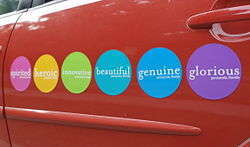
Response to the new brand was immediate and enthusiastic. In launching the brand, a campaign to capture the essence of the brand and instill renewed pride in the community was started. The plan – to place single words from the branding process on brightly colored magnet circles and to ask Pensacolians to select the one that described their city to each of them them: Innovative, Glorious, Genuine, Spirited, Beautiful, and Heroic.
The words were enthusiastically embraced, and dots were everywhere. More than 45,000 magnetic dots provided by the daily newspaper were put on cars as people cast their votes for the word that best defined Pensacola to them. The weekly independent newspaper cleverly applied the adjectives to its “best of the coast” special edition, selecting organizations, businesses, and individuals who embodied innovative, glorious, genuine, sprited, beautiful, and heroic.
After a few months of distributing the magnetic dots, the Chamber of Commerce added banners and the
words were hanged throughout downtown and major streets. Plans for other innovative applications are under way, and strategies are being developed now to incorporate the brand into other Pensacola tourism and economic development programs.
The Importance of City Branding
Pensacola’s new brand – like every successful brand – is becoming the foundation for a stronger region. It changes perceptions both internally and externally. It creates a consistent context for its communications and marketing. It deepens the region’s positioning in the economy and helps to make it more appealing for residents, businesses, and visitors. It combats negative stereotypes and delivers the promise of a distinctive and meaningful region. It provides a shared vision for the future and speaks to its own aspirations for itself.
In other words, a city’s brand is a powerful tool that defines it, speaks to its uniqueness, and attracts positive attention in a world where every person and business decision-maker is flooded with information overload.
In the end, the brand reflects Pensacola’s DNA, communicates a promise about the region, and helps deliver the distinctive assets that back it up. This case study describes one such process in Pensacola but the essence of the Smart City Consulting/Stone Mantel approach ensures deep and meaningful insights that are vital for a city as the brand is communicated both internally and externally.

All these branding articles have a sort of generic, shooting scattershot from the trees, type of feel.
If you focused, what would YOU say Memphis brand is.
I’ll stipulate that , although I don’t like the word “brand” for such a task, we do need to focus and get some understanding of what our purpose, our core matrix purpose is. We don’t have that now and the using the word brand will satisfy you, please elaborate on what that brand might be.
Whatever you do, don’t ask us to paint over the physical history, but, don’t ask us to read more into it than is there either. Build it on solid ground.
Awesome Post. I add this Blog to my bookmarks.