
Ever wonder why cities invest in parks, greenways and bike lanes? The answer is simple: it pays off.
Consider New York City’s Central Park. Beyond being a treasured local landmark at the center so many lives, it’s also the undeniable benchmark in smart park planning and proof positive that parks matter.
In 1856–before the 843 acre park was built–the assessed valuation of real estate in areas surrounding the site totaled $26 million. When Central Park opened to the public in 1872, real estate values had risen to $186 million. Central Park continues to be a major economic engine. The park provides hundreds of direct employment opportunities and thousands of indirect jobs. It’s a powerful tool to attract and retain commerce and talented employees, and a magnet for hard-won tourism dollars.
Who goes to New York without visiting Central Park?
In his book Forty Years of Landscape Architecture: Central Park, famed and visionary Central Park designer Fredrick Law Olmsted noted that “looked at from a commercial standpoint…Central Park was a success beyond all expectations” (Olmsted, 1928). Central Park is a success by many other measurements, too. It’s New York’s public living room, an environmental education oasis, a major contributor to community health, and a chief contributor to good air and water quality. It’s the green heart of the city that never sleeps.
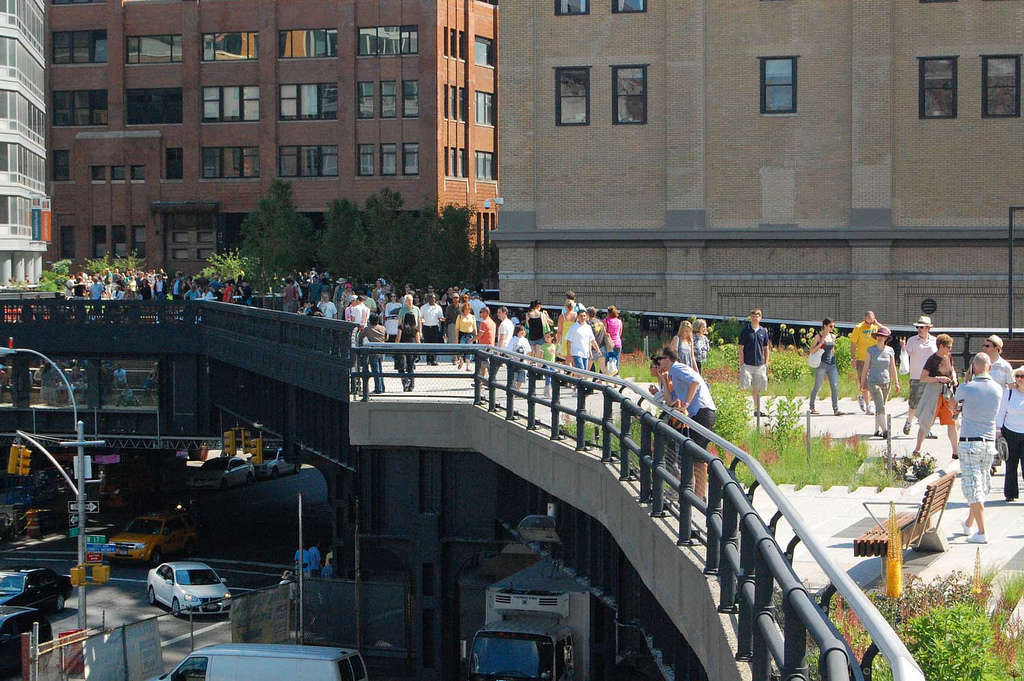
My recent visit to New York revealed a confident city that continues to understand the value of strategic investment in its public realm. I was very fortunate to have Lisa Switkin and Sarah Weidner of the landscape architecture firm Field Operations (master planners for Shelby Farms Park and the acclaimed High Line greenway in New York City) as my private tour guides. We began our tour on a cold, damp Monday afternoon with a walk along the High Line–an elevated abandoned rail bed that is being converted to an urban greenway. The first phase of the High Line (see photograph) opened to the public in June of 2009 and runs from the Financial District to Soho.
It’s an unusual concept. An elevated greenway in New York City? A visitor’s expectation might be an atmosphere reminiscent of “The Jetsons,” but the High Line is a natural oasis of wood, trees and native grasses running horizontally through a familiar vertical skyline of residential and commercial high rises. Even on a dreary winter day, the park was filled with visitors. It was abundantly clear that High Line Park has already had a profound positive impact on the neighborhoods it touches.
Our next stop was the Hudson River Park–a spectacular new waterfront park that has transformed the entire west side of Manhattan and rocketed property values in the area by 15 – 20%. Sarah, one of my capable guides, explained excitedly that with the opening of the Hudson River Park, she is now able to ride her bike from her home in Brooklyn, across the Brooklyn Bridge and up the Hudson River Park to the Field Operation’s offices on 10th Avenue in less than half an hour. Now that’s a great commute!
To complete the tour, we hopped the closest subway line and crossed under the East River to visit New York’s current mega-park project. Brooklyn Bridge Park is currently under construction, and when complete, this 85 acre park will replace abandoned piers, parking lots and other eye-sores to become a magnet for the kinds of economic development that have been attracted to Central Park, the High Line, Hudson River Park and other celebrated parks in New York City and around the world.
Parks matter in more ways than one. That’s why progressive city leaders, with the support of some visionary state and federal elected officials, invest hundreds of millions of public dollars in public park infrastructure. Parks pay dividends. That’s why local philanthropists donate precious time, energy and financial resources to enhance community parks and greenways. Parks enrich our lives. That’s why everyday citizens (like you and me) volunteer, advocate for, support and defend our neighborhood parks and greenways.
It’s clear that the quantity and quality of investment in infrastructure and operations of parks, greenways and other public realm amenities is a primary indicator of the success or failure of a city. It’s part of what separates New York City from Detroit. It helps explain why Minneapolis, Minnesota is thriving while Toledo, Ohio languishes. A winter work day in Manhattan revealed a thriving outdoor culture that reflects a sense of self-assurance, a confidence that New York City will forever be strong and relevant.
I want that for my city. Don’t you?


Yes! If Memphis could be known as the “green city” with Riverfront, Fairgrounds and Shelby Farms connected by a green line for transit, bikers and walkers along with the Wolf River green line, Memphis would be more prosperous. Young people would want to live here. Memphis had a great park system in the 1950s that was eroded by time, politics and mostly lack of money. We can have it again with even more this time.
There is no doubt park do indeed matter. However, the impact parks have differs by city. Having lived in NYC and now living in Memphis, I have some observations of key differences as to why a park of the same proportions and programming would have a major impact there and negligible impact here. The biggest difference is of course the amount of outdoor space available per resident. There is precious little green space in much of Manhattan, Brooklyn and Queens, thus having a view of a park (be it in an apartment or office) is a real find.
NYC, the ever crowded city, has little in the way of homes on quarter acre lots, at least in the inner borough areas. This lack of private outdoor space drives citizens to use these parks (and thus increases their value)- being the only “yard” available to them. Few can afford a residence with enough room for a swing and slide in the rear, or enough space for rover to run around. However, in Memphis, the vast majority of residents have their own semi-private park in front of their homes and a very private park in the rear, reducing the need for such public space and its use.
Public transit is another major driver of park use in NYC. As noted by the author, this system allowed for relatively easy access to the parks visited from almost any point in the city. In the case of Memphis, our inefficient transit system limits one’s ability to access in parks in any way other than by automobile. Hopefully the new greenways that are currently under construction will begin to address this issue, but they can never hope to replace a well panned transit system. Residents of from all sections of the city need access to both neighborhood parks for certain activities as well as access to the city’s few major parks (Overton and Shelby Farms) in order for these spaces to reach their full potential. If these parks were to experience heavy use, seeing as most would have to get in a car and drive, they would need to pave over a significant portion of their acreage to accommodate patrons.
Sunday morning I pulled out one of those big delivery maps that businesses used before tom-tom and drew all of our long planned and campaigned for park amenities for my Cub Scouts (mostly Snowden and Idlewild boys).
I included all the greenways–VECA, Shelby Farms (CSX) and the Wolfriver. I showed them how planned painted bike lanes would connect to Overton Park (soon to be State Natural Area), Downtown/Mud Island, the Fairgrounds (whatever comes of that) and Shelby Farms. Then, crafting the pitch, I added the proposed skateparks at Rodney Baber (City) and Binghampton (outdoor non-profit) and Greenlaw Community Center.
It was a good exercise in illustrating that we have and are working diligently to green Memphis. Sometimes it’s just hard to see when nearsighted.
NYC has Central Park, Riverside park, and you missed Astoria Park, EVERYBODY in the neighborhood goes there. 14 tennis courts, a NYC block sized swimming pool, quiet area near the rail bridge, a Pro track and field, high diving area, wooded walking trails, no basketball goals and nobody cares, soccer fields, baseball fields, It like Central park for Queens, minus the ice rinks.
Central park has two ice rinks, playgrounds in the shade under trees, a reservoir with a running track around it, 25 baseball diamonds, sheep’s meadow, horseback riding, trails, bridges, reflection ponds, giant boulders to flop around on, concerts, band shells, benches, cobblestones, strawberry fields, CP Zoo, Delacourt Theater, The Met Museum, and of course, the view of the Guggenheim where you see the artist’s true inspiration, a toilet, and EVERYBODY goes to that park too.
I lived there for many years and ran Riverside Park, Central Park and Astoria Park. Great parks, great funding!
We may not have 12 to 24 million people here, but, our parks don’t need to suck.
Baseball diamonds that are crowned so they don’t hold water, here’s something cheap we could do.
Track and field would be a great addition, shredded tires for rubber tracks last a LONG time, worth every penny.
There is almost NEVER any violent drama around a track and field event.
There’s something that could be done with all those tires.
“It was a good exercise.”
Motto of the Shelby County Division of Planning and Economic Development.
Thanks for putting it in perspective, IO.
Scott,
Late on a reply here, but I could not agree more on the dedictaed bike lanes denoted by painted lanes. We have numerous roads throughout the city that, at least in my humble opinion, are grossly overbuilt and underutilized due to poor planning, development that did not occur, or shifting use patterns. While I would prefer the city, county and state to narrow these roads either through the construction of medians or narrowing the roads, I know this can be an expensive process. It would be much easier- not to mention cheaper- to add on street parking to these thoroughfares and paint dedicated bike lanes on the roadways. I’m sure you are aware- the bike lanes on 9th, Hudson and Bleeker (I think) in Manhattan are great examples. The solid green, maroon or stripped paint leave little question as to whether cars are not meant to drive in those areas.