
For too long, we’ve had the tendency here to measure success by comparing Memphis against itself.
At best, it’s an incomplete context for making realistic plans, and at worst, it deludes us into thinking we’re making substantial progress.
It’s a tendency given form in exaggerated rhetoric about “history-making” economic events and breathless prose about the downtown “renaissance.”
We are reminded of this as Memphis and Shelby County continue to produce plans, strategic and otherwise, that are intended to identify key priorities and to accomplish major goals, but routinely stop short of the real destination.
What seems missing so often is a context that extends beyond our own borders. For example, we believe that downtown is booming, because we compare it to itself. We repeat some familiar numbers as justification for our hyperbole – more residents, the amount of the public investment and new restaurants.
Broader View
And yet, what is routinely missing is a broader understanding of what’s taking place in cities across the U.S. It’s not enough to set goals that are local in nature. They need also to be national in scope if Memphis is to be a competitive force in the future.
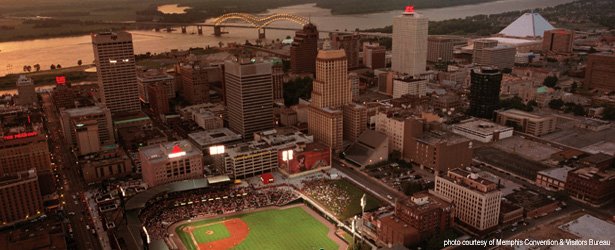
Understanding this broader context would tell us how limited our downtown progress has been. The truth is that downtown has pockets of vibrancy, generally in the Beale Street entertainment district. The rest of downtown is characterized by a lethargy that reinforces a prevailing image of Memphis as a lazy, slow-moving Southern city. This severely inhibits our ability to compete against other cities of our size, whose downtowns better reflect the kind of overall vibrancy that should be our goal.
So, who cares if downtown is vibrant or not? Most important, the kind of young, highly-educated professionals who fueling the knowledge economy. In survey after survey, including the Young and Restless reports undertaken by this firm and CEOs For Cities’ national study of these workers, these highly-coveted professionals say that vibrant cities are what they are looking for and where they want to live and work.
Cities Before Jobs
This has never been more important to Memphis, because now, two out of three of these professional workers select cities before they select jobs. In other words, in the competition for economic growth, Memphis must attract new workers, and its currency must be vibrancy. This is especially true of downtowns where people are looking for more than nodes of activity, but downtowns open 24 hours a day, active, tolerant and full of options.
Because of this, the release by the Center City Commission last week of “Downtown Memphis Moving Forward: A Strategic Framework for Success” was a significant event in the life of our community. In the report, the authors did a good job of summing up the state of downtown and summarizing general priorities for the future. There’s no question that they produced a fine report in keeping with the instructions given by their client, Center City Commission.
Unfortunately, the downtown development agency has become so defined by political considerations and dominated by political personalities that it seemed unable to instruct its consultants to develop a plan that could take downtown from good to great.
The strategies feel pretty much like those included in similar plans issued by the Center City Commission for a decade, laying out what downtown needs to do to succeed, but again, success is defined by measuring downtown Memphis against itself at a time when we need desperately to be leap frogging ahead of our rival cities.
Catapulting Ahead
Incremental change is simply not enough for Memphis. We’re in the lower rungs of U.S. cities and incremental change only means that we remain in the same comparative position. If we are to shake up our economy, invigorate our downtown and create a quality of life that is a competitive advantage, Memphis has to develop strategies for catapulting ahead of other cities.
In the past 20 years, we have moved from competing with Nashville and Charlotte to competing with Baton Rouge and Little Rock, and without dramatic, history-altering strategies, it will only get worse.
This is why there’s never been a better time to shed all provincial thinking and adopt a worldview that offers a compelling vision for the future. A sign of progress would be for all city and county agencies to adopt a policy that all plans will no longer be self-reflective. In the future, plans should adopt a national framework, and strategies like those laid out in the Center City Commission’s strategic plan should tell us how they would make downtown Memphis nationally competitive.
Too Safe
Like many plans in Memphis, there is nothing in the plan that challenges our boldness in envisioning a different future, that imagines new aspirations or inspires new thinking that can catapult downtown into more than just a place that is successful when compared to itself, but a downtown that is one of the best in the entire country when measured by the characteristics that make them successful and competitive.
These kinds of “safe” strategies and unchallenging plans are typical of government group think, and unfortunately, as the Center City Commission shifted from a private sector-driven agency to a political-driven agency, that has come to define it as well.
But, there’s good news. The Center City Commission has two “stars” on its payrolls and they should be the cornerstones on which is should build its plans for the future – Andy Kitsinger and Lee Warrren, respectively in charge of planning/development and marketing. They are imaginative, smart and articulate, and rather than interview and poll more than 1,000 citizens about downtown, perhaps the best plan of all might be to split the budget between them and turn them loose to pursue whatever strategies they think are important. We predict that this strategy would produce the best return on investment that the city-county agency could make.
New Thinking
But back to our starting point, we’ve got to shake off all parochial thinking and think beyond our own borders. There was a time when it was considered one of Memphis’ major strengths that we were located hundreds of miles from another major city, but today, this distance acts as a contributing factor to plans that are too limited in scope.
In addition, at a time when megapolitans are becoming a growing economic reality, the isolation of Memphis in the nation’s mid-section is clearly a drawback to its ability to compete within a national framework. However, we can take a major step ahead by making sure that all of our local planning takes a broader view of the challenges ahead of us and understands that concerted efforts and resources will be needed for us to compete on a national stage.